
The Centers for Medicare & Medicaid Services (CMS), on November 4, 2026, announced the final rule for the calendar year (CY) 2027 Medicare Physician Fee Schedule (PFS), affirming payment policies proposed earlier this year. The rule continues the administration’s focus on modernizing physician payment, recalibrating reimbursement, strengthening accountable care incentives, and preparing Medicare for evolving care delivery models.
The final rule implements immediate policy changes and signals several areas on which CMS might focus its attention in future rulemaking. Through its responses to public comments and the rationale provided for finalized policies, CMS highlights potential shifts in priorities and emerging directions for Medicare payment policy, reflecting the views of the Trump Administration moving forward. Stakeholders should be attentive to these signals, as they provide valuable insights into where CMS could direct further reforms and adjustments in the coming years.
Health Management Associates (HMA) Medicare experts are reviewing the finalized policies and have identified the highlights outlined in this article. Stakeholders should consider the effect on payment in 2027 as well as the longer-term practice reforms, investments, and analysis that may be required to deliver high-quality services and remain financially sustainable.
Reimagining Primary Care Reimbursement and Care Management Within Traditional Medicare
CMS received feedback on its request for information on how to “reimagine” primary care payment in Original Medicare, including alternatives to existing coding and fee-for-service (FFS) reimbursement. The agency is considering prospective primary care payment; outcomes-based approaches, including permanent prospective primary care payment within the Medicare Shared Savings Program; and how to include technology in primary care. CMS plans to consider the comments received in the development of future policies.
HMA Analysis: CMS is signaling that primary care reform remains central to its long-term strategy of shifting the US healthcare system toward a focus on preventive rather than reactive medicine. Although the final rule does not immediately respond to stakeholder feedback, it does signal CMS’s desire to redesign primary care in future rulemaking. Estimates from the Medicare Payment Advisory Commission (MedPAC) highlight that previous CMS reforms including care management codes and changes in evaluation and management (E/M) relative value units (RVUs) have increased revenue for primary care providers.
CMS Finalizes Stronger Incentives for Accountable Care and Value-Based Models
CMS continues to promote value-based care by incentivizing participation in accountable care organizations (ACOs). First, the agency finalized its proposal to replace the flat dollar payment for code G2211 (an add-on code to capture complexity associated with longitudinal primary care) with a percentage-based modifier. Under the finalized policy, visits furnished in eligible accountable care arrangements would receive double the payment adjustment than for similarly complex visits furnished outside an ACO setting (32% vs. 16% increase in payment).
CMS also finalized broader Medicare Shared Savings Program (MSSP) changes to strengthen participation in two-sided risk, encourage new entrants, refine beneficiary assignment, and improve the financial methodology.
In addition, CMS finalized its proposal to allow approved ACOs to reduce or eliminate Part B cost sharing for eligible items and services for assigned beneficiaries. Part B drugs, as well as durable medical equipment, prosthetic devices, prosthetics, orthotics, and supplies (DMEPOS) are excluded from this policy as CMS has determined they pose a higher risk for fraud. CMS will collect applications in early 2027 and approve participation by the second quarter of 2027, to allow ACOs to begin offering cost sharing support beginning April 1, 2027.
CMS finalized several technical and operational refinements to the Innovation Center’s Ambulatory Specialty Model designed to test specialty-specific value-based payment arrangements.
The agency also continues to move quality reporting toward more focused, clinically meaningful measures. CMS finalized the sunsetting of the Merit-based Incentive Payment System (MIPS), which has been in place for many years, and the transition to specialty-specific MIPS Value Pathways (MVPs). The agency’s rationale is that MVPs are more streamlined and would reduce physician burden. CMS also finalizes three more MVPs in diabetes, hypertension, and hospital-based care to increase the opportunities for physicians to report relevant MVPs.
HMA Analysis: CMS is using the PFS to drive the healthcare system toward rewarding higher-value, longitudinal care and away from isolated FFS encounters. Although the payment differential for complex visits in accountable care arrangements could strengthen the business case for ACO participation, it also creates operational and financial questions for clinicians and organizations that remain outside these models. CMS also continues to refine its quality reporting structures and seeks to reduce burden on physicians to better measure the quality of care delivered to Medicare beneficiaries.
Physician Payment Would Decline Overall, Despite Statutory Updates
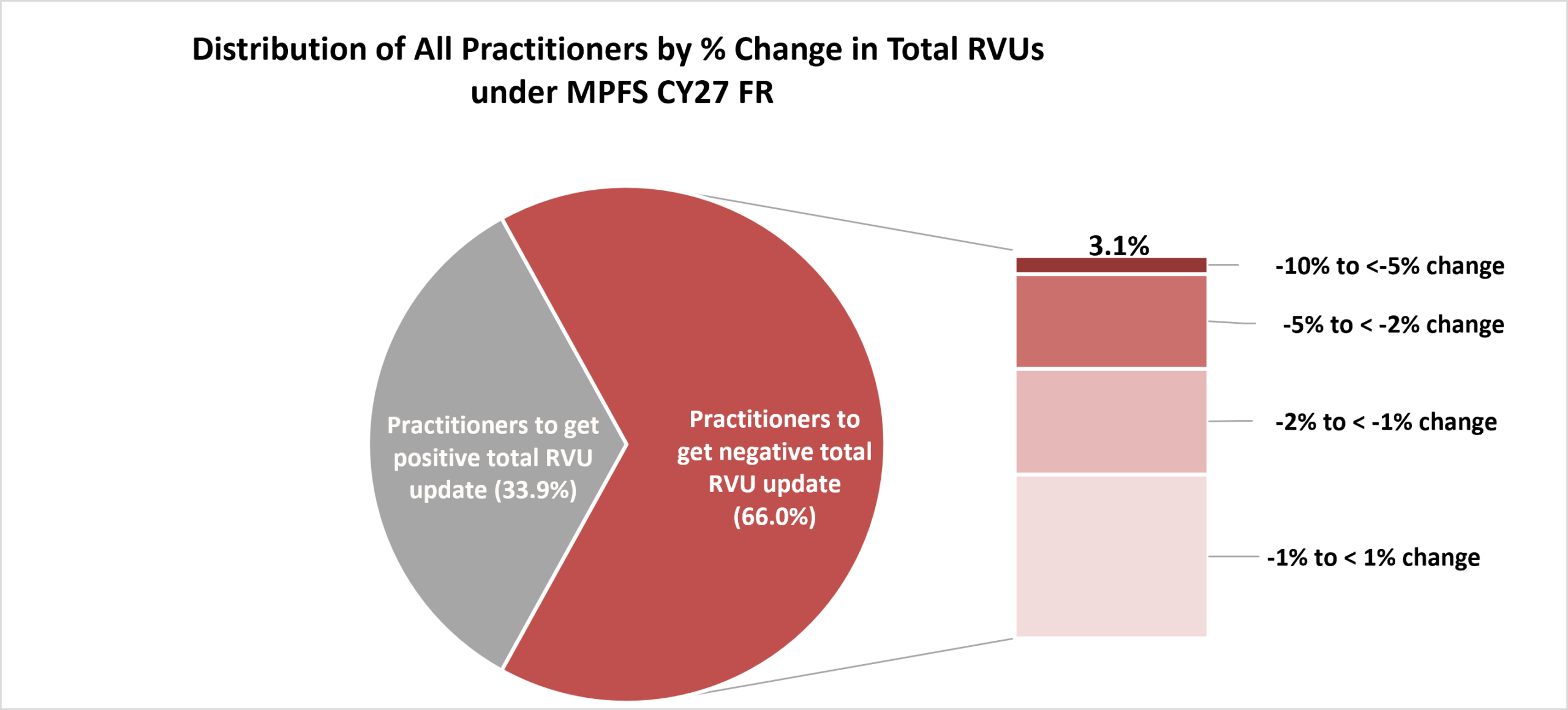
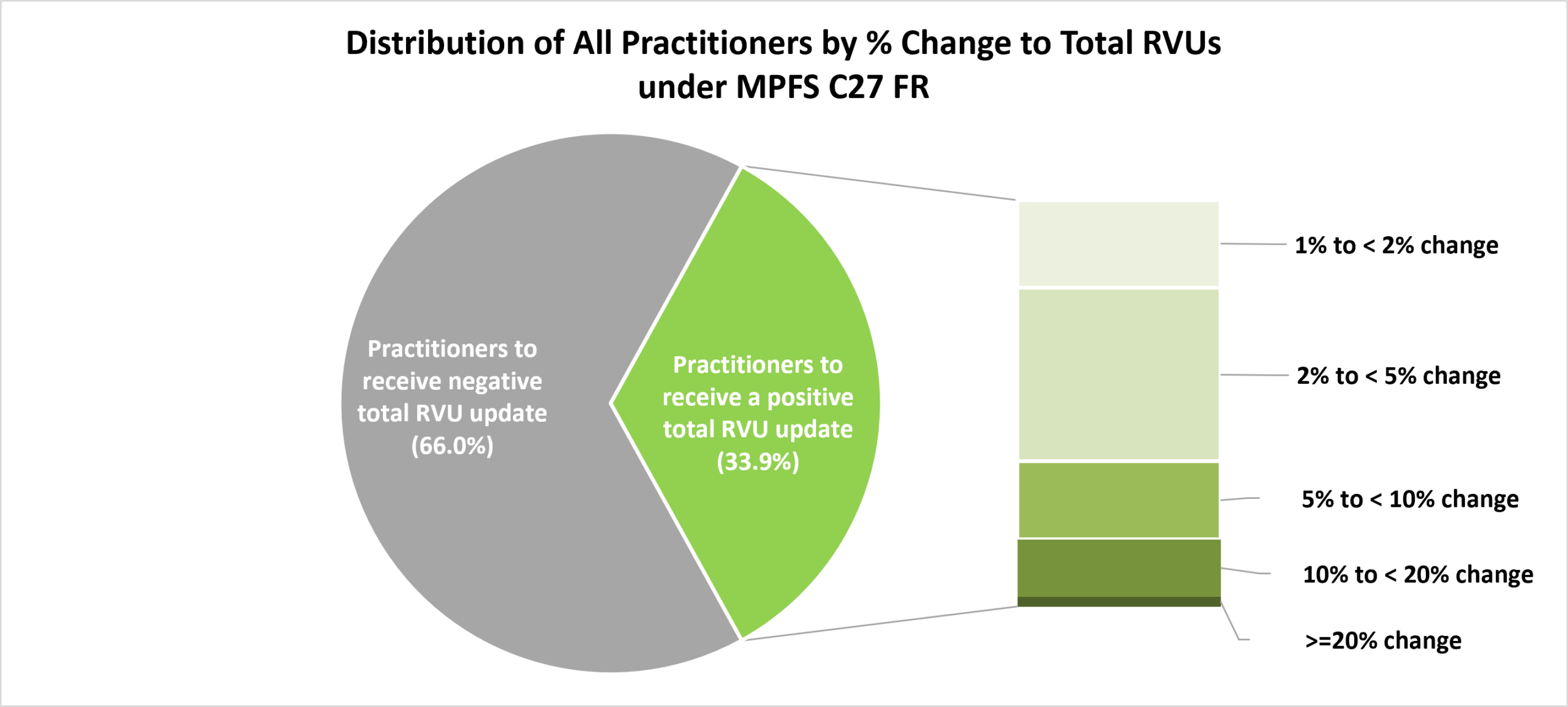
Despite a positive statutory update of 0.75% for qualifying alternative payment model (APM) participants or 0.25% for nonqualifying clinicians, the finalized Medicare PFS conversion factor (CF) will decline in CY 2027 because of a slight negative 0.12% budget neutrality adjustment to account for RVU changes and because the one-time statutory 2.5% increase Congress provided for CY 2026 expires before CY 2027.
Continuing the structural change from the CY 2026 update to the fee schedule, CMS will pay CY 2027 services at different rates depending on whether the physician or practitioner who furnished the service participates in a qualifying APM. Services furnished by providers who participate in qualifying APMs will be paid under the finalized conversion factor of $32.9548, representing a decrease of 1.83% (or $0.61) benchmarked against the 2026 CF ($33.5675). Services furnished by providers who do not participate in a qualifying APM will be paid under the finalized CF of $32.6286, representing a decrease of 2.31% (or $0.77) compared with CY 2026. Both finalized conversion factors are slightly less than CMS estimated in the proposed rule.
CMS also projects significant specialty-level variation from RVU changes. Clinical social workers and clinical psychologists would receive the largest aggregate increases at 11% and 9%, respectively, while otolaryngology and orthopedic surgery would see the largest estimated reduction at −5% and −6%, respectively. The impact of changes RVUs on allowed charges are aggregate projections.
HMA Analysis: Although the CF reductions are relatively modest, the cumulative effect of annual updates, budget neutrality adjustments, and specialty-specific RVU changes remains material. The effect on practices and clinicians will vary by service mix, specialty, payer mix, and Medicare FFS volume.
CMS Finalizes Targeted Payment Recalibration for Procedures, Visits, and Practice Expenses
CMS finalized several changes to the service/procedure payment methodology to improve accuracy, transparency, and consistency in PFS rate setting. One notable policy reduces payment when the same physician or another clinician in the same group practice furnishes a separately identifiable office or outpatient E/M service the same day as a 0-day global procedure by the same physician or another clinician in the same group practice.
Under the policy, Medicare will pay the highest-priced service at 100% and all other same-day surgical procedures or E/M visits at 80%. In response to stakeholder comments, CMS dampened the originally proposed cut from 50% to 20% and restricted the policy to 0-day global codes (i.e., minor procedures with no preoperative or postoperative days). CMS states that efficiencies occur when the same practitioner or a practitioner in the same group practice provides an E/M service in conjunction with a procedure that already includes preservice, intraservice, and post-service work through a global period.
HMA Analysis: These policies reflect CMS’s continued interest in updating payment methods that the agency views as outdated or misaligned with care delivery. The same-day E/M and procedure policy could create meaningful revenue pressure for certain procedural specialties.
CMS Aligns PFS Payment with Technology, Prevention, and Program Integrity Priorities
The final rule includes several policies that signal CMS’s interest in modernizing Medicare payment for technology-enabled healthcare while improving outcomes and strengthening program integrity. Remote patient monitoring is an area of particular focus for CMS. Consistent with recent Office of Inspector General reports and recommendations calling for additional oversight, CMS finalized guardrails for currently reimbursed technologies, including remote physiologic monitoring (RPM) and remote therapeutic monitoring (RTM).
After a delayed implementation granted in this final rule, the guardrails will require that these services be furnished only to established patients and only to allow payment for RPM or RTM services performed by clinical staff employed by the practice—not when those services are delivered by contractors. The agency is granting practices two years to adapt to the guardrails; the policy will take effect January 1, 2029. In addition, CMS finalized reduced work and direct practice expense (PE) inputs for several RPM/RTM codes (HCPCS 99445, 99453, 99454, 98975-98977, 98984, and 98985) to more accurately capture the resource costs involved with the devices typically used in remote monitoring.
Finally, the agency notes that in response to its expressed concerns over the lack of data to inform valuation of these services, the American Medical Association (AMA)/Specialty Society RVS Update Committee (RUC) will review the practice expense inputs for all 19 RPM and RTM codes during the January 2027 RUC meeting.
CMS also finalized a policy to shift reimbursement for software as a medical service (SaMS) analysis of laboratory tests from the Clinical Laboratory Fee Schedule (CLFS) to a crosswalk to the outpatient prospective payment system (OPPS) rates.
Consistent with broader prevention and Make America Healthy Again priorities, CMS also finalized national pricing for health and well-being coaching services, payment for diagnosis and management of suspected adverse vaccine reactions, and increased reimbursement for smoking and tobacco-use cessation services. CMS also finalized a proposal to recognize diabetes self-management training and medical nutrition therapy as qualified preventive services covered and paid as stand-alone billable visits under the Rural Health Clinic benefit.
HMA Analysis: The finalized changes signal CMS’s interest in distinguishing between technology that supports integrated, clinician-led care and arrangements the agency believes may increase fragmentation or inefficient or concerning billing practices. Digital health, remote monitoring, software, laboratory, and AI interest-holders should consider the payment opportunities and compliance priorities CMS signals. Prevention-focused providers and rural health organizations also should assess how coverage and payment changes could expand access to services that historically have been difficult to scale.
CMS Finalizes Payment Rule for Unbundling Maternity Services
In the final rule, CMS is following American College of Obstetricians and Gynecologists (ACOG) and AMA guidance to move away from the maternity global codes. CMS finalized deleting 17 legacy Current Procedural Terminology (CPT) codes, creating 12 new CPT codes, and revising 9 codes for maternity care services. CMS is enacting the redistribution of RVUs from prenatal visits to labor and delivery codes that the agency outlined in the proposed rule, which would reallocate approximately 15% of the relative value of services from prenatal visits to labor and delivery.
CMS did not finalize the creation of the HCPCS G-codes it had originally proposed, although the agency may consider the creation of bundled codes describing maternity care services in future rulemaking using the information on the billing patterns associated with the unbundled visit codes.
HMA Analysis: With services and payment unbundled across the course of care, this change may shift additional reimbursement toward providers that offer labor and delivery services, although it is not intended to affect the number of prenatal visits provided.
Contact an HMA Medicare Expert Today
Health Management Associates, Inc. (HMA), policy and rate setting experts are analyzing the details and impacts of the final rule. Our team can support policy and reimbursement strategy in the context of this final rule; provide actuarial and strategic services; design, implementation, and evaluation of APMs; and data analytics using Medicare 100 Percent FFS and Encounter Data.
Contact us to discuss the impact of this rule and the broader Medicare program dynamics affecting your organization.