
The Rural Health Transformation Program (RHTP) is entering a critical implementation phase. As states begin deploying historic federal investments in rural healthcare, attention is shifting from grant awards to execution, performance measurement, and sustainability. Recent Centers for Medicare & Medicaid Services (CMS) approvals of additional state RHTP initiatives, coupled with upcoming reporting requirements and future funding determinations, are heightening the focus on how states, providers, technology companies, and community organizations will demonstrate progress and long-term value.
This article examines emerging themes in RHTP implementation, including the growing emphasis on chronic disease prevention, technology-enabled care delivery, performance measurement, and sustainability planning. Health Management Associates’s (HMA) multidisciplinary teams also are available to support organizations seeking to maximize the long-term value of RHTP investments beyond the initial federal funding period.
Common Priorities Emerging in State Rural Health Transformation Program Plans
State RHTP strategies vary considerably; however, state applications share several priorities aligned with CMS’s funding priorities. Technology modernization, telehealth, workforce development, chronic disease management, behavioral health, maternal health, and care coordination appear throughout state proposals. Through its work with states, providers, and rural communities, Health Management Associates (HMA) has identified another common thread across applications: rural health challenges are deeply interconnected.
Providers struggling with workforce shortages are often serving populations with higher rates of chronic disease. Communities facing limited specialty access frequently experience transportation barriers and gaps in digital connectivity. Behavioral health needs intersect with physical health conditions, maternal health outcomes, and emergency department utilization. States are responding by increasing their focus on and pursuit of broader transformation strategies.
During a recent HMA webinar, RHTP Beyond the Grant Approval: Building Sustainable Rural Transformation, speakers highlighted one of the most important directional lessons emerging from early RHTP implementation: technology, workforce, access, care delivery, and prevention strategies must be designed as mutually reinforcing investments and not as siloed initiatives.
Chronic Disease Prevention and Management Is Central to Rural Health Transformation
Our work with states and their RHTP partners indicates that chronic disease prevention, monitoring, and management have become a central organizing principle for many RHTP investments. Technology modernization, telehealth expansion, workforce initiatives, behavioral health integration, and community-based care models are frequently being positioned as complementary strategies to improve population health and address the conditions that drive preventable morbidity, mortality, and healthcare costs in rural communities. This includes ensuring rural residents receive care earlier, stay connected and engaged in their care longer, and avoid preventable deterioration in health status.
As HMA experts discussed during the recent webinar, this represents an important shift. Historically, many healthcare systems have been structured around treating disease after complications emerge. RHTP creates an opportunity to invest in more effective models, including those that can identify risk sooner, improve follow-up with patients, and strengthen connections between patients and care teams.
Telehealth, Data Platforms, and AI Support in Rural Health Transformation
Technology appears throughout nearly every state strategy and is often viewed as one of the most visible components of RHTP. HMA webinar speakers emphasized that technology is a vital enabling capability in RHTP initiatives.
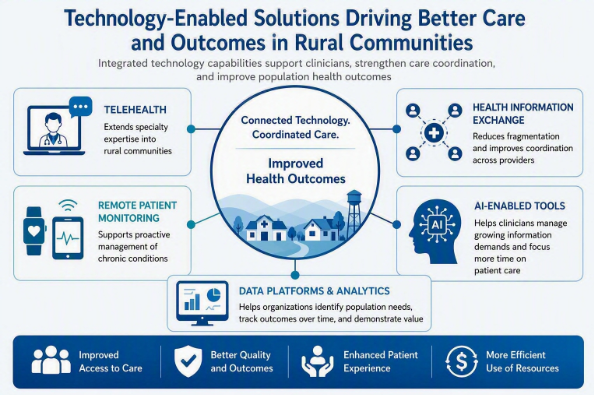
Technology alone is unlikely to produce meaningful transformation.
HMA is working with states and their partners on strategic approaches to technology adoption. For example, states, providers, care teams, and patients should consider technology initiatives that can strengthen care models, extend workforce capacity, improve coordination and collaboration in support of population health, and generate actionable insights.
Sustainability Planning Must Begin Early in the Rural Health Transformation Program
Every state and RHTP participant understands that this federal funding is temporary. The urgent challenge is to identify, early and explicitly, which initiatives can produce enough value to warrant ongoing support after the funding period concludes.
While some states awarded the first year of RHTP funding quickly, many of these awards may serve as a bridge while states establish the structures and policies needed to support long-term RHTP initiatives. CMS’s reporting and ongoing evaluation of RHTP programs will require states to embed sustainability into program design, governance, measurement, financing, and partnerships from the outset.
States will need to provide RHTP participants with clear baselines and direction on meaningful outcomes. It also requires thinking beyond grant budgets to identify long-term operational and financial models capable of supporting ongoing services.
What States, Providers, and Technology Partners Should Do Next
The window for shaping long-term RHTP success is open now. State and local government and partner organizations have an opportunity to move beyond individual projects and build integrated strategies.
HMA’s multidisciplinary teams support program design, implementation planning, data strategy, technology modernization, performance measurement, governance, financing strategy, partnership development, and sustainability planning. As states and RHTP participants make decisions regarding governance, technology, data strategy, care models, and performance measurement, HMA can help ensure decisions and investments are optimized to make the progress needed to secure future funding and sustain transformation beyond the grant period.