
Weekly Roundup -
November 11, 2026

Smart. Strategic. Essential.
Unmatched Healthcare Insights from HMA,
Leavitt Partners & Wakely.
Featured:

Health Management Associates Welcomes Back Former Florida Medicaid Deputy Secretary Brian Meyer as Principal
READ ARTICLE


Trending: In Focus
What the 2026 Election Results Mean for Healthcare Policy in 2027
The 2026 midterms reshaped the political landscape at a consequential moment for healthcare. Voters changed control of Congress and elected a large class of new governors and state officials, while affordability, including healthcare costs, remained a persistent concern across campaigns. Healthcare was rarely the headline issue, but questions about premiums, Medicaid, prescription drug costs, rural access, and the cost of care were embedded throughout the debate.
The Leavitt Partners team at Health Management Associates (HMA), together with colleagues across the enterprise, hosted a post-election webinar November 10, 2026, examining what those changes likely mean for healthcare policy in 2027. The insights in this article are drawn from that webinar, which featured HMA experts Loren Anthes, Principal, HMA; Carter Kimble, Principal, HMA; Alicia Johnson, Regional Director, HMA; Sara Singleton, Principal, Leavitt Partners; and Liz Wroe, Principal, Leavitt Partners.
This article examines how the new Congress and the administration are likely to shape the federal healthcare agenda, how new state leaders may respond within their fiscal and political constraints, and where healthcare organizations can engage most effectively.
How the New Congress Will Shape Healthcare Policy in 2027
Before the new Congress begins, lawmakers have unfinished business. The lame duck session is expected to focus on a relatively narrow agenda, including the December 11, 2026, government funding deadline, healthcare extenders, and confirmation of pending administration and judicial nominees.
Democrats will enter the 120th Congress with substantial majorities in both the House and the Senate, though still short of the 60 Senate votes needed to advance legislation subject to the filibuster. Even so, the margins give Democratic leaders more room to manage differences within their caucus and will keep healthcare high on the agenda over the next two years.
Committee control also allows Democrats to set hearing agendas, move legislation, and direct oversight. Likely oversight priorities include implementation of the One Big Beautiful Bill Act (OBBBA), also called the Working Families Tax Cut Act (WFTCA); vaccine policy; restructuring and funding decisions by the US Department of Health and Human Services (HHS); Medicaid program integrity actions; and the administration’s most favored nation drug agreements and direct-to-consumer initiatives.
Why Budget Reconciliation Matters for Healthcare, Even if Congress Passes No New Laws
Budget reconciliation is one of the things to watch in early 2027. Congress could consider reinstating enhanced Affordable Care Act (ACA) subsidies, creating new coverage pathways in Medicaid non-expansion states, exploring a Medicare-like Marketplace option, expanding Medicare drug-price negotiation, and revisiting portions of WFTCA. With Republicans holding the White House, the process is unlikely to produce sweeping healthcare legislation that President Trump would sign. Democrats could still use it to test their policy ideas and establish a future governing agenda.
Bipartisan policies will be addressed, but they may stall until later in the next Congress. The debt limit, annual appropriations, healthcare extenders, and the September 2027 Food and Drug Administration (FDA) user fee reauthorization will keep both parties at the table. Notably, though, the coalitions that were key to earlier deals will be hard to rebuild given the extensive turnover in Congress. Many Republicans who were part of past bipartisan conversations about ACA subsidies or changes to WFTCA will not return in 2027.
How the Trump Administration Can Advance Its Healthcare Agenda Without Congress
The Trump Administration is expected to continue implementing the WFTCA, emphasizing waste, fraud, and abuse in Medicaid and pursuing its healthcare agenda through authorities that are exempt from congressional approval. In terms of coverage, examples could include broader use of individual coverage health reimbursement arrangements, health savings accounts, association health plans, short-term limited-duration plans, Section 1332 waivers, and potential changes related to silver loading.
Drug pricing is one area in which Congress and the administration may share goals but take very different approaches. Democrats are expected to consider expanding Inflation Reduction Act (IRA) negotiation while scrutinizing the administration’s most favored nation agreements. This approach differs from the administration’s focus on securing new deals and implementing its existing drug pricing authorities.
Over the next two years, healthcare organizations should be prepared for many of the most consequential decisions to emerge through regulation, guidance, waivers, enforcement, and implementation.
State Elections and Healthcare: New Governors Face Fiscal and Policy Constraints
The state elections were historic, producing a significant shift in political control and an unusually large number of new governors.
Many of these governors campaigned on making life more affordable; however, they are taking office as states face tighter budgets and fewer policy options. New Medicaid eligibility changes are scheduled to take effect January 1, 2027, and changes to provider taxes and state directed payments will put added pressure on state budgets, providers, employers, and consumers. Federal savings driven by people losing coverage are expected to shift costs to states, providers, employers, and families, including in the form of higher premiums.
Although voters throughout the nation shared similar concerns, the responses are likely to be very different across the states. Ohio, Texas, and Georgia show how differences in political control, fiscal capacity, and legislative dynamics can lead new leaders down distinct paths.
State Healthcare Policy Outlook: Ohio, Texas, and Georgia
Ohio elected Democrat Amy Acton governor while retaining Republican control of both legislative chambers. Governor-Elect Acton’s agenda combines Medicaid access and administrative simplification with prescription drug purchasing through OhioRx, medical debt relief, price transparency, prior authorization reform, rural access, and program integrity. Federal financing changes and legislative control, however, limit what the new administration can do. The governor’s first budget proposal will reveal her initial priorities.
In Texas, Governor-Elect Gina Hinojosa supports Medicaid expansion, but a Republican Senate is likely to continue resisting this policy. A state-based ACA Marketplace could be a more realistic near-term means of addressing coverage in a state where approximately 16 percent of residents are uninsured. Healthcare organizations should consider which policy lever is likely to align with their goals in the context of the governor’s limited tools.
Georgia may be able to move more quickly. Bipartisan support appears to be growing for replacing Georgia Pathways with full Medicaid expansion, and state leaders expect action in the legislative session that runs from January through April.
The contrast between these states illustrates that party control indicates direction, but it does not determine outcomes. Fiscal capacity, legislative coalitions, administrative readiness, federal approvals, existing healthcare infrastructure, and the willingness of governors to spend political capital will determine how quickly campaign positions become policy.
How Healthcare Organizations Can Shape the Policy Agenda Before It Solidifies
This period of transition creates risk for healthcare organizations, but it also opens a window to engage while new members of Congress are joining committees, governors are assembling their administrations, and legislative staff and agency leaders are still deciding which problems to tackle and how. Organizations that engage now, rather than waiting for fully formed proposals, have a better chance of informing that thinking.
The most practical approach is a simple one: Be selective about where to engage, arrive with evidence, and look for partners rather than acting alone. Because policymakers’ attention will be hard to win, organizations that can quantify what a policy choice means for costs, coverage, access, workforce, state budgets, or local markets will be better positioned to make their case, and coalitions of providers, plans, employers, advocates, and others can amplify that evidence where their interests align.
Timing is also critical. Engagement with new officials and their teams should begin before legislative sessions, budgets, rules, and political positions are fully formed. Once January arrives, many new administrations and legislatures will already be consumed by governing.
Although the election determined who will hold office, the healthcare agenda they pursue is still being shaped. For organizations with a stake in what comes next, knowing where officials have control, where they need partners, and where policy remains open to influence may matter as much as understanding the election results themselves.
Access the full replay of the webinar. Learn more about federal policy actions and the state policy and strategy that can position your organization for success over the next 12–18 months and beyond.
CY 2027 Physician Fee Schedule Finalizes Major Changes for Physician Payment, Primary Care, Digital Healthcare, and Value-Based Care
The Centers for Medicare & Medicaid Services (CMS), on November 4, 2026, announced the final rule for the calendar year (CY) 2027 Medicare Physician Fee Schedule (PFS), affirming payment policies proposed earlier this year. The rule continues the administration’s focus on modernizing physician payment, recalibrating reimbursement, strengthening accountable care incentives, and preparing Medicare for evolving care delivery models.
The final rule implements immediate policy changes and signals several areas on which CMS might focus its attention in future rulemaking. Through its responses to public comments and the rationale provided for finalized policies, CMS highlights potential shifts in priorities and emerging directions for Medicare payment policy, reflecting the views of the Trump Administration moving forward. Stakeholders should be attentive to these signals, as they provide valuable insights into where CMS could direct further reforms and adjustments in the coming years.
Health Management Associates (HMA) Medicare experts are reviewing the finalized policies and have identified the highlights outlined in this article. Stakeholders should consider the effect on payment in 2027 as well as the longer-term practice reforms, investments, and analysis that may be required to deliver high-quality services and remain financially sustainable.
Reimagining Primary Care Reimbursement and Care Management Within Traditional Medicare
CMS received feedback on its request for information on how to “reimagine” primary care payment in Original Medicare, including alternatives to existing coding and fee-for-service (FFS) reimbursement. The agency is considering prospective primary care payment; outcomes-based approaches, including permanent prospective primary care payment within the Medicare Shared Savings Program; and how to include technology in primary care. CMS plans to consider the comments received in the development of future policies.
HMA Analysis: CMS is signaling that primary care reform remains central to its long-term strategy of shifting the US healthcare system toward a focus on preventive rather than reactive medicine. Although the final rule does not immediately respond to stakeholder feedback, it does signal CMS’s desire to redesign primary care in future rulemaking. Estimates from the Medicare Payment Advisory Commission (MedPAC) highlight that previous CMS reforms including care management codes and changes in evaluation and management (E/M) relative value units (RVUs) have increased revenue for primary care providers.
CMS Finalizes Stronger Incentives for Accountable Care and Value-Based Models
CMS continues to promote value-based care by incentivizing participation in accountable care organizations (ACOs). First, the agency finalized its proposal to replace the flat dollar payment for code G2211 (an add-on code to capture complexity associated with longitudinal primary care) with a percentage-based modifier. Under the finalized policy, visits furnished in eligible accountable care arrangements would receive double the payment adjustment than for similarly complex visits furnished outside an ACO setting (32% vs. 16% increase in payment).
CMS also finalized broader Medicare Shared Savings Program (MSSP) changes to strengthen participation in two-sided risk, encourage new entrants, refine beneficiary assignment, and improve the financial methodology.
In addition, CMS finalized its proposal to allow approved ACOs to reduce or eliminate Part B cost sharing for eligible items and services for assigned beneficiaries. Part B drugs, as well as durable medical equipment, prosthetic devices, prosthetics, orthotics, and supplies (DMEPOS) are excluded from this policy as CMS has determined they pose a higher risk for fraud. CMS will collect applications in early 2027 and approve participation by the second quarter of 2027, to allow ACOs to begin offering cost sharing support beginning April 1, 2027.
CMS finalized several technical and operational refinements to the Innovation Center’s Ambulatory Specialty Model designed to test specialty-specific value-based payment arrangements.
The agency also continues to move quality reporting toward more focused, clinically meaningful measures. CMS finalized the sunsetting of the Merit-based Incentive Payment System (MIPS), which has been in place for many years, and the transition to specialty-specific MIPS Value Pathways (MVPs). The agency’s rationale is that MVPs are more streamlined and would reduce physician burden. CMS also finalizes three more MVPs in diabetes, hypertension, and hospital-based care to increase the opportunities for physicians to report relevant MVPs.
HMA Analysis: CMS is using the PFS to drive the healthcare system toward rewarding higher-value, longitudinal care and away from isolated FFS encounters. Although the payment differential for complex visits in accountable care arrangements could strengthen the business case for ACO participation, it also creates operational and financial questions for clinicians and organizations that remain outside these models. CMS also continues to refine its quality reporting structures and seeks to reduce burden on physicians to better measure the quality of care delivered to Medicare beneficiaries.
Physician Payment Would Decline Overall, Despite Statutory Updates
Despite a positive statutory update of 0.75% for qualifying alternative payment model (APM) participants or 0.25% for nonqualifying clinicians, the finalized Medicare PFS conversion factor (CF) will decline in CY 2027 because of a slight negative 0.12% budget neutrality adjustment to account for RVU changes and because the one-time statutory 2.5% increase Congress provided for CY 2026 expires before CY 2027.
Continuing the structural change from the CY 2026 update to the fee schedule, CMS will pay CY 2027 services at different rates depending on whether the physician or practitioner who furnished the service participates in a qualifying APM. Services furnished by providers who participate in qualifying APMs will be paid under the finalized conversion factor of $32.9548, representing a decrease of 1.83% (or $0.61) benchmarked against the 2026 CF ($33.5675). Services furnished by providers who do not participate in a qualifying APM will be paid under the finalized CF of $32.6286, representing a decrease of 2.31% (or $0.77) compared with CY 2026. Both finalized conversion factors are slightly less than CMS estimated in the proposed rule.
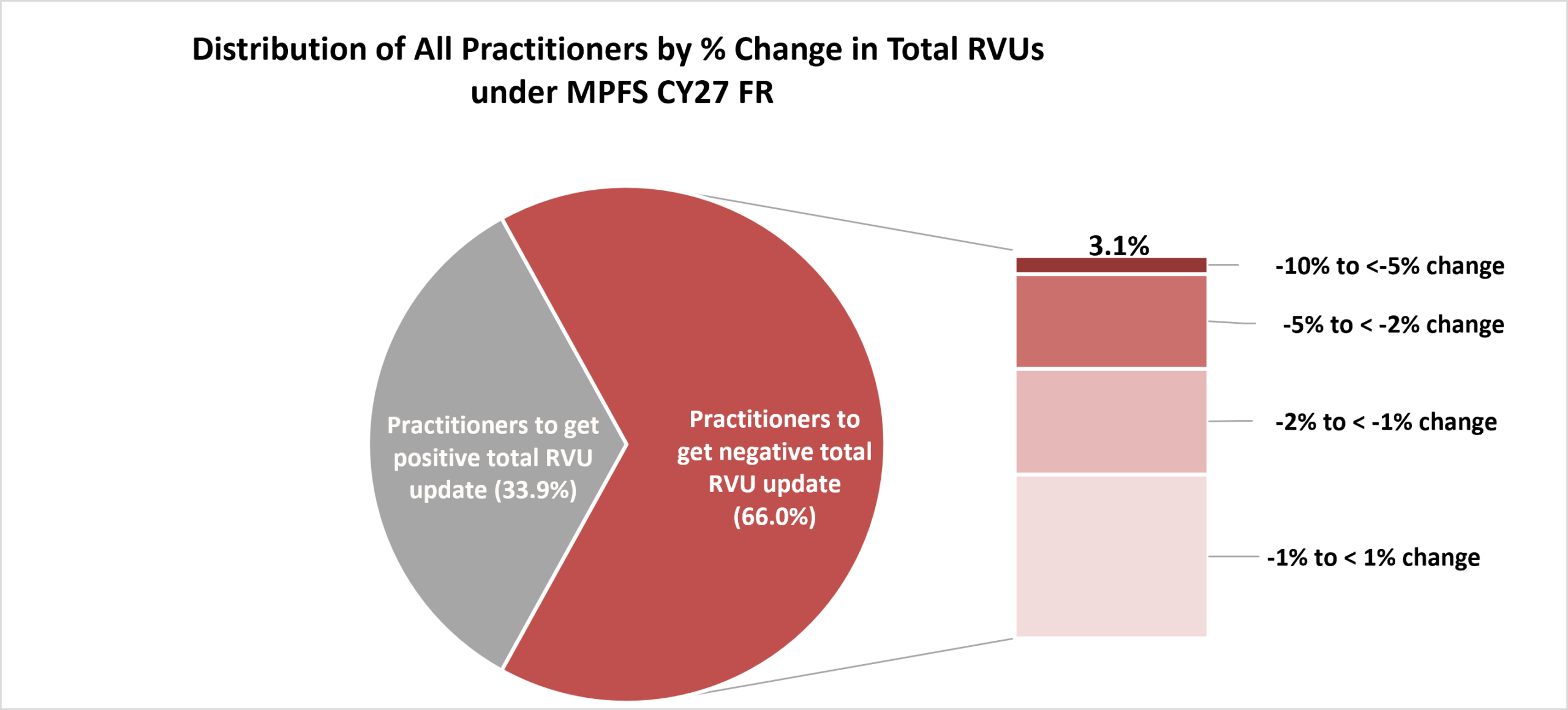
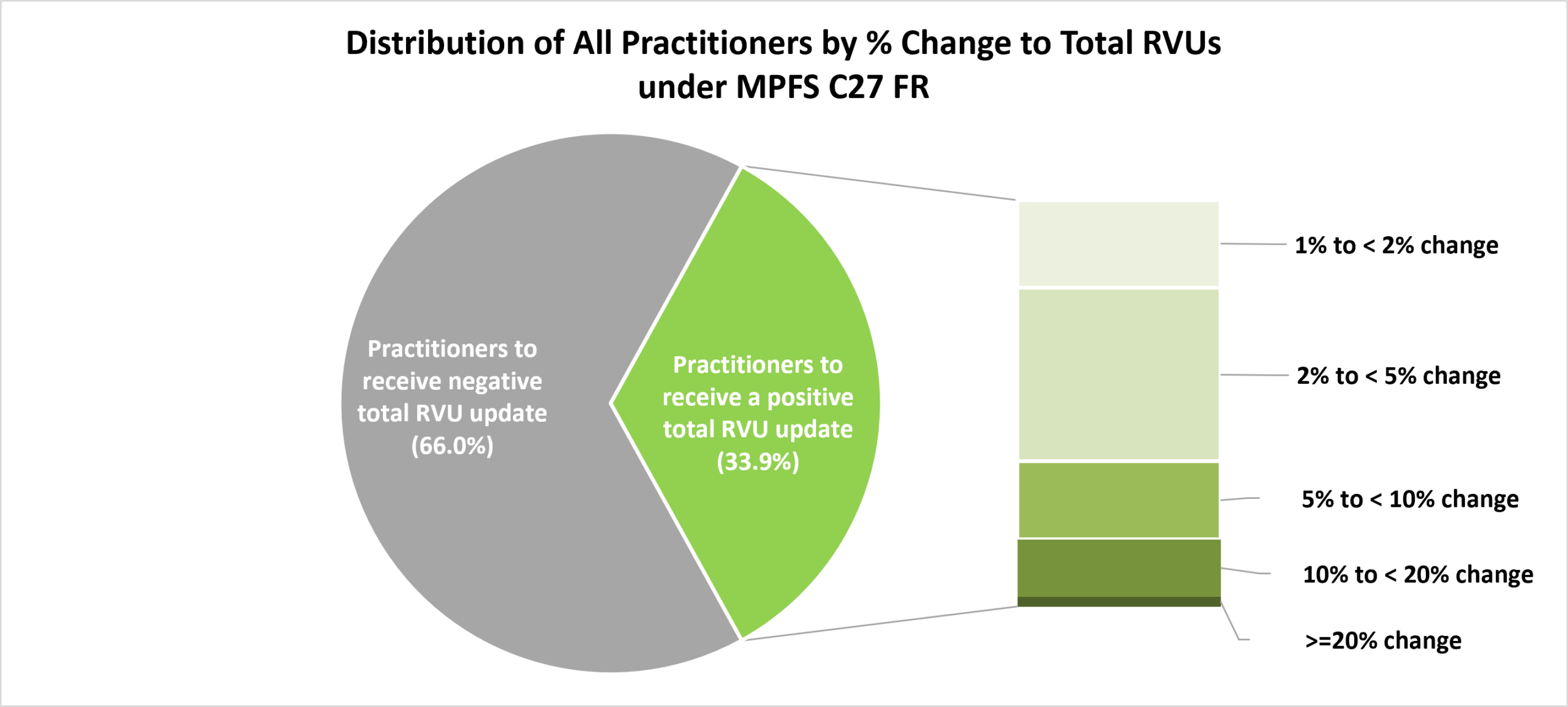
CMS also projects significant specialty-level variation from RVU changes. Clinical social workers and clinical psychologists would receive the largest aggregate increases at 11% and 9%, respectively, while otolaryngology and orthopedic surgery would see the largest estimated reduction at −5% and −6%, respectively. The impact of changes RVUs on allowed charges are aggregate projections.
HMA Analysis: Although the CF reductions are relatively modest, the cumulative effect of annual updates, budget neutrality adjustments, and specialty-specific RVU changes remains material. The effect on practices and clinicians will vary by service mix, specialty, payer mix, and Medicare FFS volume.
CMS Finalizes Targeted Payment Recalibration for Procedures, Visits, and Practice Expenses
CMS finalized several changes to the service/procedure payment methodology to improve accuracy, transparency, and consistency in PFS rate setting. One notable policy reduces payment when the same physician or another clinician in the same group practice furnishes a separately identifiable office or outpatient E/M service the same day as a 0-day global procedure by the same physician or another clinician in the same group practice.
Under the policy, Medicare will pay the highest-priced service at 100% and all other same-day surgical procedures or E/M visits at 80%. In response to stakeholder comments, CMS dampened the originally proposed cut from 50% to 20% and restricted the policy to 0-day global codes (i.e., minor procedures with no preoperative or postoperative days). CMS states that efficiencies occur when the same practitioner or a practitioner in the same group practice provides an E/M service in conjunction with a procedure that already includes preservice, intraservice, and post-service work through a global period.
HMA Analysis: These policies reflect CMS’s continued interest in updating payment methods that the agency views as outdated or misaligned with care delivery. The same-day E/M and procedure policy could create meaningful revenue pressure for certain procedural specialties.
CMS Aligns PFS Payment with Technology, Prevention, and Program Integrity Priorities
The final rule includes several policies that signal CMS’s interest in modernizing Medicare payment for technology-enabled healthcare while improving outcomes and strengthening program integrity. Remote patient monitoring is an area of particular focus for CMS. Consistent with recent Office of Inspector General reports and recommendations calling for additional oversight, CMS finalized guardrails for currently reimbursed technologies, including remote physiologic monitoring (RPM) and remote therapeutic monitoring (RTM).
After a delayed implementation granted in this final rule, the guardrails will require that these services be furnished only to established patients and only to allow payment for RPM or RTM services performed by clinical staff employed by the practice—not when those services are delivered by contractors. The agency is granting practices two years to adapt to the guardrails; the policy will take effect January 1, 2029. In addition, CMS finalized reduced work and direct practice expense (PE) inputs for several RPM/RTM codes (HCPCS 99445, 99453, 99454, 98975-98977, 98984, and 98985) to more accurately capture the resource costs involved with the devices typically used in remote monitoring.
Finally, the agency notes that in response to its expressed concerns over the lack of data to inform valuation of these services, the American Medical Association (AMA)/Specialty Society RVS Update Committee (RUC) will review the practice expense inputs for all 19 RPM and RTM codes during the January 2027 RUC meeting.
CMS also finalized a policy to shift reimbursement for software as a medical service (SaMS) analysis of laboratory tests from the Clinical Laboratory Fee Schedule (CLFS) to a crosswalk to the outpatient prospective payment system (OPPS) rates.
Consistent with broader prevention and Make America Healthy Again priorities, CMS also finalized national pricing for health and well-being coaching services, payment for diagnosis and management of suspected adverse vaccine reactions, and increased reimbursement for smoking and tobacco-use cessation services. CMS also finalized a proposal to recognize diabetes self-management training and medical nutrition therapy as qualified preventive services covered and paid as stand-alone billable visits under the Rural Health Clinic benefit.
HMA Analysis: The finalized changes signal CMS’s interest in distinguishing between technology that supports integrated, clinician-led care and arrangements the agency believes may increase fragmentation or inefficient or concerning billing practices. Digital health, remote monitoring, software, laboratory, and AI interest-holders should consider the payment opportunities and compliance priorities CMS signals. Prevention-focused providers and rural health organizations also should assess how coverage and payment changes could expand access to services that historically have been difficult to scale.
CMS Finalizes Payment Rule for Unbundling Maternity Services
In the final rule, CMS is following American College of Obstetricians and Gynecologists (ACOG) and AMA guidance to move away from the maternity global codes. CMS finalized deleting 17 legacy Current Procedural Terminology (CPT) codes, creating 12 new CPT codes, and revising 9 codes for maternity care services. CMS is enacting the redistribution of RVUs from prenatal visits to labor and delivery codes that the agency outlined in the proposed rule, which would reallocate approximately 15% of the relative value of services from prenatal visits to labor and delivery.
CMS did not finalize the creation of the HCPCS G-codes it had originally proposed, although the agency may consider the creation of bundled codes describing maternity care services in future rulemaking using the information on the billing patterns associated with the unbundled visit codes.
HMA Analysis: With services and payment unbundled across the course of care, this change may shift additional reimbursement toward providers that offer labor and delivery services, although it is not intended to affect the number of prenatal visits provided.
Contact an HMA Medicare Expert Today
Health Management Associates, Inc. (HMA), policy and rate setting experts are analyzing the details and impacts of the final rule. Our team can support policy and reimbursement strategy in the context of this final rule; provide actuarial and strategic services; design, implementation, and evaluation of APMs; and data analytics using Medicare 100 Percent FFS and Encounter Data.
Contact us to discuss the impact of this rule and the broader Medicare program dynamics affecting your organization.

Federal Policy News
Fueled By Leavitt Partners Weekly Health Intelligence
Lame-Duck Congress Faces Dec. 11 Funding Deadline, HHS Nominations
This week, Congress returns to session after taking an extended recess in the lead-up to the midterm elections. In addition to leadership elections for next Congress, the two chambers are returning with a full agenda for the lame duck. Federal funding for FY 2027 runs through December 11 and members must pass appropriations legislation or another extension by that deadline. Additionally, a large slate of Presidential nominees remain pending both before committee and the full Senate. Nominations for Mr. Chris Klomp to serve as Deputy Secretary of HHS, Dr. Tim Westlake to be Assistant Secretary for Mental Health and Substance Use, Ms. Mary Lazare to be the Assistant Secretary for Aging, and Dr. Nicole Saphier to be U.S. Surgeon General await consideration by the Senate. Current Senate Majority Leader John Thune (R-SD) has not yet announced timing for consideration of the nominees. The nominee for FDA Commissioner, Dr. Heidi Overton, is awaiting a vote in the Senate HELP Committee. Attendance, particularly among members of Congress that are not returning next year, could impact what the lame duck Congress can do.
Amid the flurry of Congressional activity, the Administration saw a major departure last week, with the President announcing that Chief of Staff Susie Wiles “will be moving over to the Trump Political Operation,” and Stephen Miller will take over as the White House Chief of Staff. Mr. Miller has been heavily involved in the Administration’s immigration policies and DOGE efforts. HHS Secretary Robert F. Kennedy, Jr. applauded the announcement, posting on social media, “Next to me, Stephen Miller is the strongest MAHA supporter in the administration. It’s time to unleash the Kraken.” The choice sets up likely clashes between the Administration and Congress in 2027.
CMS Awards $10 Billion in Year Two Rural Health Transformation Funding
On November 9, CMS announced $10 billion in year two awards for the Rural Health Transformation Program ranging from $142 million for Rhode Island to $272 million for Alaska. Funding for states under the program changes from year-to-year, with baseline amounts for states remaining the same and “workload funding”—the amount allocated to states using factors established in the RHTP Notice of Funding Opportunity (NOFO)—shifts with state plans and implementation of year one funding. CMS details the amounts awarded to each state in the announcement.
CMS Finalizes Medicare Drug Price Negotiation Rule Ahead of Fourth Cycle
On November 5, CMS issued a final rule (CMS-4215-F) establishing a permanent regulatory framework for the Medicare Drug Price Negotiation Program, beginning with prices effective in 2029. The Inflation Reduction Act (P.L. 117-169) directed CMS to implement the program’s first three cycles, covering initial price applicability years (IPAY) 2026 through 2028, through guidance rather than rulemaking. With that authority expiring, the rule codifies existing policy while adding new provisions and revising others based on experience to date. The rule takes effect December 5, and by February 1, 2027, CMS will select up to 20 additional negotiation-eligible drugs covered under Part D or payable under Part B, along with any drugs selected for renegotiation, for the fourth negotiation cycle. Among the new policies, CMS finalized a change in how it identifies qualifying single source drugs when a manufacturer markets a fixed combination product that the agency determines is a new formulation of an existing drug. CMS described the policy as addressing a program integrity risk in which a manufacturer could shift patients toward the new formulation and avoid application of the maximum fair price (MFP). The rule also implements the Temporary Floor for Small Biotech Drugs for IPAYs 2029 and 2030, which bars CMS from offering or accepting a counteroffer below a specified floor for eligible drugs and codifies two Part D policies requiring plans to include selected drugs with an MFP in effect on their formularies and limiting negotiated prices paid to dispensing entities to the MFP plus dispensing fees.
CMS published a fact sheet and an IPAY 2029 timeline alongside the rule. The agency said it intends to release final guidance this fall on manufacturer effectuation of the MFP in 2028, including for drugs payable under Part B, and to codify effectuation policies for 2029 and later years through rulemaking in 2027.
White House Issues National Policy for Nucleic Acid Synthesis Screening
On November 5, the White House Office of Science and Technology Policy released the National Policy for Nucleic Acid Synthesis Screening (NASS), which establishes a new government-wide screening policy for synthetic DNA and the equipment used to make it. The policy implements Executive Order 14292, “Improving the Safety and Security of Biological Research,” by requiring federally funded researchers to buy synthetic nucleic acids and benchtop synthesis equipment only from approved suppliers, with screening generally covering orders of 50 nucleotides or more. Approved suppliers must undergo a screening process conducted by the National Institute of Standards and Technology (NIST), conduct customer identity and legitimacy checks, report unresolved high-risk orders to federal authorities, and retain relevant records for at least eight years. Benchtop equipment must require verified authorization before synthesis, with limited offline use. NIST is directed to set and test technical, cybersecurity, and risk-based standards for these products within 90 days of these document’s release. The new policy signals a shift from voluntary, self-attested safeguards to auditable, federally enforced supply chain controls intended to reduce misuse risks and limit a source of material inputs for gain-of-function research.
Ready to talk about your organization's challenges?
Schedule a Consultation
State Policy News
Alaska Seeks Medicaid 1115 Waiver to Cover Traditional Health Practices
The Alaska Department of Health submitted on November 6, 2026, a request for a new Medicaid section 1115 Alaska Traditional Health Practices demonstration, seeking to cover traditional health care practices for eligible American Indian and Alaska Native Medicaid beneficiaries. The proposed demonstration would allow participating Tribal health programs within the Alaska Tribal Health System to provide culturally appropriate traditional health services as Medicaid-covered benefits. The state is requesting a five-year demonstration period from December 31, 2026, through December 31, 2031, with coverage of traditional health care practices beginning no earlier than January 1, 2028. The initiative is intended to expand access to culturally appropriate care and support whole-person health and wellness for eligible beneficiaries. Public comments will be accepted through December 9.
CMS Extends Arkansas ARHOME 1115 Waiver Six Months Through June 2027
The Centers for Medicare & Medicaid Services (CMS) approved on November 4, 2026, a six-month extension of Arkansas’ Section 1115 Arkansas Health and Opportunity for Me (ARHOME) demonstration, allowing the state’s Medicaid expansion program to continue through June 30, 2027. The extension allows CMS and Arkansas to continue negotiations over the state’s renewal application submitted April 30, 2026. The demonstration’s existing special terms and conditions, waiver authorities, and budget neutrality agreement will remain in effect during the extension period. CMS indicated that the state’s renewal application will likely be subject to new federal budget neutrality requirements taking effect January 1, 2027, including certification by the CMS Chief Actuary. CMS will request additional information from Arkansas to complete the budget neutrality certification process, and the state must continue monitoring and evaluating the demonstration.
DC Seeks Medicaid Work Requirement Exemption for Wards 7 and 8
The District of Columbia Department of Health Care Finance announced that it has requested a federal hardship exemption from upcoming Medicaid work requirements for residents of Wards 7 and 8. Federal law permits exemptions for counties with unemployment rates exceeding 8 percent, and District officials are seeking to have individual wards recognized as equivalent local government units. Unemployment rates in September were 9.5 percent in Ward 7 and 10 percent in Ward 8, compared with 5.6 percent citywide. Approximately 75,000 District residents could be subject to the new requirements beginning in January 2027, including 30,000 living in the two wards. The request, submitted in October, remains subject to federal approval.
Missouri Medicaid Managed Care RFP: Molina Added, UnitedHealthcare Not Selected
The Missouri Office of Administration, Division of Purchasing released on November 10, 2026, the award recommendations and scoring report for the MO HealthNet Managed Care Program. Incumbents Elevance (dba Healthy Blue) and Centene (dba Home State Health Plan) retained their General Plan contracts, while Molina Healthcare secured an award as a new entrant to the state. Incumbent UnitedHealthcare and non-incumbent Aetna Better Health were not selected. The new contracts are scheduled to take effect July 1, 2027.
Home State Health also secured the sole Specialty Plan contract, while Molina’s and UnitedHealthcare’s Specialty Plan proposals were deemed nonresponsive for failing to meet mandatory professional licensure requirements.
Tennessee Expands FIDE-SNP Alignment Requirements Starting January 2027
The Tennessee Division of TennCare announced that beginning January 1, 2027, Tennessee will implement expanded enrollment alignment requirements for full-benefit dual-eligible individuals in Fully Integrated Dual Eligible Special Needs Plans (FIDE-SNPs). Beneficiaries who want to remain in a D-SNP must receive their Medicare and Medicaid benefits through the same managed care organization. If beneficiaries do not have aligned plans, they will be disenrolled from their D-SNP and moved to traditional Medicare.

Private Market News
Fueled By Wakely Consulting Group
Labor Department Finalizes PBM Disclosure Rule for Self-Funded Employers
The Department of Labor finalized new disclosure requirements for pharmacy benefit managers (PBMs) serving self-funded employers, covering rebates, pharmacy payments, spread pricing, and other compensation beginning in July 2027. The rule gives employers greater visibility into drug spending and more leverage to audit and negotiate PBM contracts. It could put pressure on existing PBM pricing and rebate models as employers gain more information to compare arrangements. PBMs argue the requirements will add administrative burden and duplicate existing reporting.
Read the Wakely Wire

Our Insights
Fueled By Experts Across Our HMA Companies
Health Management Associates
Webinar Replay – Political Checkpoint 2026: Straight Talk on Election Results for Healthcare Leaders
Experts from HMA and Leavitt Partners gave a timely post-election analysis of the 2026 midterm results and what they mean for federal and state healthcare policy – including ongoing Medicaid changes. This webinar examined the outcomes of key congressional and state races, shifts in leadership, and the evolving health policy agenda following the November 3 election.
2026 Illinois State of Reform Health Policy Conference
On November 17 in Chicago, Illinois healthcare leaders and policymakers will examine the evolving federal landscape and its effects on the state, with sessions on Medicaid work requirements, behavioral and maternal health, health-related social needs, prior authorization reform, and the healthcare workforce.
2026 Colorado State of Reform Health Policy Conference
On December 3 in Denver, State of Reform will convene Colorado policymakers, agency leaders, payers, providers, and community organizations for a one-day conversation on the state’s most pressing healthcare and health policy issues.
2027 State of Reform Conferences Kick Off in Washington State
The 2027 Washington State of Reform Health Policy Conference returns to Seattle on January 7, 2027, bringing healthcare leaders and policymakers together at a consequential time for the industry. As federal and state priorities evolve, the conference will provide a forum to compare perspectives, understand what is changing, and discuss the issues likely to shape Washington’s healthcare landscape in 2027.
Leavitt Partners
Turn Federal Policy Insight into Executive Action
Leavitt Partners has launched Executive Strategy Sessions to help healthcare leadership teams assess how changes in federal policy could affect their organizations and strategic priorities. The facilitated sessions examine implications for revenue, growth, market access, regulatory risk, and board-level decision making, while also considering issues such as patient access, outcomes, and affordability. The offering is designed for organizations across the healthcare sector seeking to incorporate federal policy developments into broader business and organizational planning.

RFP Calendar
RFP Calendar
| Date | State/Program | Event | Beneficiaries |
|---|---|---|---|
| Date: Summer 2026 (Delayed) | State/Program: Illinois Foster Care | Event: RFP Release | Beneficiaries: 33,000 |
| Date: July 28, 2026 (Delayed) | State/Program: Nevada Children's Specialty | Event: Awards | Beneficiaries: NA |
| Date: November 9, 2026 (Delayed) | State/Program: Indiana | Event: RFP Release | Beneficiaries: 1,400,000 |
| Date: January 1, 2027 | State/Program: Illinois | Event: Implementation | Beneficiaries: 2,400,000 |
| Date: January 1, 2027 | State/Program: Nevada CO D-SNP | Event: Implementation | Beneficiaries: 88,000 |
| Date: January 1, 2027 | State/Program: Wisconsin LTC GSR 3 | Event: Implementation | Beneficiaries: 56,000 (all GSR) |
| Date: January 1, 2027 | State/Program: Illinois Tailored Care Management Program | Event: Implementation | Beneficiaries: 22,400 |
| Date: July 2027 | State/Program: Indiana | Event: Awards | Beneficiaries: 1,400,000 |
| Date: July 1, 2027 | State/Program: Nevada Children's Specialty | Event: Implementation | Beneficiaries: NA |
| Date: July 1, 2027 | State/Program: Missouri | Event: Implementation | Beneficiaries: 1,000,000 |
| Date: Fall 2027 | State/Program: Oregon | Event: RFP Release | Beneficiaries: 1,200,000 |
| Date: January 1, 2028 | State/Program: Wisconsin LTC GSR 4,6 | Event: Implementation | Beneficiaries: 56,000 (all GSR) |
| Date: 2028 | State/Program: North Carolina | Event: RFP Release | Beneficiaries: 2,200,000 |
| Date: 2029 | State/Program: California | Event: RFP Release | Beneficiaries: NA |
| Date: January 1, 2029 | State/Program: Indiana | Event: Implementation | Beneficiaries: 1,400,000 |