
Health Management Associates (HMA) analyzed monthly Medicaid managed care enrollment data from 34 states to assess enrollment trends as of March 2026. The findings show that Medicaid managed care enrollment continued to decline as states navigate new eligibility policies and preparations for new Medicaid community engagement requirements under the 2025 budget reconciliation act, P.L. 119-21, now known as the Working Families Tax Cut (WFTC) Act. These trends serve as an early indicator of how policy and programmatic changes may affect Medicaid enrollment levels in the years ahead.
Drawing on monthly enrollment data from the 34 states, HMA found that Medicaid managed care enrollment fell to 60.4 million members in March 2026—a decline of 3.1 million members from March 2025, or 4.8 percent year over year. As states prepare to address this issue, this enrollment snapshot provides important insights into how administrative and policy changes may shape Medicaid participation in the years ahead.
Medicaid Managed Care Enrollment Trends in Q1 2026
HMA Information Services (HMAIS) maintains a database of monthly Medicaid enrollment from all 50 states and Puerto Rico. The most recent HMA analysis showed that enrollment declines were widespread across the 34 states studied (Figure 1). Key findings include:
- Enrollment changes varied considerably across states, reflecting a combination of state-specific demographic, administrative, operational, and policy factors.
- Of the 34 states, only four—Colorado, Mississippi, Nevada, and South Carolina—showed modest gains in Medicaid managed care enrollment from March 2025.
- Several states experienced particularly significant declines. Arizona, Indiana, Kansas, and Louisiana each reported data reflecting , ranging from
- Among the expansion states in the analysis, enrollment declined by 2.5 million (5 percent) to 48.4 million. The eight non-expansion states included in this analysis experienced a decline of 547,000 (4.4 percent), bringing enrollment to 12 million enrollees.
Figure 1. HMA Analysis of Medicaid Managed Care Enrollment in 34 States, March 2026
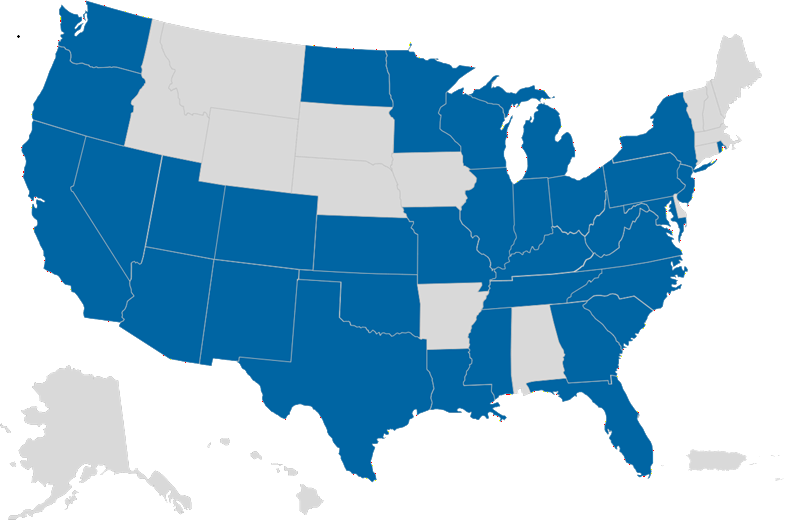
Note: States colored as blue shown on the map above are included in the HMA Enrollment Analysis.
National Medicaid Managed Care Market Share
HMAIS’s resource contains information on approximately 300 Medicaid managed care plans across 41 states and tracks corporate ownership, program participation, and tax status among participating plans.
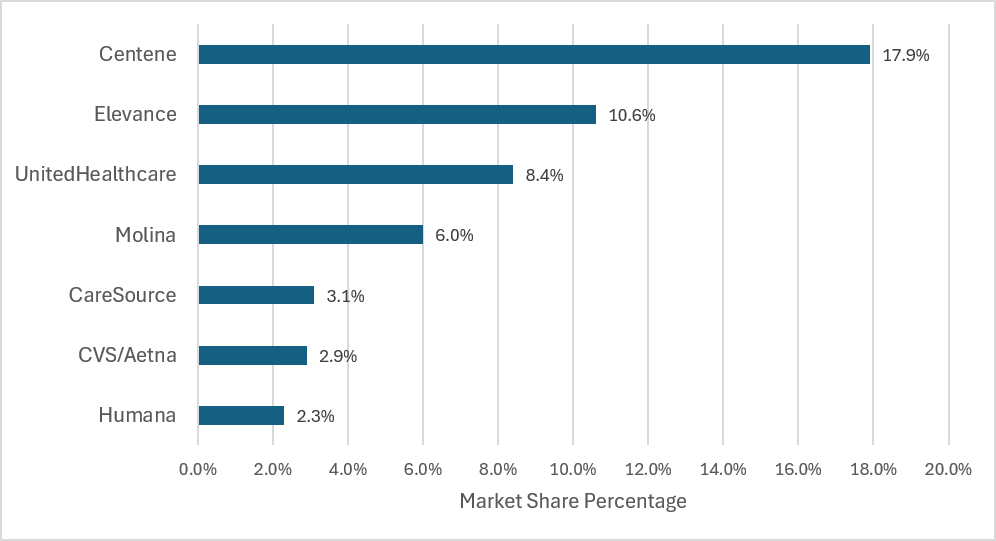
As of March 2026, Centene held the largest share of the national Medicaid managed care market at 17.9 percent. Elevance followed with 10.6 percent, while United and Molina accounted for 8.4 percent and 6.0 percent, respectively (see Figure 2). These four organizations represented 42.9 percent of enrollment among the plans analyzed, underscoring continued concentration among large, national Medicaid managed care organizations, even as overall enrollment declines.
Figure 2. National Medicaid Managed Care Enrollment Share by Parent Organization, March 2026
How Medicaid Work Requirements and Eligibility Policies Could Affect Enrollment in 2027
The enrollment trends observed at the end of the first quarter (Q1) of 2026 come on the cusp of significant policy change. On June 1, 2026, the Centers for Medicare & Medicaid Services (CMS) released an interim final rule establishing a national framework for implementing Medicaid community engagement requirements under P.L. 119-21. The rule outlines federal parameters for eligibility exemptions and state implementation responsibilities.
States must now translate these federal requirements into operational eligibility policies, technology systems, administrative procedures, and beneficiary communications. As implementation moves forward, enrollment trends will provide important insights into how policy changes and state implementation affect enrollment levels and continuity of coverage across Medicaid programs.
Several states are advancing implementation of the new eligibility policies. Nebraska launched Medicaid work/community engagement requirements on May 1, 2026. Montana plans to begin implementation on July 1, 2026, while Arkansas intends to begin a soft launch of the new requirements in July 2026 before enforcement begins in January 2027.
Declines in enrollment are often an early indicator of broader impacts across the healthcare system, including uncompensated care levels, shifts in payer mix, and increased financial pressure on safety‑net systems. For managed care organizations, even modest enrollment changes can mask shifts in risk profiles, geographic concentration, or service needs.
Data Considerations.The data in this analysis have some important limitations. States report enrollment figures at different points throughout the month, with some data reflecting beginning of the month totals and others capturing end of month enrollment. In addition, some state datasets encompass all Medicaid programs offering managed care plans, whereas others reflect only a subset of the managed Medicaid population. As a result, the findings should be viewed as indicative of broader trends rather than a comprehensive state-by-state comparison.
The HMAIS enrollment reports and analyses, available through subscription, use data from nearly 300 health plans in 41 states. The report provides by-plan enrollment plus corporate ownership, program inclusion, and for-profit versus not-for-profit status, with breakout tabs for publicly traded plans. HMAIS’s Medicaid enrollment data, financials, procurement tracking, and a robust library of public documents equips stakeholders with timely, actionable intelligence. Subscribe here.
Connect with Us
HMA knows the Medicaid managed care landscape and how it is evolving. Medicaid changes under the WFTCA are affecting eligibility, financing, waivers, managed care oversight, provider reimbursement, and program integrity. HMA helps organizations assess impact, plan next steps, and move from policy analysis to implementation with confidence. Contact us to prepare your organization.