
Weekly Roundup -
August 26, 2026

Smart. Strategic. Essential.
Unmatched Healthcare Insights from HMA,
Leavitt Partners & Wakely.
Featured:

Modernizing and Streamlining Health Plan Prior Authorization
ACCESS WEBINAR
CMS’s Proposed Provider Tax Rule Could Reshape Medicaid Financing
READ BRIEF


Trending: In Focus
Rural Health Transformation Program: The Window to Build Sustainable Change Is Now
The Rural Health Transformation Program (RHTP) is entering a critical implementation phase. As states begin deploying historic federal investments in rural healthcare, attention is shifting from grant awards to execution, performance measurement, and sustainability. Recent Centers for Medicare & Medicaid Services (CMS) approvals of additional state RHTP initiatives, coupled with upcoming reporting requirements and future funding determinations, are heightening the focus on how states, providers, technology companies, and community organizations will demonstrate progress and long-term value.
This article examines emerging themes in RHTP implementation, including the growing emphasis on chronic disease prevention, technology-enabled care delivery, performance measurement, and sustainability planning. Health Management Associates’s (HMA) multidisciplinary teams also are available to support organizations seeking to maximize the long-term value of RHTP investments beyond the initial federal funding period.
Common Priorities Emerging in State Rural Health Transformation Program Plans
State RHTP strategies vary considerably; however, state applications share several priorities aligned with CMS’s funding priorities. Technology modernization, telehealth, workforce development, chronic disease management, behavioral health, maternal health, and care coordination appear throughout state proposals. Through its work with states, providers, and rural communities, Health Management Associates (HMA) has identified another common thread across applications: rural health challenges are deeply interconnected.
Providers struggling with workforce shortages are often serving populations with higher rates of chronic disease. Communities facing limited specialty access frequently experience transportation barriers and gaps in digital connectivity. Behavioral health needs intersect with physical health conditions, maternal health outcomes, and emergency department utilization. States are responding by increasing their focus on and pursuit of broader transformation strategies.
During a recent HMA webinar, RHTP Beyond the Grant Approval: Building Sustainable Rural Transformation, speakers highlighted one of the most important directional lessons emerging from early RHTP implementation: technology, workforce, access, care delivery, and prevention strategies must be designed as mutually reinforcing investments and not as siloed initiatives.
Chronic Disease Prevention and Management Is Central to Rural Health Transformation
Our work with states and their RHTP partners indicates that chronic disease prevention, monitoring, and management have become a central organizing principle for many RHTP investments. Technology modernization, telehealth expansion, workforce initiatives, behavioral health integration, and community-based care models are frequently being positioned as complementary strategies to improve population health and address the conditions that drive preventable morbidity, mortality, and healthcare costs in rural communities. This includes ensuring rural residents receive care earlier, stay connected and engaged in their care longer, and avoid preventable deterioration in health status.
As HMA experts discussed during the recent webinar, this represents an important shift. Historically, many healthcare systems have been structured around treating disease after complications emerge. RHTP creates an opportunity to invest in more effective models, including those that can identify risk sooner, improve follow-up with patients, and strengthen connections between patients and care teams.
Telehealth, Data Platforms, and AI Support in Rural Health Transformation
Technology appears throughout nearly every state strategy and is often viewed as one of the most visible components of RHTP. HMA webinar speakers emphasized that technology is a vital enabling capability in RHTP initiatives.
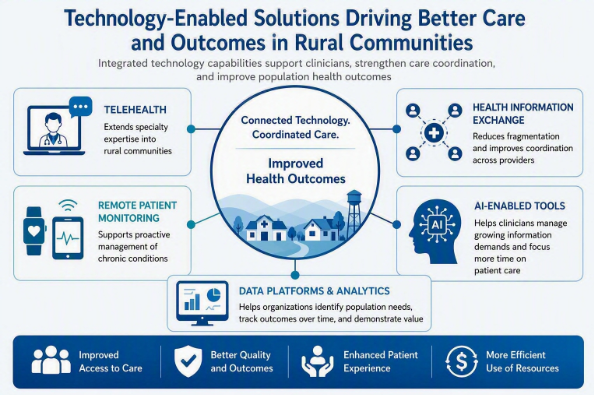
Technology alone is unlikely to produce meaningful transformation.
HMA is working with states and their partners on strategic approaches to technology adoption. For example, states, providers, care teams, and patients should consider technology initiatives that can strengthen care models, extend workforce capacity, improve coordination and collaboration in support of population health, and generate actionable insights.
Sustainability Planning Must Begin Early in the Rural Health Transformation Program
Every state and RHTP participant understands that this federal funding is temporary. The urgent challenge is to identify, early and explicitly, which initiatives can produce enough value to warrant ongoing support after the funding period concludes.
While some states awarded the first year of RHTP funding quickly, many of these awards may serve as a bridge while states establish the structures and policies needed to support long-term RHTP initiatives. CMS’s reporting and ongoing evaluation of RHTP programs will require states to embed sustainability into program design, governance, measurement, financing, and partnerships from the outset.
States will need to provide RHTP participants with clear baselines and direction on meaningful outcomes. It also requires thinking beyond grant budgets to identify long-term operational and financial models capable of supporting ongoing services.
What States, Providers, and Technology Partners Should Do Next
The window for shaping long-term RHTP success is open now. State and local government and partner organizations have an opportunity to move beyond individual projects and build integrated strategies.
HMA’s multidisciplinary teams support program design, implementation planning, data strategy, technology modernization, performance measurement, governance, financing strategy, partnership development, and sustainability planning. As states and RHTP participants make decisions regarding governance, technology, data strategy, care models, and performance measurement, HMA can help ensure decisions and investments are optimized to make the progress needed to secure future funding and sustain transformation beyond the grant period.

Federal Policy News
Fueled By Leavitt Partners Weekly Health Intelligence
FDA Commissioner Nominee Heidi Overton Faces Questions on Vaccine Policy and Agency Leadership
Last week, President Trump announced the nomination of Dr. Heidi Overton, the current Deputy Director of the White House Domestic Policy Council, to be FDA Commissioner. He made the announcement in a post on social media, in which he praised Dr. Overton’s credentials and her work in the White House on the President’s health agenda. Dr. Overton is a physician, specializing in “public health and general preventive medicine,” and she also holds a Ph.D. in clinical investigations. Prior to joining the Administration, Dr. Overton was the Chief Policy Officer of the America First Policy Institute, which is closely aligned with the Trump Administration, and Vice Chair of the Institute’s Center for a Healthy America.
FDA has been without a permanent agency head since the departure of Commissioner Marty Makary in May 2026, whose tenure at the agency has been characterized by many as a time of turmoil, during which both agency staff and industry leaders were dissatisfied with his leadership. Notably, Dr. Overton has worked closely with Dr. Makary, who served as her thesis advisor and collaborator on several publications prior to their work in the Trump Administration.
In addition to the extent to which she is aligned with former Commissioner Makary, and her planned approach to agency leadership, Dr. Overton’s perspective on vaccine policy will be under scrutiny, after she was credited for having a key role in President Trump’s August 10 Executive Order (EO 14420), which called for a revised childhood vaccine schedule. During the signing of the EO, she described the Administration’s concerns as being focused on government mandates, rather than vaccines themselves, and emphasized the role of “shared clinical decision-making.”
Dr. Overton’s nomination has not yet been sent to the Senate for review, a procedural requirement to initiate formal Senate consideration of her nomination, including a review by the Senate HELP Committee. Chair of the Senate HELP Committee, Bill Cassidy (R-LA) stated in a post on social media that he has concerns about both Dr. Overton’s stance on vaccines, as well as her ability to effectively lead the agency. In addition, a number of Democrats, including Senator Patty Murray (D-WA), have expressed opposition and concerns with the choice of Dr. Overton as the nominee for FDA Commissioner, noting concerns with her position on vaccines and other science-related issues among others.
Given the concerns expressed by policymakers thus far, Dr. Overton’s path to confirmation may prove to be difficult, with issues related to timing and Senate procedure creating additional complications. Senators Collins (R-ME) and Murkowski (R-AK), who could also have a significant impact on whether her nomination advances, have not yet publicly shared their views on her nomination. The Senate is in recess through September 14, and will be out again from October 1 through November 9, after the midterm elections. With uncertainty regarding her path through the Senate HELP Committee under Chair Cassidy’s leadership, there is a chance that Dr. Overton’s nomination is delayed until January, after his departure from the Senate, should Republicans maintain the Senate majority in November. Once Dr. Overton is formally nominated, current Acting Commissioner Kyle Diamantas may remain in the role past the December date that would have prevented him from doing so had there not been a nominee under the Vacancies Act.
Ultimately, the next confirmed FDA Commissioner will take on leadership of an agency that has experienced significant change, as well as several ongoing initiatives, including Operation Trialblazer and the recently announced FDA reorganization. While Dr. Overton’s nomination itself may unlock appointments of other senior agency leaders, unlike many of her predecessors, Dr. Overton will not inherit a seasoned cadre of long-serving center directors, deputy commissioners, and senior career executives with decades of institutional knowledge. This will certainly increase the management challenges facing her as a first-time commissioner.
HHS Seeks Public Input on Federal Vaccine Recommendation Categories
On August 21, HHS, through the Office of the Secretary, released a request for information (RFI) seeking public input on the categories used in federal vaccine recommendations and the role of “shared clinical decision-making” in the recommendation and administration of childhood vaccines. The Administration has recently renewed its effort to revise the childhood vaccine schedule through an Executive Order (EO 14420) that directed HHS agencies to take “any appropriate steps” to advance the revised schedule, which reduces the number of vaccines recommended in total and shifts multiple vaccines from being recommended as routine for all children to being recommended based on “shared clinical decision-making” (SCDM). In the RFI, HHS seeks input on the three categories of routine, risk-based, and SCDM, as well as category assignments and whether additional categories should be adopted, including “recommended, but not during infancy,” and “recommended with qualification.” In the RFI, HHS also acknowledges certain challenges related to the SCDM category that have been observed over time, including additional time to implement SCDM recommendations and confusion regarding insurance coverage of SCDM vaccines. The RFI requests responses to several questions related to SCDM recommendations including how to ensure that patients understand the coverage requirements that apply to SCDM vaccines. It also asks whether the categories convey differences in the strength of the evidence for individual and population benefits.
HHS states in the RFI that responses will be reviewed by the Task Force on Safer Childhood Vaccines, which was reinstated by HHS in August 2025 and is tasked in the EO with advancing the new schedule. The RFI does not discuss the role of the CDC or the CDC Director in adopting potential changes to recommendation categories and it is unclear what level of input, if any, the new CDC Director had in the RFI. The RFI is open for public comment until September 20.
CDC Director Erica Schwartz Delivers First Agency-Wide Address
On August 20, CDC Director Dr. Erica Schwartz gave her first “all-hands” address to agency staff. As noted in her nomination hearing, Dr. Schwartz reportedly shared with staff her three initial priorities: “earning trust through transparency and scientific rigor, strengthening CDC’s ability to detect and respond to health threats, and deepening partnerships with states and communities.”
She also reportedly sought to assure staff that she is comfortable disagreeing with Administration leadership when needed, and that they should feel safe doing the same with her. Dr. Schwartz’s confirmation as CDC Director coincides with the renewed push from the Administration to revise the childhood vaccine schedule, which is recommended by CDC’s Advisory Committee on Immunization Practices and ultimately requires the signoff of the CDC Director. Disputes over this process ultimately led to the departure of the last CDC Director, Dr. Susan Monarez.
FDA Lays Groundwork for Generative AI Medical Device Regulation
On August 18, FDA issued a discussion paper on considerations for the regulation of generative AI-enabled medical devices, in which it proposes to take a risk-proportionate approach based on the device’s intended use. In evaluating risk, FDA is considering drawing distinctions between patient-facing, informational functions versus healthcare provider-facing information functions, as well as distinctions between healthcare generalists versus specialists. The paper seeks public feedback on topics such as risk assessment, premarket evaluation, post–market monitoring, and other issues relevant to the regulation of these devices. FDA’s Digital Health Center of Excellence (DHCoE) is leading the effort as part of the agency’s broader work to advance regulatory frameworks for AI and digital health technologies. Throughout the document, FDA states it is committed to working collaboratively with stakeholders, including clinicians, “to develop efficient, scientifically sound, and least burdensome approaches” to regulating AI devices. The discussion paper is open for public comment until October 19.
Ready to talk about your organization's challenges?
Schedule a Consultation
State Policy News
CMS Awards New Rural Health Transformation Program Funding to Alabama, Alaska, North Dakota, Ohio, and West Virginia
The Centers for Medicare & Medicaid Services (CMS) announced on August 24, 2026, new Rural Health Transformation Program (RHTP) funding awards to Alabama, Alaska, North Dakota, Ohio, and West Virginia to strengthen rural healthcare access, expand behavioral health and maternal health services, support healthcare workforce development, improve care coordination, and advance health information technology initiatives. The awards highlight continued federal investment in addressing healthcare challenges facing rural communities through innovative delivery models and infrastructure improvements.
Alaska Receives $160 Million for Rural Healthcare Innovation
Alaska received $160 million in CMS Rural Health Transformation Program funding to support 142 projects designed to improve rural healthcare delivery across the state. Investments include expansion of behavioral health services, workforce development initiatives, electronic health record modernization, and healthcare technology enhancements.
Funded projects include robotic-assisted surgery capabilities in Southeast Alaska, development of a tribally led behavioral health and recovery campus, expansion of statewide health information exchange infrastructure, support for the Alaska Family Medicine Residency Program, deployment of AI-enabled imaging technology across 21 hospitals, and drone-based prescription delivery services for remote rural communities.
North Dakota Funds Rural Care Coordination
North Dakota received $1 million in RHTP funding to launch the Coordinating and Connecting Care Initiative. The program seeks to improve rural care coordination by bringing together patients, healthcare providers, tribal organizations, community partners, and volunteer organizations to identify service gaps, improve communication, and strengthen healthcare delivery across rural areas.
Ohio Expands Rural Pharmacy Connectivity
Ohio received $3.2 million in CMS rural health funding to enhance pharmacy connectivity and improve healthcare integration for rural providers. Nearly $1.2 million will support expanded access to the Ohio Automated Rx Reporting System (OARRS), while $2 million will improve pharmacist access to patient medical records, strengthen medication management programs, and reduce adverse drug events.
West Virginia Improves Rural Medical Transportation
West Virginia received $4.2 million in Rural Health Transformation Program funding to expand medical transportation services and improve patient access to care. The initiative will increase transportation capacity, broaden service availability, and expand geographic coverage for patients in rural and underserved communities.
Louisiana Medicaid Releases Dental Benefit Program Manager RFP for 1.5 Million Members
The Louisiana Department of Health (LDH) released on August 21, 2026, a request for proposals (RFP) seeking up to two Medicaid Dental Benefit Program Managers (DBPMs). Selected contractors will be responsible for running the Medicaid dental program serving approximately 1.5 million individuals. Goals of the procurement include improved coordination of care, better dental health outcomes, increased quality of dental care, improved access to essential specialty dental services, outreach and education to promote dental health, and increased enrollee responsibility and self-management. Incumbent DBPMs are MCNA and DentaQuest. Contracts will run from January 1, 2027, through December 31, 2030, with optional renewals for up to 24 additional months. Proposals are due September 30.
Maine Proposes Stricter Medicaid Provider Inspections, Payment Suspensions
Maine’s Department of Health and Human Services proposed on August 19, 2026, new MaineCare program-integrity rules in response to two citizen petitions. The proposal would require in-person inspections of provider locations during enrollment, audits, and fraud investigations; permit sanctions when providers deny access; and prohibit replacing fraud-related inspections with desk reviews or electronic document submissions. The rule would also require MaineCare to suspend and escrow payments when a provider receives notice of an alleged improper payment, overpayment, or billing violation of at least $1,000. Providers could challenge the order through informal review and an administrative hearing, but the payment suspension would remain in place during the appeal, and providers would generally have to continue delivering medically necessary services to existing MaineCare members. A public hearing is scheduled for September 10, 2026, and comments are due September 20, 2026.
Virginia Launches ‘Keep Virginia Covered’ Initiative as Medicaid Work Requirements Take Effect
WTKR reported on August 25, 2026, that Virginia Governor Abigail Spanberger signed an executive order creating the “Keep Virginia Covered” initiative in response to the federal budget reconciliation act (P.L. 119-21, OBBBA). The order directs state agencies to help residents maintain Medicaid coverage, identify alternative health insurance options, and participate in regional outreach workshops. State officials estimate that approximately 300,000 residents are potentially at risk of losing coverage because of the new work requirements. Officials also warned that changes affecting the Supplemental Nutrition Assistance Program (SNAP) could put benefits for roughly 7,000 residents at risk.

Private Market News
Fueled By Wakely Consulting Group
Providence Health Plan Shutdown Highlights Mounting Pressure in Medicare Advantage Markets
Providence Health Plan is shutting down entirely after negotiations with a national insurer to continue its Medicare Advantage business fell through, affecting more than 64,000 members. The closure follows Providence’s planned exit from its commercial, Medicaid, individual, and employer markets, amid high medical costs, regulatory pressures, and competition from national insurers.
Cityblock Health Acquires Homeward Health to Expand Medicaid and Medicare Advantage Services
Cityblock Health announced that it has signed a definitive agreement to acquire Homeward Health in an all-stock transaction. The acquisition will pair Cityblock’s urban Medicaid and dual-eligible care platform with Homeward’s rural Medicare Advantage model, expanding the company’s reach across government-sponsored healthcare populations in rural areas. Cityblock currently serves nearly 200,000 members, while Homeward serves approximately 50,000 members through partnerships with health plans and rural providers.

Our Insights
Fueled By Experts Across Our HMA Companies
Health Management Associates
Webinar: Modernizing and Streamlining Health Plan Prior Authorization (Sept. 9)
During this webinar, leaders from HMA and NTT DATA will explore the common sources of friction and inefficiency in prior authorization (PA) processes and discuss how modern technology, including artificial intelligence (AI), can help streamline PA operations, improve compliance, and enhance the experiences for health plans, providers, and members. Attendees will gain insights into the evolving regulatory landscape, the root causes of PA administrative burden, and practical strategies for leveraging IT modernization to create more efficient, transparent, and effective prior authorization workflows.
CMS’s Proposed Provider Tax Rule Could Reshape Medicaid Financing
The Centers for Medicare & Medicaid Services (CMS) has proposed significant changes to how Medicaid provider taxes are structured, reported, and monitored. Issued in response to the Working Families Tax Cut Act (WFTCA), the proposed rule would affect provider tax grandfathering, hold harmless thresholds, reporting requirements, and permissible tax classes, with important implications for states, Medicaid agencies, health plans, providers, and other healthcare stakeholders.
In this brief, our HMA team breaks down the proposal into practical, actionable insights. It highlights what is changing, what remains uncertain, and the operational and financial considerations organizations should evaluate as CMS moves toward a final rule.
Webinar Replay: Rural Health Transformation Program: Beyond the Grant Approval Phase – Implementing for Sustainability
In this webinar, our HMA team explored how the implementation of RHTP initiatives can drive sustainable improvement in the health status of the citizens of rural communities. They discussed approach to help ensure RHTP implementation can create a more financially viable healthcare provider. model in rural communities.
Wakely
ACA Supplemental Claims Are Reshaping Risk Adjustment Strategy
Supplemental claims have become a critical driver of ACA risk adjustment accuracy, financial performance, and RADV preparedness for health plans. According to Wakely’s 2025 ACA Supplemental Claims Impact white paper, supplemental claims increased average Plan Liability Risk Scores (PLRS) by 7.3% in the individual market and 3.3% in the small group market, with results varying considerably across issuers and states.
For healthcare executives, actuarial leaders, and risk adjustment teams, the findings underscore the need for a strategic approach to supplemental claims. In this new brief, our Wakely team addresses why healthcare organizations that invest in a comprehensive ACA risk adjustment strategy are better positioned to improve reimbursement accuracy, reduce audit exposure, and strengthen long-term financial performance.

RFP Calendar
RFP Calendar
| Date | State/Program | Event | Beneficiaries |
|---|---|---|---|
| Date: Summer 2026 | State/Program: Illinois Foster Care | Event: RFP Release | Beneficiaries: 33,000 |
| Date: July 28, 2026 (Delayed) | State/Program: Nevada Children's Specialty | Event: Awards | Beneficiaries: NA |
| Date: August 2026 | State/Program: Indiana | Event: RFP Release | Beneficiaries: 1,400,000 |
| Date: January 1, 2027 | State/Program: Illinois | Event: Implementation | Beneficiaries: 2,400,000 |
| Date: January 1, 2027 | State/Program: Nevada CO D-SNP | Event: Implementation | Beneficiaries: 88,000 |
| Date: January 1, 2027 | State/Program: Wisconsin LTC GSR 3 | Event: Implementation | Beneficiaries: 56,000 (all GSR) |
| Date: January 1, 2027 | State/Program: Illinois Tailored Care Management Program | Event: Implementation | Beneficiaries: 22,400 |
| Date: July 1, 2027 | State/Program: Nevada Children's Specialty | Event: Implementation | Beneficiaries: NA |
| Date: September 2, 2026 | State/Program: Missouri | Event: Proposals Due | Beneficiaries: 1,000,000 |
| Date: Fall 2027 | State/Program: Oregon | Event: RFP Release | Beneficiaries: 1,200,000 |
| Date: January 1, 2028 | State/Program: Wisconsin LTC GSR 4,6 | Event: Implementation | Beneficiaries: 56,000 (all GSR) |
| Date: 2028 | State/Program: North Carolina | Event: RFP Release | Beneficiaries: 2,200,000 |
| Date: 2029 | State/Program: California | Event: RFP Release | Beneficiaries: NA |