
Health Management Associates (HMA) analyzed monthly Medicaid managed care enrollment data reported by 34 states in the second quarter of 2026. Enrollment totaled 59.2 million members in June 2026—a decline of 3.5 million members (5.5%) from June 2025. The broader Medicaid and CHIP population has declined at approximately the same pace as managed care, with the Centers for Medicare & Medicaid Services (CMS) data showing a 5.9% decrease from May 2025 to May 2026.
The findings establish a timely baseline before new eligibility policies take effect. Under the 2025 budget reconciliation act (P.L. 119-21), now known as the Working Families Tax Cut (WFTC) Act, most states must implement Medicaid community engagement requirements for certain adults beginning January 1, 2027, conduct eligibility redeterminations every six months for this population, and implement other policies that will narrow Medicaid eligibility.
Medicaid Managed Care Enrollment Trends in Q2 2026
HMA Information Services (HMAIS) tracks monthly Medicaid enrollment for all states, including managed care enrollment in the subset of states with managed care programs. Among the 34 states with managed care programs that reported enrollment data in the second quarter of 2026:
- Enrollment changes varied across states, reflecting a combination of state-specific demographic, administrative, operational, and policy factors.
- Only three states—Mississippi, Nevada, and South Carolina—reported modest gains in Medicaid managed care enrollment since June 2025.
- Arizona, Indiana, and Louisiana each reported double-digit declines, ranging from 10.1% to 21.1%.
- The seven non-expansion states in this analysis—Florida, Georgia, Mississippi, South Carolina, Tennessee, Texas, and Wisconsin—experienced a decline of 455,000 (3.8%), bringing enrollment to 11.6 million enrollees.
Among the expansion states in the analysis, enrollment decreased by 3 million (5.9%) to 47.6 million. The larger decline among expansion states is particularly relevant because adults in expansion states will be most directly affected by the new community engagement and six-month redetermination policies. Details are illustrated in Figure 1.
Figure 1. States Included in the Medicaid Managed Care Enrollment Analysis, June 2026
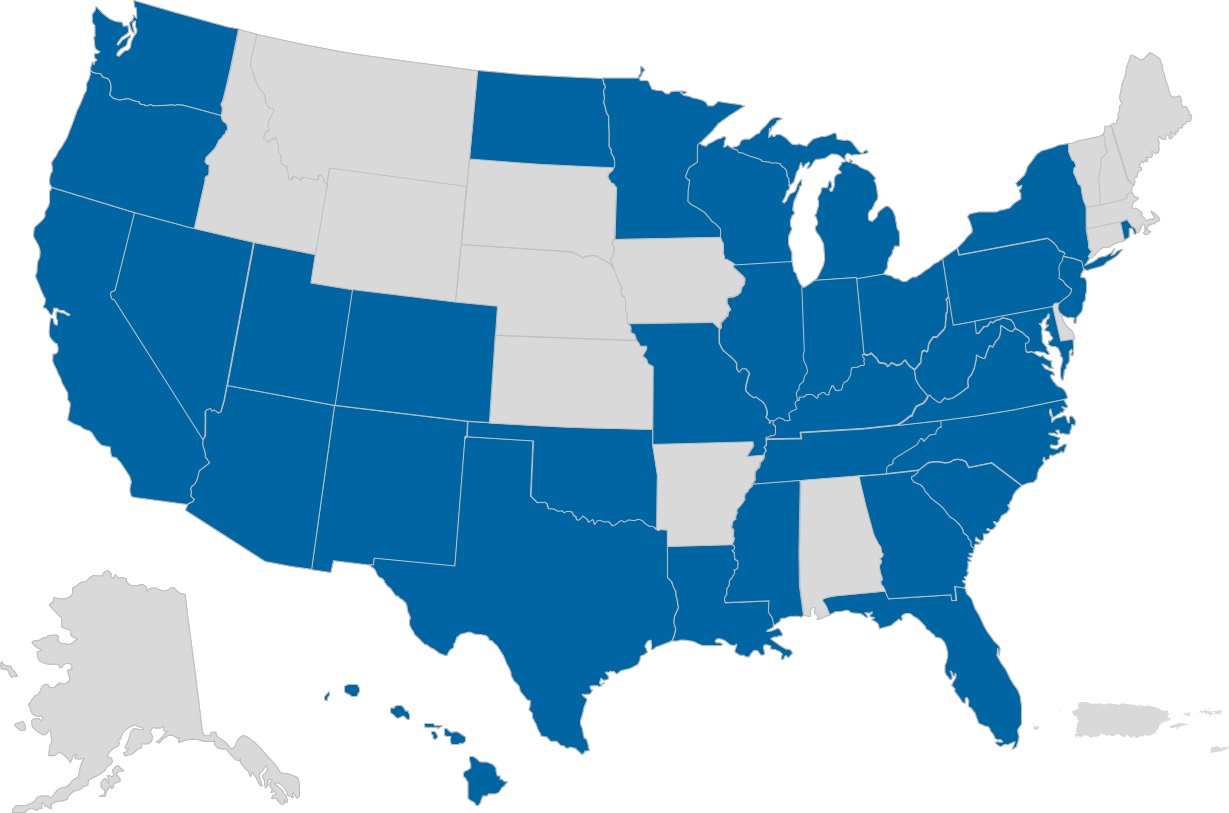
Note: States colored as blue shown on the map above are included in the HMA Enrollment Analysis.
National Medicaid Managed Care Market Share
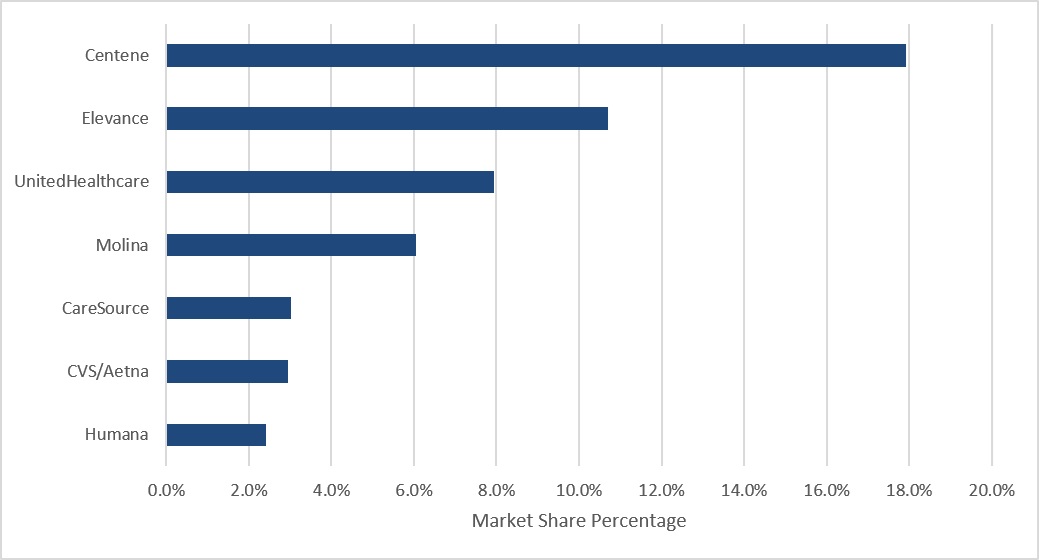
HMAIS also tracks Medicaid managed care ownership, program participation, and tax status for nearly 300 plans. In this June 2026 snapshot, Centene covered 17.9% of enrollees, followed by Elevance at 10.7%, UnitedHealth Group at 8%, and Molina at 6% (see Figure 2). These four organizations represented 42.6% of enrollment in the HMAIS dataset, underscoring continued concentration among large, national Medicaid managed care organizations. (Note: The number and mix of plans changed over the past 12 months, and several state enrollment reports reflect different reporting months. Other limitations are discussed in the Data Considerations section of this article.)
The enrollment declines as well as pressure from acuity, utilization, and payment rates are compelling Medicaid managed care organizations (MCOs) to reassess where they participate, including whether individual markets can support sustainable performance. For example, one national Medicaid MCO has publicly discussed exiting unprofitable Medicaid markets and left one state market in August 2026 with plans to exit another at the end of the year. These decisions illustrate how enrollment contraction can interact with rate adequacy, acuity, utilization, and state-specific contract performance to influence plan participation.
Figure 2. National Medicaid Managed Care Enrollment Share by Parent Organization, June 2026
How Medicaid Work Requirements and Eligibility Policies Could Affect Enrollment in 2027
In June 2025, approximately 20.4 million people were enrolled in Affordable Care Act Medicaid expansion plans—5 million of whom reside in California, and nearly 2 million live in New York. The WFTC Act applies requirements to Affordable Care Act (ACA) expansion adults and certain Medicaid Section 1115 demonstration populations in 44 states beginning January 2027.
In September 2026, CMS published an implementation resource that outlines an optional framework that states may use to identify and verify individuals who qualify for the medical frailty exclusion. Although the framework gives states options for consideration, they still must determine which health conditions to cover and data sources to use when additional documentation is requested and how to notify members of their determinations. Many states have already made decisions about these issues, which could materially affect administrative workload, the consistency of determinations, and whether eligible individuals maintain coverage as well as the number of people who retain coverage and the composition of the population that remains enrolled.
In addition, a few states have already started implementing the new eligibility policies. For example, Nebraska launched Medicaid work/community engagement requirements on May 1, 2026. Montana began implementation on July 1, 2026, while Arkansas began a soft launch in July 2026 before enforcement begins in January 2027. Iowa intends to begin early implementation December 1, 2026. Although Montana and Arkansas are not managed care states, they, along with Nebraska, can offer directional insights on beneficiary response, exclusion determinations, procedural losses, appeals, and administrative workload before nationwide implementation.
Notably, the second quarter enrollment decline predates full implementation of the new federal eligibility policy changes and community engagement requirement, which means future enrollment changes may not be entirely attributable to the WFTCA requirements.
Organizations should continue to monitor total enrollment, churn, eligibility category, risk mix, and transitions to Marketplace or uninsured status.
Data Considerations. HMA Information Services (HMAIS) tracks monthly Medicaid managed care enrollment, ownership, program participation, and tax status for approximately 300 plans. The data in this analysis have some important limitations. States report enrollment figures at different points throughout the month, with some data reflecting beginning of the month totals and others capturing end of month enrollment. In addition, some state datasets encompass all Medicaid programs that offer managed care plans, whereas others reflect only a subset of the managed Medicaid population. As a result, the analysis can be used to identify direction, magnitude, and market signals rather than as a comprehensive state-by-state comparison.
The HMAIS enrollment reports and analyses, available through subscription, use data from nearly 300 health plans in 39 states, DC, and Puerto Rico. HMAIS’s Medicaid enrollment data, financials, procurement tracking, and a robust library of public documents equips stakeholders with timely, actionable intelligence. Subscribe here.
Preparing for Enrollment Shifts
WFTC Act implementation will require state-specific policy decisions, eligibility system changes, new data-matching processes, staff training, beneficiary outreach, and workable approaches to identifying people who qualify for exemptions for medical frailty and other conditions. Differences in data availability, verification pathways, documentation requirements, and review processes could produce materially different effects on enrollment, continuity of coverage, beneficiary experience, and the risk profile of the population that remains enrolled.
Healthcare executives and state Medicaid leaders should establish a baseline, monitor emerging implementation signals, and model the operational and financial implications. Priority measures include enrollment and churn, procedural terminations, exclusion determinations, appeals, transitions to other coverage, changes in acuity and utilization, payer mix, and geographic variation. These insights can inform decisions about eligibility operations, beneficiary support, capitation and rate development, network strategy, provider reimbursement, revenue forecasting, and uncompensated care exposure.
MCOs are unable to help states with determining eligibility determination or compliance, cannot receive capitation rate bumps for non-medical activities, or use their own work programs to help beneficiaries meet the community engagement requirements but may be able to provide support through outreach and education. CMS has indicated it expects to provide additional guidance on what activities are appropriate. MCOs can potentially use their existing relationships with beneficiaries, care managers, providers, and community organizations to help members understand and navigate the new requirements.
HMAIS provides the market intelligence needed to track these shifts, including state-reported enrollment, plan ownership, financial performance, procurement activity, and related public documents. HMA consultants extend that intelligence through state- and market-specific scenario modeling, policy and operational analysis, and implementation support—helping clients forecast enrollment and revenue, assess payer mix and utilization effects, strengthen eligibility and beneficiary support workflows, evaluate competitive positioning, and prepare for changes in program financing and oversight.
Contact HMA to translate evolving enrollment and implementation signals into an actionable strategy for your state, market, or organization.