Colorado Department of Human Services and Behavioral Health Administration.
BACKGROUND
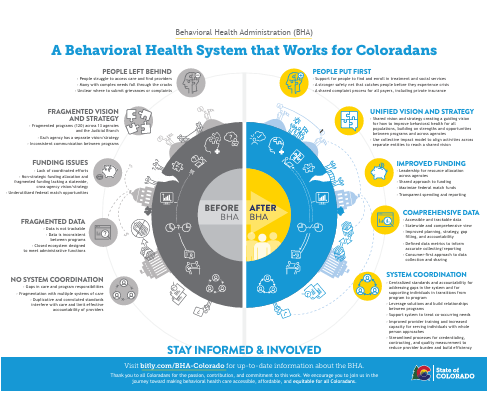
Like many states Colorado has historically struggled with a mixture of challenges relating to its public behavioral health system including funding issues, duplicate processes across multiple state systems, and the absence of a cohesive statewide strategy, which has proved increasingly problematic for Coloradans, especially those with complex needs. The state set out to create a system with a coherent vision and strategy that could provide high quality, equitable and accountable care to all Coloradans.
In 2019, Colorado Governor Jared Polis created a Behavioral Health Taskforce (BHTF) charged with evaluating and setting a roadmap to improve the state’s behavioral health system. The BHTF created a set of more than 200 recommendations that were both structural and programmatic in nature. The most significant structural change was a recommendation to create the Behavioral Health Administration (BHA)—a single accountable entity that would reduce fragmentation across sectors and programs and build a more strategic approach to ultimately improve behavioral health outcomes.
APPROACH
In 2021, HMA began an extensive partnership with the Colorado Department of Human Services to support the planning and implementation of the BHA. The initial project approach incorporated technical research, extensive stakeholder engagement, model design, and change management.
Technical research:
HMA conducted a technical review of over 100 behavioral health programs across 14 state agencies and branches of government including each program’s funding source, program details, population served, eligibility, relevant past and current legislation, administrative rule, waiver authority, contracts, data reporting, and data infrastructure. HMA also conducted research into other state models of reform and conducted interviews with six states on detailed lessons learned from reform efforts.
Stakeholder engagement:
HMA conducted three rounds of extensive statewide stakeholder engagement with more than 700 representatives across all Colorado counties. Stakeholders represented various sectors and feedback focused on: 1) understanding what stakeholders wanted from a BHA which turned into a detailed list of BHA functions; 2) gaining feedback on draft models of the BHA structure and 3) providing an update and response to the final BHA model chosen.
Model design:
HMA drafted multiple models for the BHA and facilitated a detailed evaluation process with the Behavioral Health Reform Executive Committee comprised of the Lieutenant Governor, Executive Directors of the Colorado Departments of Health Care Policy and Financing, Human Services, and Public Health and Environment, the Commissioner of Insurance, and a Deputy County Manager. The process was designed to help the committee consider multiple design elements, weigh pros and cons, and ultimately provide a BHA design recommendation to Governor Polis.
Change management:
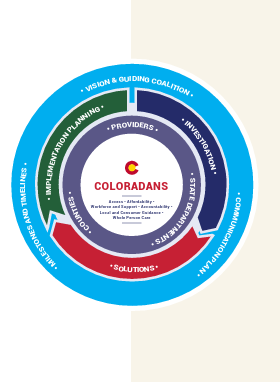
HMA employed an extensive change management approach centered on communication and transparency, partnering with communications vendor Merritt+Grace to create a website, a weekly Frequently Asked Questions update, a communication ambassador program across 14 agencies, and a formal change management plan for the BHA process.
RESULTS
The Executive Committee and Governor Polis ultimately chose a model that gives the state the ability to streamline strategy, regulation, funding for high quality and equitable care, and serves as an innovative approach for the nation. Rather than consolidating or moving all behavioral health into one department, the design provides a networked approach to behavioral health and allows for the recognition of expertise in context. The model also positions the state for an expanding impact of behavioral health with future funding on climate change, economics and other factors.
Specific design elements include:
A cabinet-level position that elevates the criticality of behavioral health
A single cross-payer and cross-sector behavioral health entity tasked with collaborating across agencies and sectors to drive a comprehensive and coordinated strategic approach to behavioral health
Better strategy and planning to leverage all funding streams including non-Medicaid, Medicaid and commercial, education, criminal justice, etc., payments for behavioral health, and ensure the state maximizes federal dollars to support the system
System and services that reflect the “voice” of individuals and families
The governance for the BHA is a cabinet-level commissioner, an interagency council of cabinet members, and an advisory council with diverse representation of individuals and family members with lived experience, local government officials, providers, tribal governments, and others.
ONGOING SUPPORT
HMA created a detailed implementation plan as a final deliverable for the project and has been subsequently providing ongoing support with implementation. HMA has also provided support in the drafting of authorizing legislation, hiring and onboarding of new staff, support in drafting a report for the legislature, additional stakeholder engagement, creation of an innovative access -to-care methodology, and development of interagency agreements to support collaboration with the BHA across all departments. HMA has also continued change management support for the BHA including multiple aspects of the daily operation of the new Administration, which necessitated changes and adjustments to previously existing state offices. It has been our privilege to support Commissioner Dr. Morgan Medlock and her leadership team as they work tirelessly to bring the vision of the BHA to Colorado.
THE CLIENT
Colorado Department of Human Services and Behavioral Health Administration.
BACKGROUND
Like many states Colorado has historically struggled with a mixture of challenges relating to its public behavioral health system including funding issues, duplicate processes across multiple state systems, and the absence of a cohesive statewide strategy, which has proved increasingly problematic for Coloradans, especially those with complex needs. The state set out to create a system with a coherent vision and strategy that could provide high quality, equitable and accountable care to all Coloradans.
In 2019, Colorado Governor Jared Polis created a Behavioral Health Taskforce (BHTF) charged with evaluating and setting a roadmap to improve the state’s behavioral health system. The BHTF created a set of more than 200 recommendations that were both structural and programmatic in nature. The most significant structural change was a recommendation to create the Behavioral Health Administration (BHA)—a single accountable entity that would reduce fragmentation across sectors and programs and build a more strategic approach to ultimately improve behavioral health outcomes.
APPROACH
In 2021, HMA began an extensive partnership with the Colorado Department of Human Services to support the planning and implementation of the BHA. The initial project approach incorporated technical research, extensive stakeholder engagement, model design, and change management.
Technical research:
HMA conducted a technical review of over 100 behavioral health programs across 14 state agencies and branches of government including each program’s funding source, program details, population served, eligibility, relevant past and current legislation, administrative rule, waiver authority, contracts, data reporting, and data infrastructure. HMA also conducted research into other state models of reform and conducted interviews with six states on detailed lessons learned from reform efforts.
Stakeholder engagement:
HMA conducted three rounds of extensive statewide stakeholder engagement with more than 700 representatives across all Colorado counties. Stakeholders represented various sectors and feedback focused on: 1) understanding what stakeholders wanted from a BHA which turned into a detailed list of BHA functions; 2) gaining feedback on draft models of the BHA structure and 3) providing an update and response to the final BHA model chosen.
Model design:
HMA drafted multiple models for the BHA and facilitated a detailed evaluation process with the Behavioral Health Reform Executive Committee comprised of the Lieutenant Governor, Executive Directors of the Colorado Departments of Health Care Policy and Financing, Human Services, and Public Health and Environment, the Commissioner of Insurance, and a Deputy County Manager. The process was designed to help the committee consider multiple design elements, weigh pros and cons, and ultimately provide a BHA design recommendation to Governor Polis.
Change management:
HMA employed an extensive change management approach centered on communication and transparency, partnering with communications vendor Merritt+Grace to create a website, a weekly Frequently Asked Questions update, a communication ambassador program across 14 agencies, and a formal change management plan for the BHA process.
RESULTS
The Executive Committee and Governor Polis ultimately chose a model that gives the state the ability to streamline strategy, regulation, funding for high quality and equitable care, and serves as an innovative approach for the nation. Rather than consolidating or moving all behavioral health into one department, the design provides a networked approach to behavioral health and allows for the recognition of expertise in context. The model also positions the state for an expanding impact of behavioral health with future funding on climate change, economics and other factors.
Specific design elements include:
A cabinet-level position that elevates the criticality of behavioral health
A single cross-payer and cross-sector behavioral health entity tasked with collaborating across agencies and sectors to drive a comprehensive and coordinated strategic approach to behavioral health
Better strategy and planning to leverage all funding streams including non-Medicaid, Medicaid and commercial, education, criminal justice, etc., payments for behavioral health, and ensure the state maximizes federal dollars to support the system
System and services that reflect the “voice” of individuals and families
The governance for the BHA is a cabinet-level commissioner, an interagency council of cabinet members, and an advisory council with diverse representation of individuals and family members with lived experience, local government officials, providers, tribal governments, and others.
ONGOING SUPPORT
HMA created a detailed implementation plan as a final deliverable for the project and has been subsequently providing ongoing support with implementation. HMA has also provided support in the drafting of authorizing legislation, hiring and onboarding of new staff, support in drafting a report for the legislature, additional stakeholder engagement, creation of an innovative access -to-care methodology, and development of interagency agreements to support collaboration with the BHA across all departments. HMA has also continued change management support for the BHA including multiple aspects of the daily operation of the new Administration, which necessitated changes and adjustments to previously existing state offices. It has been our privilege to support Commissioner Dr. Morgan Medlock and her leadership team as they work tirelessly to bring the vision of the BHA to Colorado.