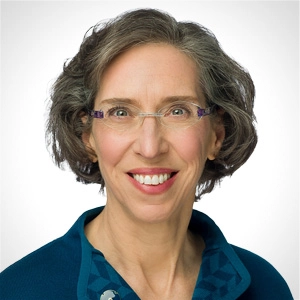
Jennifer Colamonico
Welcome to another episode of Vital Viewpoints on Healthcare, a podcast that brings together bold thinkers and seasoned practitioners to explore what it really takes to improve health systems, policies and outcomes, especially for the people and communities who need it most. Today, we're joined by Sarah Hudson, surely a nationally recognized leader in health, quality and person centered care with more than 30 years of experience shaping how we measure what matters in healthcare.
Sarah has been at the forefront of designing quality frameworks that not only drive performance, but that prioritize people. Sarah has held key roles at the National Committee for Quality Assurance, where she led groundbreaking work on care for underserved populations. And she's also contributed to national efforts to improve care for populations with complex health needs. Now a principal at Leavitt Partners, an HMO company, Sarah supports cross-sector collaborations aimed at building smarter and fairer systems of care.
Sarah, thank you for being with us today.
Sarah Hudson Scholle
Thank you.
Jennifer Colamonico
So I'm excited to talk about the word quality, the idea of quality. It seems like, one of those words that people say, well, you know, of course we should have quality and, and yet I think often what people mean by quality varies. So I'm interested just to start, over the time you've spent in academia at NCCa and now at Leavitt Partners, as you've worked across these different sectors, what are the through lines that you've seen over time and how we define and measure quality?
Sarah Hudson Scholle
That's a that's a great question. Because, you know, as I was starting my career, that was the, beginning of the efforts from the National Academy of Medicine to define the domains of quality. And what's interesting is that it is domains. It's not just one thing it has to do with whether care is meeting the needs of individual people has to do whether it's effective.
So is it going to achieve the outcomes that we expect to have? Is it care that is working for all different groups of people who might have different kinds of needs? So I think we started to understand that that quality is not one thing. It's not the same thing for me and for you that we need to be attentive to.
What are the goals that, individuals have in mind for their lives? And how does I how does the health care system actually help people meet those goals and, address the diversity that we each present.
Jennifer Colamonico
As you mentioned, you know, quality differs for each person and what they're trying to accomplish in their lives, what their health status is and where they want to get to. How do we different differentiate between the idea of quality and these quality measures, which is, you know, kind of where we put the stake in the sand of whether somebody has achieved quality, right? Yes, or no?
Sarah Hudson Scholle
Yes. So, I think people don't understand how until you get in the middle of it, when I started at the National Committee for Quality Assurance, I had no idea how much work went into specifying all the details of a quality measure that will enable us to understand how does one organization compare to another, and has to do with defining the population, defining the amount of change you want to see, defining the code sets that you're going to use and what counts and what doesn't count.
And what happens is that these, this, this entire sort of developing that quality measure involves a lot of research, not understanding the data, but really one of the most important pieces of it is inviting the different stakeholders who are part of that work to say, okay, will this work and can we do something with it? Is from clinicians.
Can we actually improve it? So when we're trying to go from quality to a quality measure, we're trying to get at something that will give us consistent information across different organizations so that we can make fair comparisons. The challenge is that over time, these quality measures, which have been created to be part of how we hold organizations accountable for achieving the goals that we want them to achieve.
We want to use that information to pay organizations for getting to better outcomes. But sometimes it's felt like, oh, it's this measure that gets in the way, and that forces doctors to document things in a specific way and forces patients all to, to, achieve the same thing. And so it becomes a measurement exercise rather than a quality discovery and learning exercise.
And so I think that's been one of the challenges that we face. It's more about the measurement and less about the quality that we're hoping to get. We want quality measurement to be fair. We want it to be comparable across different organizations, but we also need it to focus on things that really matter, not just the things that are easy to measure in a consistent way.
It's like looking under the light post at what you can see to measure instead of saying, hey, what other information do we really need to know whether the health care system is performing as we hope.
Jennifer Colamonico
That's a big question. Whether the health care system is performing, how do, how do you create measures that are meaningful for both physicians and for patients? If part of this is encouraging that quality discussion, as you talked about, you know, their perspective on what is quality might differ. So how do you kind of square that circle?
Sarah Hudson Scholle
I think that's been a real challenge for us in thinking about this process, because, you know, we've had some periods where it's like, okay, we need more measures. We need a measure for this condition, for that condition, for this health program. The thing is that it takes time to make a good measure, and it actually takes some practice.
You know, one of the things in my work, that I've benefited from is having a couple of contracts from, PCORI, the Patient Centered Outcomes Research Institute. And, you know, when PCORI came in, it said, you've got to have patients and other stakeholders involved in every piece of the process of, of the contract. And so we were working on the use of patient recorded outcomes in primary care settings, and particularly settings that were serving, vulnerable populations.
And you know what it required there to record actually having a conversation among the clinicians and the patients together to say, okay, what's important here? How could we use that information? What's going to be the best way to collect it? How will we know what amount of improvement we should be able to see over time? And if you can't actually engage in that conversation an honest way, then it's hard to get to a quality measure that everybody's going to feel like, I can be responsible for this.
And so I think it's actually, it takes a lot of time to have this conversation actually takes a lot of practice. And learning from organizations are really committed to this kind of work. Is important because it's those examples that can help us learn what is possible and what might be achievable.
Jennifer Colamonico
And I have to ask this question. I, I have very much had a love hate relationship with statistics in graduate school. So, I ask this with that lens, you know, how much of it is looking into data to figure out what might be predictive? You know, starting with the set of very here are things we think might be predictive in.
And now how do you feel about those versus kind of a top down. You know here's what we think matters to us. And then let's kind of create a variable or a data capture moment in order to measure that how much of it's kind of coming from which direction.
Sarah Hudson Scholle
Well, it's about it's actually got to be both. But what we're trying to do is we're trying to change behavior. When we create a new quality measure, we're doing it because we want something to change. We want care to improve, right? So when we create a quality measure that is about improving outcomes for people with depression, we're saying we're not doing a very good job.
Now we want something to improve. So that means people have to change. And it's actually on both sides of the equation. Right. It's the care team, the clinician. The organization might have to change what they do, but it's actually requiring a commitment from the patient as well. We need your information, help us do a better job and help you to get better.
What does getting better look like for you? How can we help you? We can look at research that says, okay, well, about a 50% improvement in symptoms is a response, and we're going to use that as a number. We did that. And actually getting rid of depression symptoms that's remission. And so that's what you know the clinical trials were developed around those ideas remission and response.
Well guess what. We created that measure. We made it available. It was became a key. It's a hiatus measures now, but it's actually not reported by very many plants. And part of the reason I mean, there are many reasons. One reason is it's just hard to collect the data. But another reason is we built the definition of remission response based on research data, based on what we knew from the literature about what would be a good improvement in a clinical trial.
What we didn't do was sit down with patients and clinicians and say, okay, let's think about what would it mean to see improvement? What does getting better mean to you as a patient? What are the tools you need to have in your toolbox to help this patient get better? And so that's the kind of, collaboration in the learning and improvement process that actually hasn't had enough influence on how we develop measures and how we develop learning health systems that are really going to work to improve, rather than spending all their time trying to figure out how am I going to get the data, and then and how am I going to report it,
rather than saying, okay, what will it take? And and in particular, I think people are afraid that, when you ask patients, they're going to ask for the moon, and, in fact, as I've worked with, patient partners and different projects over the years, they're actually so practical and so reasonable. I mean, the, the first what I remember patients saying, well, what are you going to do with these?
Did I mean, I don't fill out these questionnaires because I don't think anybody reads them. That is the kind of honesty and truthfulness that you want to have at the table so that you say, okay, well then how do we how do we explain that, what are we going to do? What do we need from you as a patient in order for us to be able to serve you?
Well? A lot of the work that we did, at NC, QA, I was excited to be part of the development of a set of measures called person centered outcomes. And that really rest around this idea of saying, okay, when we have people who have complex needs that might be older, people that have multiple medical conditions that might be experiencing life threatening or like limiting conditions, or when we have people that have physical or mental health disabilities and that might be competing with medical needs, with non-medical needs, like in that case, some of the standard quality measures we've developed just don't apply.
And so we don't have a way to say, is your care as good as it should be? And so that's why we developed the set of measures. And but it really starts from a conversation of trust about, well, what are your goals, what matters to you? What would a good day look like for you? And I remember interviewing patients who said, nobody's ever asked me what my goals are.
I don't know how to answer that question. We had to actually write a script about how to have that conversation because it was so foreign to patients, but also for clinicians. So there's a lot of training that has to happen, but it's that partnership that is actually what's going to help people improve. And it's through that partner ship and that relationship that you can begin to build on.
Some of the challenging behavior changes, the challenging other kinds of non-medical situations, making the decisions about whether a particular health care intervention is actually going to help. And that's a frank conversation. We want to see that requires time. And that's another challenge with this entire quality space. You know, where we have clinicians saying, my whole the whole visit is, is based on trying to fill in all these different quality measures.
I actually think there's a tremendous amount of progress being made to make that more efficient. I'm excited about movement and interoperability that I think will help to make that data sharing and the use of new tools to make those data available. And for understanding people's needs and quality of care. I think that's happening. It has to happen in order for people to feel like they've got the time, actually have that relationship.
Jennifer Colamonico
I want to, come back to the topic of, kind of digital quality measurement, which, you I know you started to go there, but before we go there, I just, in, in my previous career doing sort of health care market research, oftentimes, you know, the patient's experience of what quality or what value or whatever word we might want to use really starts with, convenience and, and affordability.
And, and so I just wonder how much, those factors, you know, being able to have somebody answer the phone when I call or, you know, getting an appointment in a reasonable amount of time, like those things that are very far outside, well, sometimes outside the realm of what clinicians can influence. But for my patient, what do I need to be healthy to stay healthy, too?
You know, some of it is the system needs to work for me. So how have those, kind of concepts evolved? And do you see those any of those, components being pulled into these kind of definitions of quality? If we're going to get to a better patient outcome and achieve those behavior changes that you're talking about.
Sarah Hudson Scholle
We do measure some of those aspects of care access. And they're really important. Right. Because if you can't get that phone call then you might end up at the emergency room because you don't know what to do. Right. So it is important to create friction loss care. So both from the perspective of the clinician and the care team, but also the patient, because you have patients who feel like you're, you're important, your, your, your needs are being met.
So, but for some people it's way more important than it is for others. I think, you know, when I look at the way that we've asked people about their experiences of care, we've done some good work in trying to understand things that are just kind of timeless about, can I, can I get information when I need it?
Do people respect me as a person? But there are other things that we don't ask about, and that's about, do I trust my provider? Do I feel like I'm going to get good advice? This is someone who knows me, and people will attach different kinds of value to those different pieces. Right now we have a pretty much a static kind of, approach instead of one that can help you as a person say, look, this is what's important to me.
And how do I find the right kind of care setting the right clinician that's going to support me? It's important to think about that customer service piece of making this, an easy way to get care. At the same time, we're trying to help people, you know, get the right out of care. I think given the constraints on resources and time, it can be challenging.
I think that's why you see different groups of people gravitating to different kinds of health care systems. I know my values and what I value for care is different from my colleagues, and some of it has to do with, well, I don't have a major, illness. I'm, you know, what I care about is that I know where I can go and all of my records in one place and other people, it's like I want that relationship with the doctor I choose.
And I think really being able to customize and personalize how we think about care, I think that's kind of the next frontier in quality. Like how could that happen?
Jennifer Colamonico
Some of that's clearly personality or interest. You know, what's important to you in your life, but it's also like what are your managing within the health care system, right. Are you managing prevention or are you managing, you know, kids physicals and paperwork and things that have a higher premium on convenience and or are you managing, an onset of a cancer diagnosis or something where you're like, entering the system in a meaningful way and need to coordinate?
I mean, both of those have a can have similar, a backbone, you know, having data sharing. And let's talk more about kind of the digital opportunity. I mean, in both of those scenarios, better data sharing would improve that experience, right? Avoiding the repetition, avoiding the confusion, avoiding the misinformation or unnecessary charges for things that already were done in another setting.
Even though what those two people might value might be different, but there is an opportunity to kind of improve the system for both. So talk a little bit about how kind of digital, you know, the interoperability. And I know there's lots going on this week about it in particular. But how these kind of digital frameworks, I guess, are going to move the needle on, on some of these quality measures.
Sarah Hudson Scholle
Yeah. So the announcements, from CMS about the new interoperability framework and its commitment to making available the ability to have access to their data and to be able to share their data with other providers. This is great. It can definitely reduce some of the redundancy. Definitely hear a lot of complaints about, oh, I got this and I have to fill this out again.
I already did it. There is a an incredible opportunity for people to contribute to that data stream. This is where there's an opportunity for the patient to say, here's what I want you to know about me. I work, I do work, with Special Olympics, about, health care needs for people with, intellectual and developmental disabilities.
And in, in that environment, we heard from, from patients and family members how important it is to be able to say, here's who I am, here's how I like to communicate, here's what's important to me in my like, you should know this about me and, you know, so excited that in in some health systems, they actually have something like a header on their record that allows the clinicians who are meeting them to see that are tremendous.
If that's something that you could have in your health data app that you could say, here's the header, I want you to know this about me. And that's the kind of value of the information that's coming from the patient or from the family or caregivers. When the patient needs help, it says, here's what you should know about me.
Here's what my goals are. Here's how I like to spend my time. Here's what I'm trying to get to. Here's how I like to be addressed. Here's who I am. Now let's work together that kind of information to be able to make that available. And I think that will help people. It's, you know, unless excited about sharing data with me, than I am about being able to say, here's what I want you to know.
And I think that's an opportunity, with, with this data exchange that can happen. I also think it should be able to lessen a lot of the drudgery and the quality measurement process. If something happened here, you get credit for it. Instead of having multiple people have to ask the same questions about smoking or about, did you have this mammogram?
Right. So that that information is available to all. And but also giving opportunities to say, okay, I see this hasn't happened. And can we help you? Do you have any barriers? Do you need more information? In my world and my ideal, this move to interoperability actually sets up an opportunity for multi-way communication, particularly for people that are managing with multiple doctors.
I help to manage, some of the health care events for my, 93 year old father. And I've got a bunch of plug ins for him. And that's it's just it's a nightmare. But more importantly, I want those different providers to be aware of what's going on at the other place. And if this can help to make that smoother so that there's less repetition, but also less opportunity for an oversight, it should certainly, I hope, help members of the care team, the clinicians, to spend less time on documentation.
Jennifer Colamonico
How do you kind of think about patient privacy issues? I've seen in some of the reporting this week, some of those issues pop up. In some ways, it's two sides of the same coin, right. It's convenient. And it's perhaps more effective for your clinician to know more about you and what's important to you. But at the same time, there's, you know, kind of the slippery slope, and especially when you get to issues like mental health or substance abuse that have been so deliberately kept in separate silos from the physical health care system for so long, and yet are so critical to providing whole person care.
So, how are we threading that needle with, what is rightfully very exciting about interoperable data, but also like who gets to decide what goes in and out? How are we threading the needle?
Sarah Hudson Scholle
There's such an important question. In fact, I was talking with, with my colleagues who are, you know, on the leading edge of all this, interoperability work. And I said, when you feel like your needs have not been understood or when you feel that information about you has been used against you rather than for you, then you approach, this opportunity with a lot more skepticism about, well, who's going to have the data, who's in control?
How do I make sure that that I can share what I want to share and not share what I want to keep private? And how do I trust that the consumer based apps that will be the place where these data get shared, where these transactions happen, how do I trust them now? Fortunately, the Karen Alliance has a website, the My Health application.com website of application vendors that have signed on to a code of conduct about data sharing.
And I think that's really important. The regulations about data sharing and apps and what they can and can't do that falls actually to the Federal Trade Commission. I really do think that this question needs to be addressed clearly, and we need to figure out what are the concerns that people have. Do we need additional privacy or security settings that will allow people to feel comfortable in sharing data, particularly data that they feel could be used in unexpected ways or unanticipated ways?
It's a huge issue that we need to deal with. I think we have some structures in the private sector and in regulation that can help to address that, but I think it's a big point of training and, education. And it may be that we need to make some, additional efforts to really make sure that those concerns about privacy and security are actually being carefully addressed.
We all know about data mishaps that have happened. And so, you know, many people go into this not feeling like, oh, this is great. All my day. Go somewhere else. It's that we need to be able to prevent those kinds of actions. And that's going to require that the companies that are in this business are really thoughtful about it, that clinicians and patients really understand what they're getting into and that organizations are vigilant.
Jennifer Colamonico
Yeah, I was going to say it's like we have, you know, you have data breaches everywhere, and yet you're giving more and more of your information into your phone every day. And yet it's almost like you're numb to it because like every health system where you get to know what is, it feels like once a month you get a note from somebody that's had a data breach.
So we're sort of simultaneously more skeptical and also sharing more. So it's you know, there has to so the framework is important and understand, you know, the entities that you mentioned understanding what really needs to happen to make it work, I think is really important here. Does this all lead us then to more measures or just more inputs to fewer measures?
And I know that there's been rhetoric in the past, if we're going to cut, you know, there's going to be fewer measures. And, and I remember, a former, mentor of mine, Mark Smith, doctor Mark Smith, saying, like, it's not really about more or fewer. It's are they the right ones? Right. Because it might be the right ones are actually more and it might be that they're less.
It kind of depends on the issue and the illness and the outcome. And so having more pieces of data now through this kind of digital infrastructure, does that help us simplify or does that inherently make it more complicated?
Sarah Hudson Scholle
I do think Mark is right. Right. So it's having the right measures. And it's also kind of figure out what's the balance. Right. Because when you have a quality metric that is used in a high stakes purpose, like paying health plans, their bonuses in the Medicare Advantage program or paying for doctors, those are high stakes purposes. And there you really want to be confident that the data that are being used, the quality measures and the data that are reported are making fair comparisons.
And that takes a level of scrutiny and data collection and expense that is not always needed. When the purpose is for quality improvement. And I think part of what because of the quality improvement, we're trying to look at the data, we want to look at it over time. It might be changing what do we learn? Over time, it'll be okay if the data come in different formats or different points in time.
It doesn't all have to be exactly the same data collection process everywhere. It's not a research study. Right. So I think part of what is going to be important is for us to figure out, like, what are those high value measures that we are comfortable using in these accountability arrangements, and are those measures that capture things that are important to people, capture things where clinicians say, I can be part of this, I know what to do.
I believe that this is valuable for my patients and for my organizations. Right. So we want those measures. And if you look at the universal foundation of measures that CNET's leaders posited a couple of years ago, and they've been making progress and moving to that, that universal foundation. So it's a it's a small number of measures and key topic areas that that is progress.
There also needs to be an opportunity for building new measures that are going to get new things that people care about, and that that is from a learning process. And that's where we are in particular with measures that are based on patient reported outcomes, that are about what matters to people. We need to have experience with those measures in the real world.
We need organizations to be building those. And it's likely going to be different because different patient groups with different kinds of conditions might need a different way to measure functional status, like functional status. It's like, okay, can you do the things that you want to do? Well, that's going to be a different set of questions for people with back pain, and then for people with congestive heart failure than people with a disability.
And actually having the flexibility to think about that. I think we actually have to have the data to be able to say, hey, let's figure out a way to look at this information that's coming in from different tools and try to create some cut points or boundaries that are consistent. We can do that with different tools. For depression, we can say five different symptom scales.
For depression, we can say what's an equivalent cut off across the scales. I think we need to be thinking about, well, how do we do that? And in a world where we have access to more detailed patient level data, more data that's collected over time in the course of care, I think we're going to actually have more opportunities to be using creative approaches like that.
I believe the focus should be on are you helping people get better? That should be the first focus. We probably need to limit some of the requirement for other kinds of measures. If we move this kind of innovation to happen, we actually have to make space both in terms of how organizations focus their quality improvement efforts and how clinicians think about their time.
I think actually engaging patients and saying, okay, how do we do this together so that it doesn't become a challenge, like, organizations that are using patient reported, measures like in the the hospital program where there's hip and knee replacement outcome measures, have a really hard time getting patients to respond to questionnaires after surgery. How do we make that clear that we need to know how this is working for you?
Because that's what we need to do to help the next patient. And I don't think the quality world has really tried to engage patients in that conversation. It's your information that's going to help us determine whether this is high quality care. And if you want that for yourself, we need you to help give information that's going to help us with your community that you live in with other patients like you.
I think there's a great opportunity here, in particular when we do encounter problems. I've been talking with some folks about patient safety issues and how we miss so many opportunities to identify patient safety events, right, where there have been medication errors because they don't get reported. Who is most able to see when there might be a disconnect? When, oh, that medication is not the right one here.
Wait, here's the list. It's the patients in the families that are there. So I think there's also an opportunity for people to say to bring their experiences good and bad. But it needs to be in a way that there's a commitment and a relationship and an understanding. It's not a gotcha. It is about, hey, we're all working to improve this health care system as patients, as families, as clinicians, care teams, as an organization.
And we're really all we have to do it together.
Jennifer Colamonico
You may have already answered this in some form, but I'm, I want to ask you are kind of standard question here. Which is if you had a magic wand and you were able to wield it to, kind of make all of these things work better, more seamlessly, this the kind of new world order that you've described.
How would you wield that wand?
Sarah Hudson Scholle
Well, the first step has to be, we've got to listen to patients and families. So how do we do that? And what are the different ways that we can involve patients and families in the policy world across the board? And it needs to be not just not just people that are going to raise their hand. It's going to have to be, okay, let's go find people that might be disengaged from the system.
We need those voices involved from the policy level. We need that involvement in health care systems. And, you know, many hospital systems have patient and family advisory council. This is a great way to do it. But it's also it's not just kind of advising. It's actually participating in the quality improvement. It's actually talking to people and following them on their journey through the through the health care system.
So that part of saying, so what's important to you at this point? What happened? How did it happen? And that's, you know, we have dozens of stories of health care organizations that do those things and use that to guide their improvement efforts. And, and yet, I don't think we use that resource that's available to us as much as we could.
Jennifer Colamonico
That makes sense. Well, I thank you very much for your time today. Hopefully, others have found this as illuminating as I have. It's one of those, as I said at the outset, you know, you think you understand what quality means, and yet it's so much more complicated than that. So I appreciate you, laying it out for us today and helping us understand where this movement is headed. So much appreciated.
Sarah Hudson Scholle
Thanks very much. Enjoyed it.
Jennifer Colamonico
This episode of Vital Viewpoints on Healthcare is sponsored by HMA Information Services. HMAIS is a subscription based service that provides state level data on publicly sponsored programs like Medicaid from the latest managed care enrollment, market share, and financial performance data to up to date RFP calendars and state by state overviews, HMAIS has all the information you'll need to power your initiatives to success.
This podcast was produced by myself, Jennifer Colamonico along with Tiffany McKenzie, in collaboration with our guests. The content is the property of Health Management Associates.