Strategic Expenditure Planning: Empowering County Government Agencies to Optimize Opioid Settlement Funds
THE CLIENT
The Lake County Behavioral Health Services Department and the residents of Lake County, California.
BACKGROUND
In 2021, opioid manufacturer Janssen Pharmaceuticals along with three opioid distributors, McKesson, Amerisource Bergen, and Cardinal Health (collectively known as The Distributors) reached settlements for their roles in the opioid epidemic that amount to $26 billion. These settlements will be distributed to states that participated in the joint lawsuits. It is estimated that California will receive approximately $2.05 billion over 18 years to focus on opioid abatement activities within the state. As a participating subdivision, Lake County is set to receive a portion of California’s Abatement Fund and began receiving payments on November 15, 2022. The County will receive approximately $18 million over the course of eighteen years.
HMA was tasked with creating an expenditure plan for the opioid abatement settlement funds distributed to the Lake County Behavioral Health Services Department and the residents of Lake County. HMA facilitated community engagement to gather stakeholder feedback and align community priorities with the High Impact Abatement Activities (HIAA) and goals as defined by the California Department of Healthcare Services.
APPROACH
HMA works with state, county, and local government entities across the U.S. in collaboration with community members, engaged stakeholders, and policymakers to develop funding priorities that are designed to facilitate improvements in the quality of life of those experiencing opioid use disorder (OUD) and to prevent overdose deaths. The HMA team has worked closely with organizations in counties across the U.S. to help develop plans for OUD programs using opioid settlement funds, and does so through partnering with clients and communities, community advisory councils/boards and with local community-based organizations to co-create community engagement strategies, tools, and plans and to engage communities in the decision-making process.
For this project, HMA organized and conducted four, 4-hour, collaborative meetings with a variety of partners in Lake County, as well as analyzed the capacity, available resources, and demographic trends of the OUD population. This comprehensive data collection culminated in a final report which provides an analysis of persistent challenges, proposed actions, and desired outcomes, including identifying current efforts and best practices that are most effective in addressing OUD needs across the continuum of care (prevention, intervention, and treatment).
TESTIMONIAL
“It has been an absolute pleasure working with HMA on the Opioid Settlement Funds project. You guided us deftly through a methodical and intentional process with a clear focus on results. You have a unique ability to both diffuse and validate the tensions that typically arise whenever you bring a community together to make decisions about a big pot of money. I must admit, there was a point during the stakeholder engagement process where I was worried we might not be able to land on shared ground. At the finish line of this project I am excited and energized with a clear plan to move forward.”
Elise Jones, Director, Lake County Behavioral Health Services
RESULTS
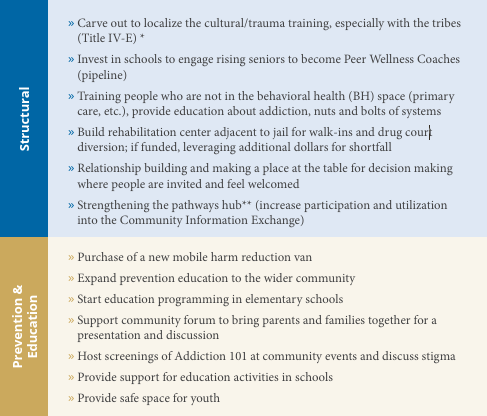
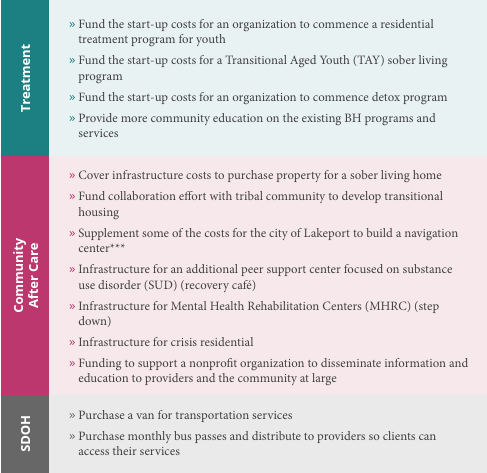
As the final deliverable, HMA developed a dynamic and actionable expenditure plan for the opioid settlement funds. Lake County was adamant that the voice of community members including, persons with lived experience, health service providers, and local partners were elevated to inform the funding priorities. The expenditure plan highlights the engagement process and input received, including the invaluable perspectives of tribal partners, older adults, children and families, and people with lived experience. The culmination of the engagement process resulted in community-wide consensus of 26 prioritized strategies, categorized into f ive themes: structural, prevention & education, treatment, aftercare & community, and social determinants of health (SDOH). The expenditure plan will serve as a manual for the use of opioid settlement funds informed not only by the state’s requirements but also by Lake County community members.
*The Title IV-E Stipend Program is the nation’s largest consortium of schools of social work and public service agencies providing support for the delivery of a specialized public child welfare curriculum and support for students committed to service in public child welfare.
**The Pathways Hub is a hub for community-based service providers to ensure the coordination of care.
***The city of Lakeport is working on creating a navigation center that will provide a variety of resources to the community, largely focusing on the unhoused population and will likely be funded through Lakeport’s opioid settlement dollars. This navigation center is still in the conceptual phase, but the intention is to serve as a hub for providers offering SUD services, housing coordination, operating mobile health clinics, and more.
THE CLIENT
The Lake County Behavioral Health Services Department and the residents of Lake County, California.
BACKGROUND
In 2021, opioid manufacturer Janssen Pharmaceuticals along with three opioid distributors, McKesson, Amerisource Bergen, and Cardinal Health (collectively known as The Distributors) reached settlements for their roles in the opioid epidemic that amount to $26 billion. These settlements will be distributed to states that participated in the joint lawsuits. It is estimated that California will receive approximately $2.05 billion over 18 years to focus on opioid abatement activities within the state. As a participating subdivision, Lake County is set to receive a portion of California’s Abatement Fund and began receiving payments on November 15, 2022. The County will receive approximately $18 million over the course of eighteen years.
HMA was tasked with creating an expenditure plan for the opioid abatement settlement funds distributed to the Lake County Behavioral Health Services Department and the residents of Lake County. HMA facilitated community engagement to gather stakeholder feedback and align community priorities with the High Impact Abatement Activities (HIAA) and goals as defined by the California Department of Healthcare Services.
APPROACH
HMA works with state, county, and local government entities across the U.S. in collaboration with community members, engaged stakeholders, and policymakers to develop funding priorities that are designed to facilitate improvements in the quality of life of those experiencing opioid use disorder (OUD) and to prevent overdose deaths. The HMA team has worked closely with organizations in counties across the U.S. to help develop plans for OUD programs using opioid settlement funds, and does so through partnering with clients and communities, community advisory councils/boards and with local community-based organizations to co-create community engagement strategies, tools, and plans and to engage communities in the decision-making process.
For this project, HMA organized and conducted four, 4-hour, collaborative meetings with a variety of partners in Lake County, as well as analyzed the capacity, available resources, and demographic trends of the OUD population. This comprehensive data collection culminated in a final report which provides an analysis of persistent challenges, proposed actions, and desired outcomes, including identifying current efforts and best practices that are most effective in addressing OUD needs across the continuum of care (prevention, intervention, and treatment).
TESTIMONIAL
“It has been an absolute pleasure working with HMA on the Opioid Settlement Funds project. You guided us deftly through a methodical and intentional process with a clear focus on results. You have a unique ability to both diffuse and validate the tensions that typically arise whenever you bring a community together to make decisions about a big pot of money. I must admit, there was a point during the stakeholder engagement process where I was worried we might not be able to land on shared ground. At the finish line of this project I am excited and energized with a clear plan to move forward.”
Elise Jones, Director, Lake County Behavioral Health Services
RESULTS
As the final deliverable, HMA developed a dynamic and actionable expenditure plan for the opioid settlement funds. Lake County was adamant that the voice of community members including, persons with lived experience, health service providers, and local partners were elevated to inform the funding priorities. The expenditure plan highlights the engagement process and input received, including the invaluable perspectives of tribal partners, older adults, children and families, and people with lived experience. The culmination of the engagement process resulted in community-wide consensus of 26 prioritized strategies, categorized into f ive themes: structural, prevention & education, treatment, aftercare & community, and social determinants of health (SDOH). The expenditure plan will serve as a manual for the use of opioid settlement funds informed not only by the state’s requirements but also by Lake County community members.
*The Title IV-E Stipend Program is the nation’s largest consortium of schools of social work and public service agencies providing support for the delivery of a specialized public child welfare curriculum and support for students committed to service in public child welfare.
**The Pathways Hub is a hub for community-based service providers to ensure the coordination of care.
***The city of Lakeport is working on creating a navigation center that will provide a variety of resources to the community, largely focusing on the unhoused population and will likely be funded through Lakeport’s opioid settlement dollars. This navigation center is still in the conceptual phase, but the intention is to serve as a hub for providers offering SUD services, housing coordination, operating mobile health clinics, and more.