On May 31, the House passed H.R. 3746 – the Fiscal Responsibility Act of 2023, otherwise known as the “debt ceiling” bill, which increased the federal debt limit, established new discretionary spending limits, rescinded unused funds, and expanded work requirements for federal programs. It was passed by the Senate on June 1 and will soon be signed into law. What does all this have to do with healthcare workforce? Well, part of the rescindment plan comes from $28 billion in unused pandemic funding, with a substantial portion of those funds that were allocated for healthcare workforce efforts. This includes funds set to be used for mental health and substance use disorder training, grants to improve mental health and burnout in the healthcare workforce, and additional educational and training grants for promoting future workforce. Overall, part of $28 billion specifically includes removal of $1.7 billion from the Centers for Disease Control and Prevention (CDC) and $13.4 billion from the Department of Health and Human Services (DHHS), including $10.4 billion from public health and social services emergency funds.
So, what does this mean for the healthcare workforce? It means healthcare organizations will need to continue to optimize their current and future workforce plans, without additional funding that could provide some relief.
At Health Management Associates (HMA), our healthcare workforce experts have not only partnered with health system leaders to identify real-world solutions, we have directly experienced the same challenges, because our team includes physicians, nurses, advanced practice providers, and former health system operations and financial executives who share the same lived experiences.
HMA offers a number of workforce solutions to healthcare communities across the spectrum. We cannot fill all your staffing gaps tomorrow; however, we can give you an innovative, model-of-care plan designed to lower costs, increase revenue, and position organizations for long-term financial success and operational sustainability.
An experienced team of health system leaders, bedside clinicians, and workforce subject matter experts with real-world experience and modern health care delivery solutions
A thorough quantitative and qualitative assessment including:
Workforce capacity, needs, and gap analysis.
Leadership and governance structure evaluation.
Key regulatory and policy gap analysis.
Compensation and benefits review.
Clinical and/or non-clinical workflow evaluation.
Provider billing practices and quality metric capture.
Provider and staff utilization analysis.
What organizations receive is:
A customized, comprehensive phased implementation plan that:
Improves cash flow and maximizes revenue.
Reduces turnover, increases retention, and improves health system culture.
Optimizes the ‘Model of Care’ delivery while still maintaining quality and safety.
Provides solutions for long-term financial success and operational sustainability.
Offers on-going executive and leader coaching services to help provide support through the change management process.
Today’s healthcare workforce challenges are unwavering, especially given the recent passage of the “debt ceiling” bill. From significant workforce shortages, to rising costs and competition, to decreasing employee engagement and burnout, today’s health systems face tremendous challenges. But by understanding workforce and health system needs and identifying gaps and inefficiencies, employers can fully utilize the employees they have to their highest potential and deliver care more effectively and efficiently. Here at HMA, our delivery system optimization team can help health care communities struggling with workforce challenges do just that.
Contact our healthcare delivery system experts, who can partner with your organization to design a custom workforce solution for you.
This is part of an ongoing series highlighting efforts in Human Services and Family Wellbeing.
During the month of May, National Foster Care Month provides an opportunity to raise awareness on issues related to foster care and to celebrate those who are dedicated to serving our children, youth, and families. Yet it is important to note that unfortunately issues surrounding children and youth experiencing foster care are not limited to one month a year. As noted in our recent child well-being blog, Child welfare services face challenges every day to prevent, treat, and reduce risk of maltreatment, neglect, trauma, housing instability, and violence in communities. All these issues contribute to the significant number of children and youth who enter or remain in the foster care system. These issues are year-round and decades in the making. They need to be seen as a priority for public health and community wellbeing and not just the jurisdiction and responsibility of child welfare agencies.
To positively impact the number of children and youth experiencing foster care, there are some strategies that can be implemented now to promote change:
We must meaningfully elevate the voices of those with lived experience to help us design systems that meet their needs. For foster care, working to hear and understand the voices of youth based on how they have experienced foster care will help create opportunities to improve the system from those most impacted. Further, the meaningful elevation of these voices helps to ensure their input is not contributing towards tokenism and re-traumatization.
Multi-system involvement is important. We can work together to enhance access, increase prevention-oriented services, improve community health, and well-being, and achieve better outcomes using an equity lens, but proposed system reforms cannot be successful without shared ownership within the community and across government agencies. This requires building a responsive and integrated system of care approach to allow communities to seek solutions with the necessary support of the highest leadership within their organizations.
Continue to find ways to assure that mandated reporters and staff who work within child welfare understand that poverty is not neglect, and poverty alone should not be a reason children and youth are removed from their home(s).
System redesign is needed. From front end reporting and assessment, to working with court systems, to building up networks of caring service providers, each component of the current child welfare system and human services partners can strive to find areas needing improvement and collectively change the experiences for children and youth engaged in the child welfare system.
Focus on mental health. This year’s theme from the Children’s Bureau for national foster care month is “Strengthening Minds, Uplifting Families” and is dedicated to supporting children and youth mental and behavioral health as the largest unmet need related to foster care. According to the Children’s Bureau, Up to 80 percent of children experiencing foster care have significant mental health issues, compared with approximately 18 to 22 percent of the general population.[1]
HMA can help public sector and community partners align themselves to improve and develop new delivery systems that will work to address inequalities and disparities as communities strive to meet the needs of children, youth and families impacted by issues like mental health and substance use disorder, domestic violence, child abuse and neglect, food insecurity, housing instability, incarceration and other traumas that impact them greatly.
HMA can help support foster care prevention or reunification program efforts in the following ways:
Creating additional human service system integration of prevention services to help support families and youth experiencing child welfare interventions or foster care.
Increasing Medicaid providers who offer more Evidenced Based and Informed Practices (EBP) among Community Based Organizations (CBO), Providers, and Local Government.
Supporting Managed Care Organizations to develop programs specifically designed to support the wellbeing of children and youth in the foster care system and their families.
Connecting the Family First Prevention Services Act (FFPSA) & Medicaid funding together to ensure that funding supports the need and enhance service implementation.
Working to implement School Based Mental Health programs in communities. We can help convene stakeholders, create process flows, and support the development of sustainable funding for such programs.
Increasing the meaningful use of youth voice for true collaboration in system redesign.
Enhancing judicial engagement with the child welfare system in a way that supports meaningful youth and family voice and representation in court while maintaining the child welfare system’s responsibilities around assuring child safety. Making the court process less traumatic for children and youth and more part of a solution for them will support better outcomes.
Recognizing longstanding racial inequities in foster care experiences that can and should be addressed holistically in communities and supporting efforts to understand the root causes for the disparities in foster care placement.
Healthcare executives gathered with HMA leaders in March to learn and share about new initiatives in quality improvement. Panels and discussions were led by esteemed experts, who provided important insight into the multitude of opportunities to improve quality and equity:
From the Experts: CMS has doubled down on its commitment to improve healthcare quality, equity, and access.
The HMA Point of View: Current leadership in Washington has set very clear goals to improve health equity, aligning federal policy as a lever to improve healthcare outcomes. Federal dollars passed along to states are including new rules and objectives to improve quality in an equitable manner. Therefore, those applying for federal contracts and grants must include a strategy to improve quality, equity, affordability, and access.
From the Experts: Interventions need to be robustly evaluated to address equity and social determinants of health (SDOH).
The HMA Point of View: Governments, care providers, and payers have been experimenting with approaches to SDOH, but the bar is now higher and results have to be measurable. New investments that address SDOH and aim to improve equity must include a strategy to measure and analyze results of interventions, including evaluation of critical subpopulations to address disparities. Although experiments will continue, we have reached the point where a robust analysis of outcomes is an expectation.
From the Experts: Quality is playing a central role in operationalizing equity.
The HMA Point of View: While there are many reasons for disparities in health, quality metrics and programs must be designed to improve quality for all patients. Identifying inequities is only the first step; successful programs will advance equity by reducing barriers to care. Measurable quality programs should be designed for population health, but personalized for individuals with clear provider incentives to not only identify disparities but also minimize them. Quality is the tool by which we achieve health equity.
From the Experts: We are on the precipice of doing great things in quality.
The HMA Point of View: Our ability to integrate data from multiple sources is finally getting to a place where patients can get the quality care they need, and providers can give the right care at the right time to improve outcomes. Policymakers have broken down barriers to data sharing, enabling a new economy of information sharing that promises to empower patients and reduce costs. It is no longer enough to have a separate IT or data strategy; anyone working to improve healthcare quality needs to have data strategies within and across every operational function across their organization.
From the Experts: Being rewarded for doing what’s right for the patient is central to continuous quality improvement.
The HMA Point of View: Quality care for the patient means creating the right incentives for payment and care delivery that focus on outcomes and experience. Every point of care in the patient’s health journey needs to be evaluated and designed from the point of view of providing a quality experience. Not every patient has the same journey, and our healthcare system must meet them where they are, delivering for their unique needs. Convenience, personalization, accuracy, simplification, and affordability are nearly as important as clinical outcomes in the mind of most patients and addressing barriers to health can have clinical benefits.
HMA has a long history of working with clients to achieve their quality improvement goals including securing accreditation for both payer and provider organizations, driving clinical practice transformation, and improving the overall value of care. We strongly believe that there is no quality without equity, access, and measurement, and are investing in people and resources to support these needs. Together we are working with clients to advance value-based care, develop programs demonstrating quality, value, and equity in behavioral health, and implement new quality and accreditation programs to better serve their communities.
Learn more about HMA’s continuing work in quality and accreditation and join the conversation on LinkedIn and Twitter using #HMAtalksQuality.
Policy crossroads and the end of the public health emergency due to COVID-19
This is part of a three-part series on significant implications of the end of the Public Health Emergency (PHE).
The end of the Public Health Emergency on May 11, 2023 is likely to mark a transitional point in the rapidly evolving arena of virtual care services and not a dramatic end of coverage. Coverage of virtual care services will continue to evolve significantly over the next five years given the exponential growth in the public’s awareness of, and comfort with, these services — all hastened by the COVID-19 Federal Public Health Emergency.
The U.S. Congress and the Centers for Medicare and Medicaid Services (CMS) used its authority during the PHE to significantly expand Medicare coverage for virtual care services, covering telehealth visits in urban areas and from patient’s homes. In addition, Medicare began covering a wide range of clinical services virtually such as behavioral health and physical therapy; it also expanded coverage for different service delivery modalities to include audio-only visits. As a result of the changes, Medicare became a leading payer for virtual care nationally between 2020 and 2022. Over this same period, private insurers and state Medicaid programs largely followed Medicare’s lead by expanding their own virtual care coverage.
One of the consequences of the PHE is that most payers have embraced Medicare’s basic definitional structure for types of virtual care services. As a part of this typology, virtual care services are divided into two general buckets of services: telehealth visits (physician office visits conducted via audio and video technology), which are typically prohibited by statute in urban areas or a patient’s home; and Communication Technology-Based Services (CTBS) which can be conducted anywhere. CTBSs include: remote patient monitoring (RPM); virtual check-ins (brief patient-to-clinician exchanges); e-visits (online portal or email visits); and e-consults (clinician to clinician interaction).
With the end of the PHE on May 11, Medicare coverage of virtual care services and coverage offered by other payers will change. The details and scope of this change have many stakeholders concerned and confused. HMA has a keen sense for which virtual care services may get a new lease on life in the coming months and which are likely to be hotly debated in the years ahead. The one certainty is that the last 3 years have altered the landscape for virtual care services for years to come.
Shift in Virtual Care Landscape
As a result of the statutory geographic limitations and restrictions placed on traditional fee-for-service (FFS) Medicare coverage, use of telehealth services was minimal most of the last decade, with only one-quarter of 1 percent (0.25%) of beneficiaries in FFS Medicare using virtual care services.[1] Even among Medicare Advantage plans and Medicare Accountable Care Organizations (ACOs), neither of which which face the same restrictions, virtual care was utilized very rarely before 2019.
This sluggish use of telehealth was radically altered when HHS used its PHE authority to relax constraints on the use of use virtual care services by Medicare beneficiaries and providers.[2],[3] Among the most consequential changes made by policymakers at the outset of the PHE were:
Enabling telehealth services to be provided anywhere (e.g., urban areas and patients’ homes);
Allowing Federally Qualified Health Centers (FQHC) and Rural Health Clinics (RHC) to conduct virtual care services;
Granting various types of clinicians permission to deliver virtual care services;
Enabling new patients to receive virtual care services;
Authorizing audio-only services;
Permitting telehealth services for more than 200 different types of clinical services (e.g., mental health, emergency department, physical and occupational therapy, critical care, inpatient care);
Relaxing HIPPA rules to enable the broad use of smartphones for virtual care.
Due to these policy changes, rates of virtual care skyrocketed during the PHE (Figure 1). In April of 2020 the number of Medicare claims for any type of virtual care service exceeded 9 million, while 2019 the number of these services provided monthly never exceeded 100,000 (Figure 1). On an annual basis, from 2019 to 2021 the number of virtual care visits jumped from roughly 1 million to 39 million and the number of unique beneficiaries receiving these services increased from 300,000 to nearly 12 million.
Figure 1: Number of Virtual Care Service Visits, Number of Unique Medicare Fee-For-Service Beneficiaries, and Number of visits per Utilizer by Month, December 2019 to December 2021.
Source: HMA analysis of CMS’s 100 percent Medicare Fee-For-Service Claims data for 2019, 2020, and 2021.
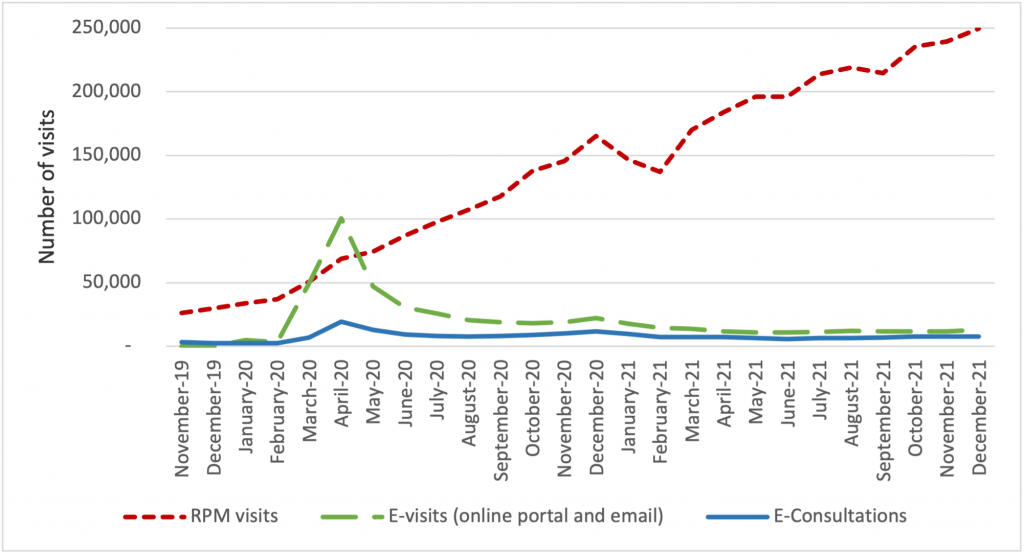
The growth of virtual care services has largely been driven by an increase in telehealth visits, but we observe important trends in the use of CTBSs, as well. In late 2021, more than 90 percent of visits were associated with telehealth, while 10 percent were associated with CTBSs. Early in the PHE, all of these service types experienced an initial, abrupt increase in use (Figure 2). By contrast, the growth in the use of remote patient monitoring (RPM) has been continuous since 2020. The growth in use of RPM reflects the general movement of services into patients’ homes and has been accelerated by specialist such as cardiologists and endocrinologists beginning to leverage the power of RPM. We expect greater diffusion and use of RPM and other CTBSs in the next five years.
Figure 2: Number of Virtual Care Service Visits for Remote Patient Monitoring, Virtual Check-ins, E-visits, and E-Consultations by Month, December 2019 to December 2021.
Source: HMA analysis of CMS’s 100 percent Medicare Fee-For-Service Claims data for 2019, 2020, and 2021.
Policies temporarily in place until the end of 2024
During the PHE, Congress made critical long-term changes to Medicare’s coverage of virtual care services that continued to spur the use of these services and offer access to care for beneficiaries. In 2021, Congress changed the law to permanently allow Medicare beneficiaries to receive behavioral/mental telehealth services regardless of location (urban or rural) and for this care to be available to patients in their own homes.
In 2022, Congress severed the link between the PHE declaration and Medicare coverage policies for virtual care services, extending those benefits through the end of calendar year 2024. We expect that coverage for all telehealth services will receive considerable attention from federal policymakers and stakeholders towards the end of 2024.
Immediate impact of expiring policies
Certain aspects of Medicare’s virtual care policies will, however, terminate May 11, 2023, when the PHE declaration comes to an end. Several of the expiring policies have a broader impact beyond the Medicare program, affecting patients insured by private payers and State Medicaid programs.
Specifically, when the PHE ends, policymakers will need to address the following anticipated changes:
The Office for Civil Rights (OCR) will return to imposing penalties on providers who violate the provisions of the Health Insurance Portability and Accountability Act (HIPAA) by using public-facing remote communication technologies which are not HIPAA-compliant. This may prohibit the use of some of the most common smartphone-based video conferencing tools for health care visits.
Medicare beneficiaries without an existing relationship with a clinician will be unable to receive CTBSs such as RPM, virtual check-ins, and e-visits.
Providers will no longer be allowed to provide virtual care services across state lines, because most state medical licensure boards will return to pre-PHE policy.
Federal rules from the Drug Enforcement Agency (DEA) may revert to the pre-PHE requirement that clinicians establish a patient-provider relationship in-person before being permitted to prescribe controlled substances for substance use disorder treatment.
Potential policy changes occurring before 2025 As explained earlier, Medicare coverage for many virtual care services will remain in place for the next 19 months. Before the end of 2024, Congress will need to address several policy questions, and among the most widely debated are whether to:
Restore Medicare’s statutory prohibition on telehealth services being delivered in urban areas or in home settings;
Allow Federally Qualified Health Centers and Rural Health Clinics to provide telehealth services to Medicare beneficiaries; or
Continue to cover audio-only telehealth visits under Medicare.
Lawmakers will look to payers, patients, and providers for feedback before making these policy decisions. Among the most critical pieces of information they will also consider will be the results of the study Congress has required of HHS regarding trends in the use of virtual care. This study’s final report is due in 2026, which has led some to speculate that Congress will delay action on virtual care coverage policy until then. In the meanwhile, we expect HHS will be assessing the overall volume of virtual care use, who is using which types of services, and the levels of related fraud and abuse.
Looking Ahead
In the United States, our experience during the acute phase of the pandemic demonstrated that patients and providers are more receptive than previously thought to utilizing digital technologies for the delivery of care. This experience may also influence policymakers’ decisions about reimbursement and coverage of wearable devices, as well as other cutting-edge tools that rely on artificial intelligence or machine learning.
HMA believes payers and providers alike can take steps now to strategically prepare for the still evolving and growing landscape of digital health care.
Based on the various changes that have occurred in the virtual care environment over the last 3 years, we are intently watching several areas of potential change in the practice of medicine and the ways payers set coverage policy. Below are some of the trends we anticipate in the years ahead:
Continued use of virtual care services at levels observed in 2021.
An expansion of CMS’s programs to protect against fraud and abuse related to virtual care.
Notable growth in the use of RPM, and related services for physical and occupational therapy services.
The proliferation of innovative home-based screening and testing technologies. We anticipate payers will encourage the use of these at-home tests for things like kidney function, liver function, and colorectal cancer screening in order to limit care delivery in higher cost settings.
Growth in “virtual-first” insurance plans, where patients are encouraged to use virtual care first – prior to being seen in person. As these plan options expand, we anticipate virtual care use will rise, and reimbursement rates will begin to change.
Virtual care services are primed for additional growth and HMA is working with a wide variety of payers, providers, and foundations to develop strategies for adapting to state and federal rules and regulations related to virtual care. Changes in this landscape will hinge on research CMS will complete by the end of 2026, and coverage decisions made by states and commercial payers. HMA is well positioned to assist stakeholders with work in this area and can leverage access to Medicare and Medicaid claims data to conduct health services research to illustrate geographic variations in the use of virtual care.
If you have questions on how HMA can support your agency before or after the end of the PHE, please contact our experts below.
[2] Centers for Medicare & Medicaid Services. Medicare telemedicine health care provider fact sheet. March 17, 2020. https://www.cms.gov/newsroom/fact-sheets/medicare-telemedicine-health-care-provider-fact-sheet
[3] HHS Administration for Strategic Preparedness & Response (ASPR). https://aspr.hhs.gov/legal/PHE/Pages/default.aspx
The integration of behavioral health and medical care has emerged as a crucial method for improving health and reducing the cost of care. Integrated care offers solutions and advancements in healthcare delivery by improving access to behavioral healthcare, including scarce psychiatric resources, reducing stigma, and enhancing behavior change in everyday life.
As an emerging standard of care, policy makers, payers, and leaders are expecting organizations to develop evidence based approaches to team based care that can demonstrate health outcomes and cost savings. HMA can help your organization navigate this important culture change. Our multidisciplinary team includes clinical, finance and payment, and policy experts with hands-on experience in integrated care service delivery.
Our integration experts can help your team with:
Readiness assessment
Evidence based policy, finance, and model design
Technical assistance, training, team based care
Operational changes including billing, HIE, credentialing
Measurement based care metrics and evaluation
Cultural change and leadership
We are working with an array of clients on integration
Health plan integration
State departments & statewide implementation
Integrated delivery systems
Hospital based providers
PCMH & FQHC primary care providers
Accountable care organizations
Certified community behavioral health clinics and other BH providers
Department of corrections
For more information, contact our featured experts below.
The healthcare industry is constantly evolving and requires a workforce that is responsive and able to lead and adapt to changes. Healthcare professionals are continually asked to incorporate new services, care models, quality measures, and process improvements into daily work.
While clinical innovations and operational improvements are promising, there is growing recognition of the gap between plans to implement them and actual implementation.
HMA has extensive leadership, operational, and clinical expertise working directly with health systems, health plans, providers, foundations, community-based organizations, and associations adopt implementation science informed approaches for successful change.
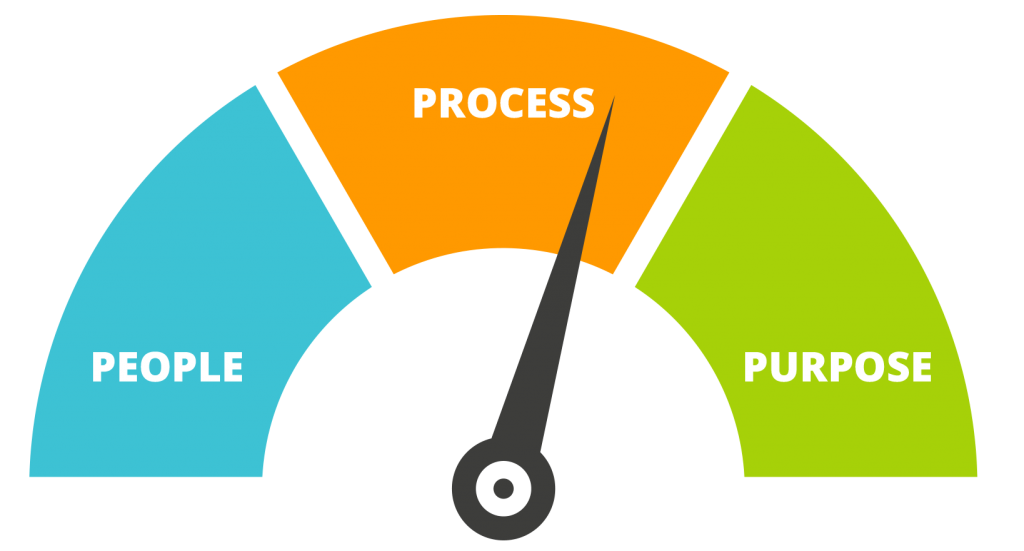
Drawing on this experience, we developed the HMA Implementation Accelerator, a leadership development framework that utilizes implementation science to address on-the-ground challenges and lead successful implementation efforts.
“The importance of leadership is noted in just about every discussion of implementation. The absence of leadership support is a well-documented barrier, and success is attributed to the presence of leadership support.”
– Active Implementation Research Network
HMA Implementation Accelerator
PEOPLE
Leadership development
Build knowledge, skills, and abilities and apply them to implementation
Change agent engagement and development
Identify formal and informal leaders to inform, support and influence engagement
Implementation approach training
Build knowledge and skills critical to successful implementation
PROCESS
Project management
Develop or enhance structures and approach to guide implementation
Continuous improvement and critical feedback
Integrate structures and practices that facilitate continuous improvement, sustain momentum, and highlight critical adaptation
Communication planning
Plan and deploy intentional, pro-active communication strategies to effectively guide and support implementation
Tool development
Identify, develop, and deploy tools that support effective implementation and create efficiencies for implementation teams
Sustainability planning
Pro-actively plan for sustainability from outset
PURPOSE
Executive sponsorship
Engage and activate sponsorships for critical support and resources
Align implementation with mission
Connect implementation efforts to a larger “why” in alignment with mission
What’s included
Conceptual framework to guide implementation process
Strategies to develop effective sponsorship at the executive or senior leadership level to mitigate barriers and resource effort
Leadership skill development at the level of implementation
Processes to enhance effective ownership and commitment at all levels
Prioritization of change initiatives
Clear accountability of actions in implementation
Continuous quality improvement as part of implementation
Sustainability planning from the start
Research shows that successful leadership development occurs when the learning can be directly applied to active work processes, which aligns with how adults learn most effectively.
Through the Implementation Accelerator, we use a combination of interactive training, peer learning, and coaching to support hands-on learning. The integration of leadership development and implementation science provides a robust opportunity to develop and sustain leadership skills and develop an organizational methodology to guide both current and future implementation efforts.
For more information, contact our featured experts below.
HMA’s team of over 50 behavioral health experts have direct experience in behavioral health policy, clinical program design and delivery, quality improvement and financing. Our breadth of expertise, including authors of NCQA’s Behavioral Health Quality Framework to Promote Joint Accountability, positions us well to support the design, delivery and payment of high quality behavioral health care.
We help clients demonstrate the value of their behavioral health care through:
Accreditation Readiness
Meet accreditation standards and demonstrate compliance
Analyze and use behavioral health-specific HEDIS, CAHPS/ECHO, HOS, ASAM/CARF to inform QI
Use key data sources to drive performance improvement plans
Use of Behavioral Health Quality Tools
Behavioral health network adequacy and equitable access
Integration of behavioral health, physical health and social needs
Measurement-based care
Patient outcomes
Cohesive Strategy Development
Behavioral health quality strategy planning aligned with organizational mission and vision
Standardized performance metrics
Value-based care and payment incentives
Pragmatic regulatory tools and policies
HMA is positioned to support
State and municipal departments of health and public health
Health plans & Managed Care Organizations
Health systems
Provider organizations
Community-based organizations
Certified community behavioral health clinics
Correctional health
Accreditation Readiness
Meet accreditation standards and demonstrate compliance
Analyze and use behavioral health-specific HEDIS, CAHPS/ECHO, HOS, ASAM/CARF to inform QI
Use key data sources to drive performance improvement plans
Use of Behavioral Health Quality Tools
Behavioral health network adequacy and equitable access
Integration of behavioral health, physical health and social needs
Measurement-based care
Patient outcomes
Cohesive Behavioral Health Quality Strategy Development
Behavioral health quality strategy planning aligned with organizational mission and vision
Standardized performance metrics
Value-based care and payment incentives
Pragmatic regulatory tools and policies
HMA is positioned to support
State and municipal departments of health and public health
Health plans & Managed Care Organizations
Health systems
Provider organizations
Community-based organizations
Certified community behavioral health clinics
Correctional health
For more information, contact our featured experts below.
The current youth behavioral health system is under-resourced, underfunded and often not well coordinated. Historic approaches that minimally adapt adult models to children and youth have led to insufficient child and youth specific strategic design of effective systems. Recent investments and policies offer a tremendous opportunity to redesign strategies, payment, and the delivery system to enhance access and achieve better outcomes, equity, and satisfaction of children and families. Health Management Associates (HMA) understand the levers and impacts across the system from state and local policy makers to payers, providers, schools, and communities. Our multidisciplinary teams will partner with you to identify challenges and solutions to advance and sustain the system of care.
What Makes HMA Unique?
HMA’s cross sectoral, multidisciplinary team is comprised of more than 20 dedicated children and youth behavioral health experts with rich backgrounds in government, community-based providers and payers. Our approach includes a deep understanding of policy, clinical, operations and fiscal systems, providing our clients with fundamental tools to design and implement sustainable solutions.
Our expertise spans multiple specialty areas impacted by children’s behavioral health:
Juvenile justice and justice-involved
Child welfare and foster care
Children’s behavioral health – primary care and social services, children with serious behavioral health issues (SMI, including co-occurring issues)
Youth crisis and mobile services, crisis stabilization unit design (CSU) services
School-based wellness centers, community schools
Certified community behavioral health clinics (CCBHCs)
Suicide prevention
State policy and system redesign, evidence-based practices and strategic planning including the intersection of Medicaid and child welfare
Telehealth for children and adolescents
Tech-enabled care
Mental health first aid
Our team is advancing the design, integration, and quality of children’s behavioral health across states and the continuum of care.
Examples of our work include:
Policy and system design for behavioral health services, foster care, and the intersection of Medicaid and child welfare
Maternal and child health programing and 2Gen approaches
Managed Care Organizations (MCO) reviews, strategy ad program design
Health system emergency department boarding and health system and community intervention design
Mobile Crisis Response (MCR) design and implementation
Implementation of school-based wellness centers and building connections to the health system
Services across the healthcare spectrum.
With a deep understanding of current and emerging shifts in care and policy, our behavioral health consultants are well equipped to provide specialized services for a range of clients.
Mental health and substance use treatment organizations struggle to meet the increase in demand for services, due in large part to a national workforce shortage. This challenge has been exacerbated due to the Covid-19 pandemic. Demand for behavioral health organizations’ services has continued to increase. At the same time, organizations are having trouble recruiting and retaining employees, and patient waitlists continue to grow. Competition for behavioral health workforce has only grown with new opportunities in telehealth and the entrance of private equity into the behavioral health market. The safety net providers are the most impacted and often have the least flexibility to address underlying factors leading to the shortages in large part due to regulation and administrative burden and underfunded payment models.
HMA, in partnership with the National Council for Mental Wellbeing (NatCon), developed a series of issue briefs outlining state policy and provider steps that can help to address the critical shortage.
HMA is also working with NatCon and the College for Behavioral Health Leadership (CBHL) to engage national partners using a collective impact framework to provide backbone support for organizations to work together in a more structured and action-oriented approach and to leverage various implementers (policy, regulatory, payers, providers, educators, etc.) to move recommendations to action.
Behavioral Health Workforce is a National Crisis: Immediate Policy Actions for States
HMA can help state policy makers and provider organizations with workforce support and problem solving, workforce assessment, strategy and policy design.
Our team of experts includes clinicians with on-the-ground experience as well as previous policy makers. We’ve worked within the certified community behavioral health clinic (CCBHC) model and provide technical assistance to organizations planning for its adoption. We have experience in extending it beyond the demonstration utilizing Medicaid state plan amendments (SPA) or 1115 waivers to enhance the workforce.
HMA capabilities
Identifying effective workforce strategies including training and maximizing of multi-disciplinary teams (e.g., peers, behavioral health providers, nurses, licensed health care providers).
Policy and system design for behavioral health services and workforce expansion
Managed Care Organizations (MCO) strategy and program design as well as strategies to enhance the provider network
Conducting certified community behavioral health clinic (CCBHC) readiness and implementation support.
Maximizing virtual and technology interventions.
Convening stakeholders and building partnerships across sectors.
HMA is positioned to support
State Medicaid agencies
State and local departments of health, public health, behavioral health, and child welfare
Health plans & Managed Care Organizations
Hospitals & health systems
Provider organizations
Community-based organizations
Foundations & advocacy organizations
Certified community behavioral health clinics
School-based behavioral health
Correctional health & juvenile justice systems
For more information, contact our featured experts below.
With the planning and implementation of 988 and mobile crisis teams, as well as co-responder models, state policy makers are working rapidly to advance effective approaches to systemically and effectively address the needs of individuals and families who are experiencing behavioral health crises.
Central to effective implementation is attention to specific community needs. States are working to partner with local communities to build capacity, leverage the knowledge and expertise of local partners, and gain an understanding of how new benefits and system changes fit into existing community frameworks. This local approach is particularly important for rural and frontier communities, and for tailoring models to meet specific priority populations’ needs, while building trust and ensuring crisis services are grounded in equitable access and culturally responsive care.
With more than 25 years of crisis system development, HMA colleagues stand ready to support crisis system community partners in advancing their crisis systems and services.
With our finger on the pulse of the science-backed research and approaches necessary to create integrated and comprehensive systems, we can help identify barriers and explore and implement solutions.
Our HMA crisis system team supports community partners with:
Partnership development
Stakeholder engagement
Crisis system needs assessment – strengths and gaps analysis
Program design and implementation
Crisis service development
Cross-system protocols
Cost modeling and sustainable reimbursement approaches
Distilling and meeting regulations
For more information, contact our featured expert below.