State of Rhode Island: Advancing Health System Resilience Through Capacity Assessment
THE CLIENT
The Rhode Island Attorney General’s Office (the Office) engaged Health Management Associates (HMA) to assess the current capacity of the state’s healthcare delivery system and identify policy considerations to ensure access, quality, and sustainability across hospital, long-term care, and primary care settings.
BACKGROUND
Amid growing public concern about emergency department crowding, long-term care access, and delays in primary care, the Office commissioned a statewide assessment to understand systemwide strain and inform proactive policymaking. The goal was to quantify key pressure points across care sectors and identify interrelated trends that affect patient access and outcomes.
APPROACH
HMA conducted a cross-sector analysis of Rhode Island’s healthcare system to identify systemic challenges and capacity constraints, using both quantitative and qualitative methods to surface actionable insights. The team: + Examined emergency department utilization trends and care delays + Analyzed hospital occupancy and discharge flow challenges tied to long-term care availability + Evaluated long-term care ownership models and capacity shortfalls + Reviewed primary care availability, access, and workforce trends + Synthesized findings into a concise, policy-focused report with clear implications for state leaders and health system partners
Key considerations included:
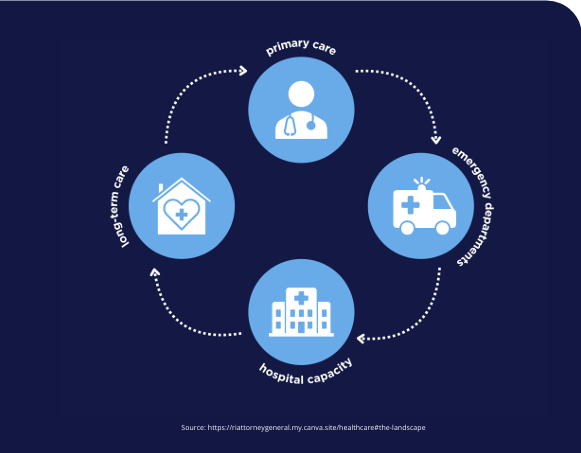
Interdependencies between hospital, long-term care, and primary care sectors
The role of workforce shortages in limiting access and care coordination
Discrepancies between the number of available providers and lived patient experiences
Opportunities to strengthen data collection and analytic infrastructure
TESTIMONIAL
“HMA’s systemwide capacity assessment helped us identify where gaps existed and provided a roadmap for actionable policy solutions. It’s already shaping the way we think about coordinated care delivery and long-term resilience planning.”
Julia Harvey, Special Assistant Attorney General, Health Care Advocate, The State of Rhode Island | Office of the Attorney General
RESULTS
HMA’s assessment provided a timely and impactful snapshot of Rhode Island’s health care delivery system, highlighting key findings that underscored the urgency of statewide coordination and investment:
Emergency Departments: Overburdened due to delayed discharges and lack of post-acute capacity, limiting timely care
Long-Term Care: Insufficient beds and staffing, with for-profit ownership dominating the sector, reducing flexibility during public health crises
Primary Care: Workforce data overstated capacity; access barriers remained high despite apparent provider density
The report emphasized that these challenges are interconnected and that piecemeal solutions may exacerbate strain elsewhere in the system. The Office is now using the assessment to prioritize policy interventions, guide workforce investments, and design an integrated approach to capacity monitoring.
HMA’s work laid the foundation for a strategic shift toward whole-system resilience, data-driven resource planning, and a more patient-centered delivery model in Rhode Island.
THE CLIENT
The Rhode Island Attorney General’s Office (the Office) engaged Health Management Associates (HMA) to assess the current capacity of the state’s healthcare delivery system and identify policy considerations to ensure access, quality, and sustainability across hospital, long-term care, and primary care settings.
BACKGROUND
Amid growing public concern about emergency department crowding, long-term care access, and delays in primary care, the Office commissioned a statewide assessment to understand systemwide strain and inform proactive policymaking. The goal was to quantify key pressure points across care sectors and identify interrelated trends that affect patient access and outcomes.
APPROACH
HMA conducted a cross-sector analysis of Rhode Island’s healthcare system to identify systemic challenges and capacity constraints, using both quantitative and qualitative methods to surface actionable insights. The team: + Examined emergency department utilization trends and care delays + Analyzed hospital occupancy and discharge flow challenges tied to long-term care availability + Evaluated long-term care ownership models and capacity shortfalls + Reviewed primary care availability, access, and workforce trends + Synthesized findings into a concise, policy-focused report with clear implications for state leaders and health system partners
Key considerations included:
Interdependencies between hospital, long-term care, and primary care sectors
The role of workforce shortages in limiting access and care coordination
Discrepancies between the number of available providers and lived patient experiences
Opportunities to strengthen data collection and analytic infrastructure
TESTIMONIAL
“HMA’s systemwide capacity assessment helped us identify where gaps existed and provided a roadmap for actionable policy solutions. It’s already shaping the way we think about coordinated care delivery and long-term resilience planning.”
Julia Harvey, Special Assistant Attorney General, Health Care Advocate, The State of Rhode Island | Office of the Attorney General
RESULTS
HMA’s assessment provided a timely and impactful snapshot of Rhode Island’s health care delivery system, highlighting key findings that underscored the urgency of statewide coordination and investment:
Emergency Departments: Overburdened due to delayed discharges and lack of post-acute capacity, limiting timely care
Long-Term Care: Insufficient beds and staffing, with for-profit ownership dominating the sector, reducing flexibility during public health crises
Primary Care: Workforce data overstated capacity; access barriers remained high despite apparent provider density
The report emphasized that these challenges are interconnected and that piecemeal solutions may exacerbate strain elsewhere in the system. The Office is now using the assessment to prioritize policy interventions, guide workforce investments, and design an integrated approach to capacity monitoring.
HMA’s work laid the foundation for a strategic shift toward whole-system resilience, data-driven resource planning, and a more patient-centered delivery model in Rhode Island.