
October 29, 2025

This week's roundup:
- In Focus: Preparing for Change: Strategies for States and Issuers Amid 2026 Marketplace Shifts

- Massachusetts Releases Roadmap for 2028–2032 MassHealth 1115 Demonstration Extension
- Michigan Updates Requirements for Healthy Kids Dental Rebid
- New York Court Upholds $11 Billion CDPAP Home Care Contract
- Oregon Approves PacificSource Medicaid Transition Plan
- Wisconsin Releases Medicaid Managed LTC RFP for GSR 3
- CMS Appoints Dan Brillman to Oversee Medicaid, CHIP
- FDA Unveils Plan to Cut Costs, Accelerate Biosimilar Development

In Focus
Preparing for Change: Strategies for States and Issuers Amid 2026 Marketplace Shifts
The upcoming 2026 open enrollment period for the Affordable Care Act (ACA) marketplaces is likely to be one of the most complex since the program’s implementation. Recent federal policy changes, ongoing litigation, and uncertainty around the extension of enhanced premium tax credits (ePTCs) are converging to create significant challenges for federal and state regulators, policymakers, and issuers. Rising premiums, expiring subsidies, and shifting federal regulations also have created an environment of significant uncertainty for consumers, navigators, and brokers.
A new report, Complexity for the 2026 Marketplace Open Enrollment: Risks of Consumer Confusion & Coverage Loss, authored by Health Management Associates (HMA) and Wakely, an HMA Company, with support from the Robert Wood Johnson Foundation, explains these changes and their collective effect on costs and consumer experiences.
In this article, HMA and Wakely experts preview the options policymakers, states, regulators, issuers, consumer advocates, enrollment assisters, and other stakeholders can implement to mitigate potential confusion and coverage losses.
Federal Policy Shifts Driving Complexity
Central to the current challenges is the scheduled expiration of ePTCs at the end of 2025. Without congressional action, the “subsidy cliff” returns, eliminating subsidies for consumers with incomes above 400 percent of the federal poverty level and reducing assistance for those living below. Early filings suggest average premium increases of 20 percent, which could be untenable for millions of families and small business owners enrolling in individual market coverage.
Additional federal changes compound the challenge:
- The 2025 Budget Reconciliation Act (OBBBA) removes advance premium tax credit (APTC) eligibility for certain lawfully present immigrant populations and eliminates Internal Revenue Service repayment caps on excess APTCs, including financial risk for consumers.
- The Marketplace Program Integrity and Affordability (MIA) Rule changed eligibility and enrollment requirements. Some provisions are paused due to ongoing litigation (City of Columbus v. Kennedy and State of California v. Kennedy), creating implementation uncertainty.
- CMS updated issuer renewal and discontinuation notice guidance, allowing issuers to omit premium and APTC information from their 2026 renewal notices, reducing clarity for consumers comparing plans.
- Changes to catastrophic plan policy broadens eligibility but may create confusion when comparing options.
These changes are occurring alongside notable issuer exits, affecting millions of enrollees. States and issuers must be prepared to manage plan mapping and consumer transitions, potentially involving different networks and benefits.
Emergent Conditions for Open Enrollment Season
The combined impact of these changes is likely to increase marketplace call center traffic, broker and navigator assistance requests, eligibility appeals, and special enrollment activity, all of which will strain system capacity. Vulnerable populations, including those with limited English proficiency and those living in non-expansion states, face heightened risks of disenrollment. Operational strain is expected across marketplaces, issuers, and enrollment assistance networks.
Enrollment losses and affordability challenges also will be more significant in states that have not expanded Medicaid, particularly for lower income and older enrollees. The ACA Marketplaces experienced an influx of new enrollees as a result of ePTC, leading to historical enrollment growth in these states. On average, non-expansion states have seen their ACA Marketplaces grow by 152 percent from 2020 to 2024 versus 47 percent average growth in expansion states.
Regulators and issuers also must navigate the legal uncertainty surrounding the 2025 Marketplace Integrity and Affordability Rule and OBBBA provisions. With litigation ongoing, some rules may change mid-enrollment, requiring flexible implementation and communication strategies.
Strategies to Navigate the Current Complexity
To address these challenges, stakeholders can take several steps, including:
- Clear, Consistent Messaging. Consumers will need clear communications advising them to review and update their plan selections. Communications should be direct, succinct, culturally appropriate, multilingual, and delivered repeatedly and through multiple channels.
- Strengthened Noticing. It will be critical that federal, state, and issuer notifications to consumers be aligned, when possible. Notices should clearly explain premium and eligibility changes for affected populations and the actions they need to take.
- Expanded Outreach. Enrollment assistance and direct to consumer education are critical, especially for low-income consumers, immigrants, and those previously auto enrolled. Partnerships with brokers, assisters, and community organizations will be key to reaching difficult-to-engage populations.
- Enhanced Capacity. Investments in call center staffing, assister funding, and broker training can help address increased volume of consumer inquiries. Marketplace and issuer call centers should leverage available data to enhance their ability to serve affected consumers. States may consider adjusting compensation models to reflect the increased complexity.
- Policy Flexibility. Federal and state marketplaces should prepare to use operational flexibility to mitigate coverage losses. If ePTCs are extended during or after open enrollment, special enrollment periods or extended deadlines may be needed. Retroactive coverage and grace period extensions could also address gaps.
Looking Ahead
The 2026 open enrollment period will test the resilience of the ACA infrastructure. For regulators, states, and issuers, the priority must be clarity, retention, and stability. Monitoring enrollment trends, premium differentials, and consumer confusion will be essential for adapting strategies and maintaining market viability.
Without coordinated communication and outreach, coverage losses and poor plan choices could undermine individual financial protection and destabilize the broader individual market. Lessons from previous enrollment periods and Medicaid’s COVID-19 public health emergency unwinding can guide efforts to keep consumers informed and enrolled.
Connect with Us
HMA and Wakely experts are closely tracking federal policy activity and state actions to address these challenges. Our experts support states, managed care organizations, consumer groups, and other interest holders to achieve success in the operation of and participation in the marketplaces. Our team has broad historical knowledge of the challenges and opportunities in this market and can support every step of the planning and execution processes to optimize markets as they continue to evolve in the coming months and years. If you have questions or want to discuss the recommendations included in the report, contact Michael Cohen, Lina Rashid, or Zach Sherman.
HMA Roundup
Massachusetts
Massachusetts Releases Roadmap for 2028–2032 MassHealth 1115 Demonstration Extension. The Massachusetts Executive Office of Health and Human Services (EOHHS) has released the roadmap for Massachusetts’ 2028–2032 MassHealth Section 1115 demonstration extension which outlines the state’s vision for advancing health equity, strengthening primary and behavioral healthcare, and sustaining near-universal coverage. The plan focuses on expanding value-based care through accountable care organizations (ACOs), addressing social determinants of health, and reinforcing the provider safety net. As part of the development process, MassHealth will host two virtual public meetings to review the roadmap and gather stakeholder feedback on November 10.
Michigan
Michigan Updates Requirements for Healthy Kids Dental Rebid. Michigan Department of Health and Human Services (MDHHS) issued October 27, 2025, updated procurement requirements for the Healthy Kids Dental Program, which provides dental care to approximately 955,000 children covered by Medicaid and Healthy Kids Dental statewide. The upcoming competitive bid, expected to be released in November 2025 and administered by the Michigan Department of Technology, Management & Budget (DTMB), will establish new contracts beginning October 1, 2026. As part of the rebid, MDHHS is strengthening network adequacy and timely access standards in alignment with federal requirements, and bidders will be responsible for demonstrating compliance through executed provider contracts at the time of submission. While the procurement is intended to be statewide, MDHHS retains the option to award a plan serving only Region 10 (Macomb, Oakland, and Wayne counties) if needed to ensure adequate access and coverage.
New York
New York Court Upholds $11 Billion CDPAP Home Care Contract. Crain’s New York Business reported on October 23, 2025, that a New York State appeals court has dismissed allegations of bid manipulation in the state’s $11 billion consumer-directed personal assistance program (CDPAP) home care program, ruling in favor of the Department of Health and its contractor, Public Partnerships LLC (PPL). The court rejected claims by former administrator Freedom Care of bid-steering, affirming the legality and integrity of the state’s selection process. However, state legislators and federal investigators continue to examine potential bid-steering and pre-award communications between PPL and health officials as scrutiny of the state’s transition to a single home care administrator persists.
Oregon
Oregon Approves PacificSource Medicaid Transition Plan. Lookout Eugene-Springfield reported on October 24, 2025, that the Oregon Health Authority has approved PacificSource’s transition plan to transfer approximately 90,000 Medicaid enrollees in its Lane County Coordinated Care Oragnization (CCO) to Centene/Trillium. PacificSource’s Lane County contract ends January 1, 2026, and the state plans to complete the transition by February 1, 2026.
Wisconsin
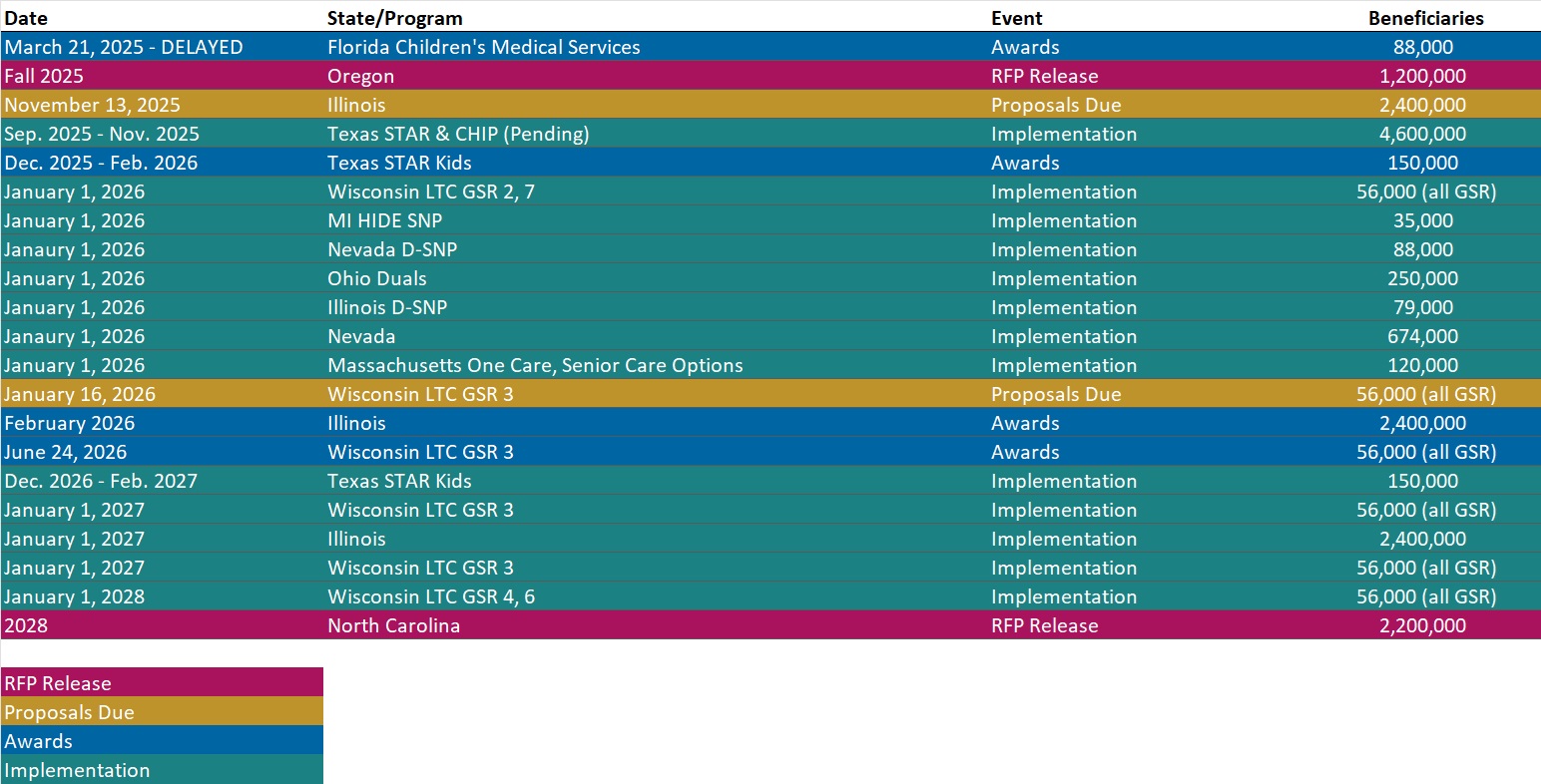
Wisconsin Releases Medicaid Managed LTC RFP for GSR 3. The Wisconsin Department of Health Services (DHS) released on October 28, 2025, a request for proposals (RFP) for Managed Care Organizations (MCOs) to deliver managed long-term care services under the Family Care and Family Care Partnership programs in Geographic Service Region (GSR) 3. The procurement represents part one of a three-part process to award multiple contracts for services to low-income frail elders and adults with physical, developmental, or intellectual disabilities.
DHS is merging former GSRs 6 and 11 into the newly aligned GSR 3 for this procurement. For Family Care, DHS intends to award two to four MCO contracts across the full region; for Family Care Partnership, DHS intends to award one to three contracts, with MCOs required to cover Kenosha, Ozaukee, Racine, Washington, and Waukesha Counties, with the option to expand to additional counties within the region. Proposals are due January 16, 2026. An intent to award is estimated to be released June 24, 2026. Contracts are expected to begin January 1, 2027, with seven one-year renewal options, not extending past December 31, 2034.
National
CMS Appoints Dan Brillman to Oversee Medicaid, CHIP. Fierce Healthcare reported on October 28, 2025, that former Unite Us chief executive officer Dan Brillman has been appointed Deputy Administrator at the Centers for Medicare & Medicaid Services (CMS) and Director of the Center for Medicaid and the Children’s Health Insurance Program (CHIP) Services, where he will oversee implementation of recent Medicaid reforms enacted through President Trump’s 2025 budget legislation. Outgoing Acting Director Caprice Knapp will transition to the role of Principal Deputy Director. Unite Us announced that co-founder Taylor Justice will succeed Brillman as Chief Executive Officer.
FDA Unveils Plan to Cut Costs, Accelerate Biosimilar Development. The U.S. Food and Drug Administration (FDA) released on October 29, 2025, a new draft guidance aimed at streamlining the development of biosimilars, lower-cost alternatives to biologic drugs, by reducing unnecessary clinical testing and simplifying approval requirements. The agency also plans to make it easier for biosimilars to qualify as interchangeable with brand-name biologics, expanding patient access to affordable treatments. FDA officials said the reforms will accelerate innovation and lower costs in markets where biologics represent over half of total drug spending but biosimilars hold less than 20 percent market share. The new policy is expected to help more manufacturers bring biosimilars to market while maintaining safety and efficacy standards.
Industry News
ACA Federal Marketplace Premiums to Rise 30 Percent on Average. The Washington Post reported on October 24, 2025, that premiums for the most popular plans available on the federal Affordable Care Act (ACA) Marketplace are set to rise 30 percent on average for 2026, according to final data from the Centers for Medicare & Medicaid Services. This reflects the largest increase in recent years and will affect approximately 17 million individuals.
RFP Calendar
Actuaries Corner
States Jostle Over $50B Rural Health Fund as Trump’s Medicaid Cuts Trigger Scramble. Rural hospitals and clinics nationwide face a looming financial catastrophe, with the massive tax-and-spending laws expected to slash federal Medicaid spending on health care in rural areas by $137 billion over 10 years. Editor’s Note: States are racing to win their share of a new $50 billion rural health fund, with half of the $50 billion being divided equally among all states with an approved application; the other half going to states that win points.
Discover other developments in the Wakely Wire here.
HMA News & Events
HMA Webinars
Impact Investing as Good Medicine: Prescribing Capital for Healthier Communities. Thursday, November 13, 2025, 12 PM ET. This webinar will convene investment professionals from major healthcare systems alongside leaders in impact investing to explore how strategic investments in the social drivers of health affordable housing, community infrastructure, food access and security, transportation, and local community and economic development—can both improve population health and deliver financial returns to healthcare systems and payers. Healthcare leaders will discuss how leveraging balance-sheet capital toward upstream solutions strengthens organizational sustainability, creates competitive differentiation in RFPs, builds community trust, and aligns with regulatory and value-based care incentives. Impact investing practitioners will discuss how they identify opportunities that deliver both financial performance and measurable health outcomes, and share lessons from structuring investments that balance institutional rigor with community impact. Register Here
Value Based Care Advisory Services: HMA and Wakely Put Analysis into Action. Thursday, November 20, 2025, 1 PM ET. Join experts from HMA and Wakely for an inside look at how our teams help organizations navigate and thrive in the value-based landscape. This session will highlight case studies and recent work that demonstrate a comprehensive advisory solution for any value-based entity. Attendees will gain a deeper understanding of how integrated insights across strategy, analytics, and implementation can drive measurable results in value-based care. Register Here
NEW THIS WEEK ON HMA INFORMATION SERVICES
(Exclusive Access for HMAIS Subscribers):
HMAIS Medicaid Market Overviews, Reports, and Data
- Updated FY 2026 Enacted State Budget Overview
- Updated Medicaid FFS PBM RFP Calendar
- Updated State Medicaid Leadership Inventory
- Updated HMA Federal Health Policy Snapshot
- New Medicaid enrollment, RFP documents, and other market intelligence resources for dozens of states
- Updated Delaware, North Dakota, and Puerto Rico Overviews
A subscription to HMA Information Services puts a world of Medicaid information at your fingertips, dramatically simplifying market research for strategic planning in healthcare services.
If you’re interested in becoming an HMAIS subscriber, contact Andrea Maresca at [email protected].