
October 8, 2025

This week's roundup:
- In Focus: CMS Clarifies Grandfathering Rules for State Directed Payments

- HMA Conference: From Uncertainty to Strategy: Leading Through Healthcare Change
- Wakely White Paper: ACO Foundations: Four Pillars for Successful Risk Management In Value-Based Contracts
- Delaware Launches Statewide Behavioral Health Coordination Platform
- Michigan Fiscal 2026 Budget Reshapes Medicaid Funding While Preserving Core Services
- New Mexico Governor Signs Bills Addressing Expiring ACA Tax Credits, Rural Health Amid Federal Cuts
- Ohio Issues Medicaid Work Requirement Compliance RFI
- Oklahoma Governor Appoints Clay Bullard to Lead State’s Health Care Authority
- NeueHealth Acquired by New Enterprise Associates in $1.47 Billion Deal
- United Sells 54 Home Health, Hospice Sites to Pennant Group

In Focus
CMS Clarifies Grandfathering Rules for State Directed Payments
The Centers for Medicare & Medicaid Services (CMS) last month issued a letter to states providing preliminary guidance on Medicaid State Directed Payments (SDPs), which outlines new federal payment limits, clarifies grandfathering provisions, and signals significant changes ahead for Medicaid financing and policy. The letter is part of CMS’s implementation of Section 71116 of the Budget Reconciliation Act of 2025 (OBBBA, P.L. 119-21)—the portion of the legislation that focuses on curbing SDP spending and reinforcing program integrity.
Though CMS describes the guidance as preliminary, it is the view of Health Management Associates (HMA) experts—including former state officials, actuaries, and policy strategists—that it signals directionally new policy for Medicaid agencies, managed care organizations (MCOs), and providers. CMS is working on two proposed SDP-related regulations, which are in the final stages of federal review. The preliminary guidance and forthcoming rules will likely reflect long-standing concerns for several years, even over shifting congressional control and multiple presidential administrations.
This article addresses key clarifications in the letter; the impact of the preliminary guidance on states, MCOs, and providers; and how the directive may influence Medicaid budgets, financing strategies, and future policy reforms.
Guidance Clarifies Timeframes for SDPs
Grandfathering Limited to Specific Rating Periods
CMS will allow states to maintain SDP spending amounts, up to the average commercial rate ceiling, that were in place for state fiscal year (SFY) 2025, calendar year (CY) 2025, and SFY 2026 rating periods. Nonetheless, new or expanded SDPs above Medicare equivalent levels in expansion states and 110 percent of Medicare in non-expansion states—even those based on legislation passed in 2025—are ineligible for grandfathering if they apply to rating periods starting after July 4, 2025. These grandfathered spending amounts will need to phase down with rating periods beginning on or after January 1, 2028.
Preliminary Grandfathering Determinations
CMS has begun notifying states whether a preprint is “likely eligible” for grandfathering. Because these are preliminary determinations, states should prepare for further review and revisions.
Submission Cutoff Date Clarified
In response to confusion around the May 1, 2025, submission deadline, CMS clarified that July 4, 2025, is the cutoff for grandfathering eligibility, provided the state fully completed the preprint. States may have rushed to meet a July 4 submission deadline and may have left questions on the preprint unanswered. In these instances, it is possible—if not likely—that CMS will consider the application incomplete and thus ineligible for grandfathering. Since this is a developing area with limited precedent, states may still seek clarification or reconsideration, though CMS has not yet issued definitive guidance or a formal process for resolving these situations.
No Increases Allowed Until 2028
States are prohibited from increasing the total dollar amount of grandfathered SDPs—the “expected spend”—until January 1, 2028. This restriction limits flexibility for states to expand their programs and may require that they reassess their SDP strategies. For example, using percentage-based calculations tied to average commercial rates, will no longer capture year-to-year growth because of utilization or acuity changes.
10 Percent Phasedown Unaddressed
CMS has yet to provide official guidance on the 10 percent phasedown of SDPs. Stakeholders remain in a holding pattern, awaiting a forthcoming proposed rule that will clarify how reductions will be calculated.
What It Means for States and Healthcare Organizations
SDPs have become a critical tool for states to stabilize provider networks through increased Medicaid reimbursement. This authority will be significantly limited, and states will need to reduce many existing programs. Medicaid enrollment losses resulting from other Medicaid policy changes, such as work requirements and minimum semiannual redetermination, will likely compound the strain on provider payments.
Providers and states need to start planning for these losses in revenue now. Strategic planning for SDP sustainability and close monitoring of upcoming CMS rulemaking is essential.
While the guidance imposes constraints, it also opens the door for policy innovation. For example, some states may use this moment to reform Medicaid financing, streamline supplemental payments, and reconfigure provider incentives to better reflect quality and access, advancing value-based care goals and achieving total cost of care savings through efficiency and aligned incentives.
Connect with Us
HMA is uniquely positioned to support states, MCOs, and providers as they navigate the evolving landscape of Medicaid SDPs. Our team includes former state Medicaid directors, actuaries, and policy strategists with deep expertise in designing sustainable financing arrangements and guiding public engagement processes. We bring robust modeling capabilities to clients seeking to assess the financial impact of CMS’s new restrictions, including the 10 percent phasedown and interactions with provider tax limitations. Our experts are actively engaged with CMS and understand how to translate federal guidance into actionable strategies that align with state goals and operational realities.
Whether revising preprint submissions, evaluating quality frameworks, or rethinking provider incentives, HMA delivers the technical and policy insight needed to move forward with confidence.
For questions about the federal guidance and considerations for your organization, contact Greg Uszak.
From Uncertainty to Strategy: Leading Through Healthcare Change
The Health Management Associates (HMA) National Conference is just days away—taking place October 14‒16, 2025, in New Orleans. With major changes underway across Medicare, Medicaid, and the Affordable Care Act Marketplace programs, this year’s event offers a timely and essential space to understand evolving issues and their potential impact on healthcare organizations.
This will be HMA’s 8th National Conference, and it arrives as the healthcare landscape is undergoing rapid transformation. Healthcare organizations across government, health plans, provider systems, philanthropy, and community-based organizations are grappling with new funding realities, policy directions, and operational challenges. The conference is designed to help attendees anticipate, adapt, and lead through this transformative time.
What’s Inside the Program
Keynote & Plenaries
- Former Arkansas Gov. Asa Hutchinson will deliver the keynote address, The Policy and Politics of Making America Healthy, offering a candid perspective on health improvement strategies in polarized times.
- Plenary sessions will explore publicly financed health coverage, payment reforms, behavioral health innovation, and population health strategies.
Expert-Led Workshops
- Throughout the day attendees will dive into hot topics like Medicare Advantage risk adjustment and STAR ratings, the Rural Health Transformation Program, digital health acceleration, Medicaid work requirements, and community strategies to build systems that work for underserved communities.
- Confirmed speakers include Stuart Archer, Chief Executive Officer, Oceans Healthcare; Liz Fowler, Senior Adviser, HMA, and former Deputy Administrator and Director of the Center for Medicare and Medicaid Innovation, Centers for Medicare & Medicaid Services; Jeremy Klemanski, MBA, President and Chief Executive Officer, Gateway Foundation; Mary C. Mayhew, President and Chief Executive Officer, Florida Hospital Association; Lynnette Rhodes, Chief Health Policy Officer, Georgia Department of Community Health; and Matt Yancey, Deputy Commissioner, Tennessee Department of Mental Health.
Coffee Conversations & Collaborations
- We will break down these issues even further during intimate, expert-facilitated roundtables offering candid problem-solving and practical takeaways.
Why HMA? Why Now?
To say we’re navigating a moment of profound change in healthcare isn’t an understatement. The HMA National Conference content and networking meets the moment with nearly 300 attendees from almost 200 organizations. Online registration is open through October 10, 2025.
Please contact Andrea Maresca with questions about grabbing one of the remaining spots.
ACO Foundations: Four Pillars for Successful Risk Management In Value-Based Contracts
Wakely, an HMA Company, has released a new white paper ACO Foundations: Four Pillars for Successful Risk Management In Value-Based Contracts. The white paper outlines four foundational pillars for successful risk management in value-based contracts that ACOs must address to achieve sustainable performance: Underwriting and Contracting, Risk Adjustment, Medical Economic Reporting, and In-Year Forecasting. Wakely supports a range of providers who take risk in Medicare Advantage (MA) and other government and commercial insurance programs. Learn More
HMA Roundup
Delaware
Delaware Launches Statewide Behavioral Health Coordination Platform. Fierce Healthcare reported on October 6, 2025, that Delaware has launched DTRN360, a new statewide behavioral health coordination platform developed by Bamboo Health to improve access, referrals, and care transitions. The system connects providers through real-time data, integrates into existing workflows, and enables coordination across behavioral, physical, and social services. Since its launch, more than 180 organizations have joined, facilitating 250,000 referrals with 80 percent follow-up completion and faster response times. State officials say the platform reduces administrative burden and provides actionable data for long-term planning especially as states prepare to apply for federal Rural Health Transformation Fund grants.
Michigan
Michigan Fiscal 2026 Budget Reshapes Medicaid Funding While Preserving Core Services. Michigan Advance reported on October 2, 2025, that the Michigan fiscal year 2026 budget makes a significant shift for Medicaid and health programs, with the Department of Health and Human Services cut by $7.6 billion, bringing its budget to about $30 billion. Much of the reduction stems from changes in how hospital and provider tax revenue is accounted for, rather than service cuts. Core Medicaid services including behavioral health, substance use treatment, and the Supplemental Nutrition Assistance Program (SNAP) remain funded. Despite the reductions, state leaders emphasized the budget sustains essential programs while meeting fiscal constraints.
New Mexico
New Mexico Governor Signs Bills Addressing Expiring ACA Tax Credits, Rural Health Amid Federal Cuts. The Associated Press reported on October 3, 2025, that New Mexico Governor Michelle Lujan Grisham has signed a variety of bills during a special legislative session that aim to address food assistance and healthcare affected by the policies approved under OBBBA. One new law appropriates $17 million to backfill Affordable Care Act (ACA) tax credits in the event that they expire, as they are currently set to do at the end of the year. Other new appropriations, totaling $162 million, support rural healthcare and food assistance, as well as non-health-related government programs affected by OBBBA.
Ohio
Ohio Issues Medicaid Work Requirement Compliance RFI. The Ohio Department of Medicaid released on September 29, 2025, a request for information (RFI) regarding compliance systems for the upcoming federal Medicaid community engagement requirements for the expansion population outlined in OBBBA. ODM’s current eligibility system, Ohio Benefits, would be able to verify some individuals with additional programming, but some expansion members’ data cannot be verified automatically. The department is seeking information about systems, data, staffing, and workflow to bolster the process and accuracy of checking for compliance with community engagement requirements, which must be able to be integrated with Ohio Benefits. Responses may guide a Community Engagement Compliance Verification procurement. Responses are due October 29, 2025.
Oklahoma
Oklahoma Governor Appoints Clay Bullard to Lead State’s Health Care Authority. KGOU reported on October 6, 2025, that Oklahoma Governor Kevin Stitt has appointed Clay Bullard as the new director of the Oklahoma Health Care Authority (OHCA), following former CEO Ellen Buettner’s departure to lead the Regional University System of Oklahoma. Bullard will also serve as chief advisor for health and mental health focusing on strengthening care delivery systems and driving innovation.
Industry News
NeueHealth Acquired by New Enterprise Associates in $1.47 Billion Deal. Modern Healthcare reported on October 2, 2025, that NeueHealth, formerly Bright Health Group, has been acquired by venture capital firm New Enterprise Associates in a $1.47 billion transaction that takes the company private. Under the deal, most stockholders received $7.33 per share in cash, while New Enterprise and other investors rolled their holdings into equity. The company’s stock has ceased trading, and the move provides NeueHealth with a reset following Bright Health’s 2023 exit from the insurance market after financial challenges.
United Sells 54 Home Health, Hospice Sites to Pennant Group. Modern Healthcare reported on October 2, 2025, that Pennant Group has acquired 54 home health and hospice locations in Tennessee, Alabama, and Georgia from UnitedHealth Group for $146.5 million. The sale is part of a larger Justice Department settlement requiring UnitedHealth and Amedisys to divest 164 locations across 19 states to address antitrust concerns tied to UnitedHealth’s $3.3 billion acquisition of Amedisys. Pennant leaders said the deal provides a strong foothold for expansion in the Southeast, adding to the company’s more than 150 existing home health and hospice sites across 17 states.
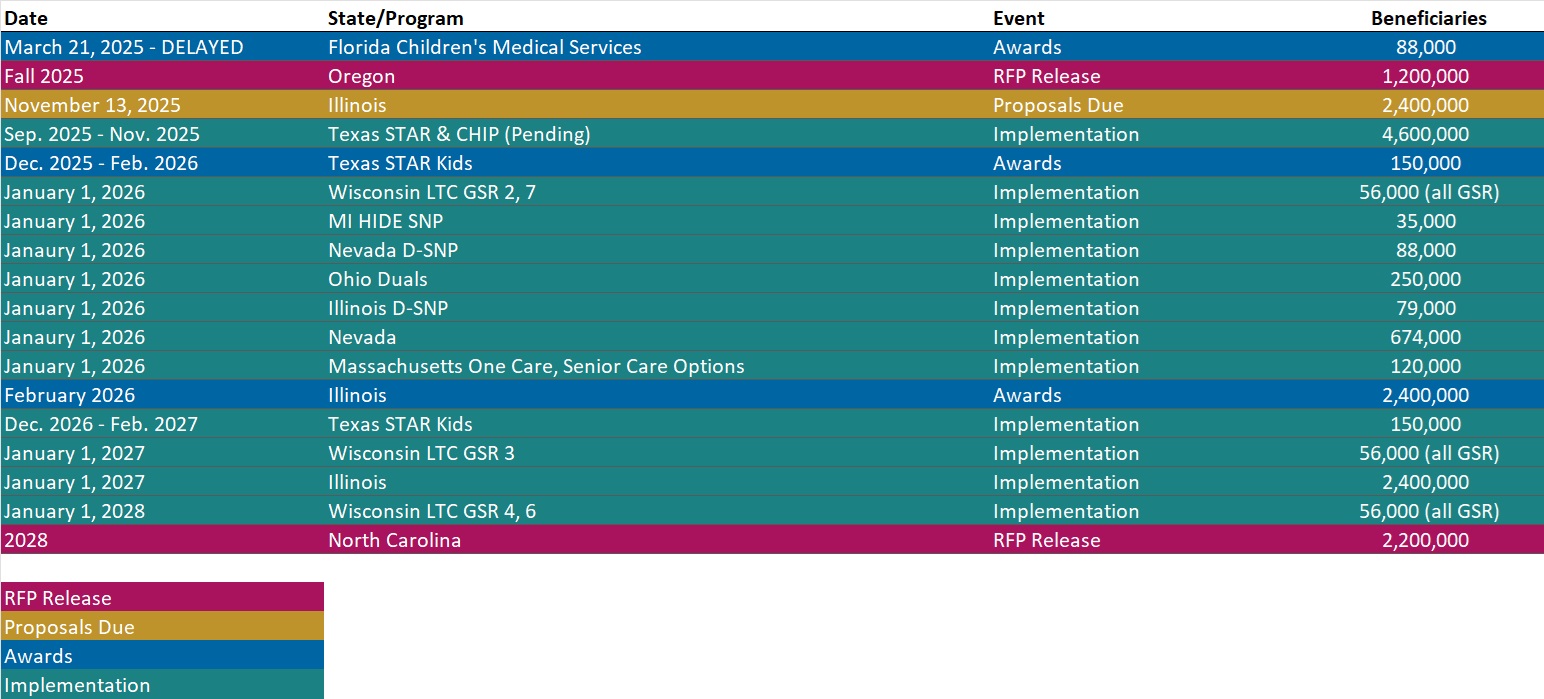
RFP Calendar
Actuaries Corner
A Look at Insurers’ Medicare Advantage Plans for 2026. Major insurers are reshaping their Medicare Advantage offerings for 2026 amid financial pressures, with CMS projecting a slight enrollment decline and payers emphasizing lower premiums, preventive care, and targeted benefits.
Discover other developments in the Wakely Wire here.
Company Announcements
MCG Announcement
MCG Publishes New White Paper on Observation Care: Bill Rifkin, MD, FACP, Associate Vice President and Managing Editor at MCG Health, explores the pivotal role of observation care in addressing rising healthcare costs while ensuring patient safety and high-quality outcomes. In this downloadable white paper, Dr. Rifkin presents evidence, data, and real-world scenarios that highlight how observation care—when applied appropriately—can benefit payers, providers, and patients alike. Download the free white paper.
HMA News & Events
HMA Webinars
Medicaid 1115 Justice Involved Reentry Demonstration Opportunities: Engaging Key Stakeholders. Wednesday, October 22, 2025, 12 PM ET. This webinar will explore how states, local agencies, and community organizations can maximize Medicaid’s new 1115 demonstration authority to improve reentry outcomes for justice-involved individuals. Presenters will discuss practical strategies for assessing health and social needs, building strong collaborations with community providers, and implementing effective Medicaid enrollment processes. Attendees will gain insights into designing and operationalizing reentry programs that promote continuity of care, reduce recidivism, and support successful community reintegration. This session is ideal for State Medicaid agencies, carceral facilities, correctional healthcare companies, health plans, community-based organizations, and federally qualified health centers.
NEW THIS WEEK ON HMA INFORMATION SERVICES
(Exclusive Access for HMAIS Subscribers):
HMAIS Medicaid Market Overviews, Reports, and Data
- Updated HMA Federal Health Policy Snapshot
- New Medicaid enrollment, RFP documents, and other market intelligence resources for dozens of states
A subscription to HMA Information Services puts a world of Medicaid information at your fingertips, dramatically simplifying market research for strategic planning in healthcare services.
If you’re interested in becoming an HMAIS subscriber, contact Andrea Maresca at [email protected].