HMA Insights: Your source for healthcare news, ideas and analysis.
HMA Insights—including briefs, webinars, and our podcast—gives you easy access to HMA’s deep expertise, helping you stay current on the latest healthcare trends and topics. Search for a topic of interest or browse the latest insights below.
In this dynamic and interactive Behavioral Health Town Hall hosted by Health Management Associates (HMA), our experts answered questions live on a wide range of critical topics, including:
Federal policy, personnel, and funding changes;
Emerging strategies for addressing social determinants of health, substance use disorder and crisis coordination (including 988);
Behavioral health revenue cycle management and alternative payment models; and
Innovations in addressing workforce shortages, integrated service delivery, digital mental health tools, and best practices for community mental health service delivery.
During the month of May, HMA is featuring thought leadership and insights around Behavioral Health (BH) and changes within the BH delivery system in the U.S. Along with several presentations happening at NatCon25 in Philadelphia, May 5-7, we want to highlight some of the work done by HMA experts. Starting us off, Josh Rubin, HMA Vice President, Client Solutions, has spent his career working with BH, intellectual and developmental disabilities, and child welfare service providers. In this post, he discusses the changing BH delivery system, and the issues surrounding the treatment of co-occurring mental health conditions.
Ever since the 19th century when Dorothea Dix crusaded up and down the east coast encouraging state legislatures to fund state psychiatric hospitals, we have had separate systems for medical and mental health care. I mean Ms. Dix no disrespect, far from it; before her work we simply had no system of care for people with mental illnesses. Her contribution was immeasurable. But in 1963 when President Kennedy signed the Community Mental Health Act, it was an acknowledgement that the “out of sight, out of mind” warehousing of people with mental illnesses in large state psychiatric hospitals was inappropriate and had to end.
Those of us who remember the heady days of the 1960s rightly celebrate the advance this represented in acknowledging the rights of people with mental illness to live in the community, and the opportunity it created for people with behavioral health conditions to build lives of dignity, productivity, and inclusion. And while we ought to celebrate that important advancement, we must nonetheless acknowledge that it maintained a separation between the underfunded mental health system, and a significantly better funded medical system. And thus, the community mental health system in America was built. It was designed to provide mental health care to the roughly 5% of the population that has a serious mental illness (SMI). In the nearly 60 years since, much has been done of which community mental health providers should be proud. We have transformed countless millions of people’s lives (and those of their families), built new program models, identified and implemented new practices, and built a service delivery system that offers a comprehensive continuum of care for people with SMI.
Unfortunately, that system was not built to address the needs of people with co-occurring mental health and substance use disorders (SUD), which is problematic because nearly half of people with a substance use disorder have a mental illness and nearly half of people with a serious mental illness have a substance use disorder. This is no surprise; the conditions are related. Some people with mental illnesses use drugs to manage their symptoms. Sometimes drug use can cause or exacerbate mental illnesses. In most cases, it is impossible to figure out where a mental illness ends, and a substance use disorder begins, or vice versa.
Yet in the U.S. we have always had separate service systems for these two conditions. Our systems grew up this way because although the stigma of mental illness is bad, the stigma of substance use is worse. While we have frequently been willing to address mental illnesses as health problems, we have long treated substance use disorders as criminal justice problems. We created community mental health centers. We launched a war on drugs.
The federal government provides two separate funding streams for states, one for mental health, the other for substance use disorder services. In many states there are separate agencies overseeing the two conditions, separate funding streams, and separate regulatory structures. Many providers respond to the funding and offer separate programs for one condition or the other.
This systemic failure leads every day to the death of Americans who have co-occurring mental health and substance use disorders but cannot access treatment for the two conditions together. Treatment works, and recovery is possible, but treatment works best when you are able to get treatment for your entire problem.
And just as the mental health and SUD systems were separated, they were both also segregated from the general healthcare delivery system. The stigma of our clients’ illnesses attached to us and our service system, so we were largely ignored by the healthcare delivery system and the people who funded and oversaw it.
While we have, as I said, much to be proud of, we cannot ignore the impact of our segregation. Our clients continue to die much younger than their peers. BH-related hospitalizations continue to increase. Overdose deaths and completed suicides, the worst possible outcomes, keep climbing, leaving incalculable suffering in their wake. And the financial costs of BH conditions continue to escalate, falling hardest on the historically underserved and marginalized communities that can least afford them. When America establishes a separate system, it isn’t equal; being ignored has consequences.
The good news? BH is not being ignored any longer. The bad news? BH is not being ignored any longer.
Healthcare policymakers have finally awakened to the reality that they will not be able to achieve their goals of better outcomes, lower costs, and improved customer service unless they address the BH needs of their populations. They are figuring out that everyone needs behavioral healthcare, and that a dichotomy that focuses BH care only on those with the most significant BH issues is ill serving. They are coming to understand that the skills, capabilities, and expertise of community BH providers have extraordinary value. It’s nice to be acknowledged and invited to help.
But it’s not all good news, because while being ignored left us underfunded and disrespected, it also protected us. Now that hospitals (which have been buying up outpatient practices at a remarkable pace) have started opening up BH services, we must compete with their deep pockets. And private equity (with even deeper pockets) has increased the pace at which they are acquiring BH providers, forcing additional competition on us. We are not even safe from our own phones. 10,000 mental health apps in the app store offer our clients a totally different paradigm for care, much of it lacking any evidence-based foundation. This makes it more dangerous for our clients, not less competitive for BH providers.
This environment requires fundamental changes in the way BH providers operate. We need new models of care that better meet the needs of the people we serve. Certified Community Behavioral Health Clinics (CCBHCs) are a step in the right direction, but they’re not a significant change in the service delivery model. If you look at the history of the BH system in America, from Dorothea Dix through today, you will see that the movement has been consistently in the same direction – inward. We have moved out of the hospitals in the countryside into clinics in the neighborhood. We have slowly chiseled away at the barriers dividing mental health from substance use disorder services. We have patiently worked to integrate with our health care colleagues. Now things are accelerating, and the pace of change is scary, but we should embrace the opportunity. We have a once in a lifetime chance to build something new, better, more effective.
HMA consultants are participating on four panel sessions at NatCon25 in Philadelphia, May 5-7. In this blog, HMA Principal Suzanne Daub offers a peek at her session topic and explains how improvisation is being used in behavioral health.
In the fast-paced, high-stakes world of behavioral health, case and care managers are often the steady bridge between crisis and stability, support and recovery. Yet the complexity of their roles—navigating systems, engaging clients with diverse needs, adapting to change in real-time—requires more than clinical knowledge. It calls for presence, empathy, adaptability, and clear communication. These are exactly the skills honed through applied improvisation.
Several years ago, I attended a national healthcare conference and found myself in a session on applied improvisation for medical professionals. I expected a few communication tips. What I experienced instead was a transformative, embodied approach to learning that blended empathy, collaboration, and spontaneity in a way that felt deeply relevant to behavioral health. I knew immediately: this belongs in our field.
That session sparked my own journey. I began formal improv training, developed a personal improv practice that I’ve now sustained for over five years, and eventually became a certified trainer in applied improvisation for healthcare professionals. Since then, I’ve been focused on bridging this work into behavioral health—especially to support case and care managers, who often work at the emotional and logistical front lines of client care.
What Is applied improv? Applied improvisation takes the tools and principles of theatrical improv—like active listening, collaboration, spontaneity, and “yes, and” thinking—and uses them in professional, non-performance contexts to strengthen human interaction. It’s grounded in neuroscience, play theory, and experiential learning.
In medical training, applied improv is used to support communication, teamwork, leadership, and emotional resilience. It helps providers stay grounded in the face of uncertainty, build trust with patients and teams, and respond rather than react. Academic medical centers, residency programs, and interprofessional training teams are increasingly turning to improv to improve quality of care and reduce burnout.
Applied improv is still emerging in behavioral health, but momentum is growing. Innovative programs are using improv to support:
Engagement in developmental disability services where play-based, nonverbal, and responsive communication is vital.
Reducing isolation among older adults and dementia caregivers through shared storytelling, and connection-building.
Substance use disorder recovery by helping individuals rediscover joy, flexibility, and authentic connection in group work.
Supervision and team development where role-play and real-time scenarios help staff practice challenging conversations and build peer support.
For case and care managers in behavioral health, applied improv can help:
Enhance engagement, improve presence, listening, and rapport-building with clients across cultures and abilities.
Build comfort with unpredictability and navigating uncertainty —essential when managing client crises or changing systems.
Foster collaboration and trust in interdisciplinary teams.
Bring joy, presence, and creative reset—tools we all need to stay grounded, prevent burnout and foster resilience.
If you’re attending NatCon25, I invite you to join our interactive workshop: “Improv in Behavioral Health: Strengthening Empathy, Collaboration and Adaptability,” where you’ll gain hands-on tools, and leave with a new lens on what it means to connect. There are two sessions available, Monday, May 5, 4:30 PM – 5:30 PM ET or Tuesday, May 6, 11:15 AM – 12:15 PM ET, both located in room 204C.
Don’t miss these other HMA presentations at NatCon25:
Monday, May 5, 10:15 AM – 11:15 AM ET session A3 in room 103B Harnessing Your Superpowers in Times of Disaster Breakout Presenter: Monica Johnson, MA, LPC – Health Management Associates
Monday, May 5 10:15 AM – 11:15 AM ET session A13 in room 115BC Building Sustainable Pathways for Behavioral Health Careers Breakout Presenter: Allie Franklin, MSSW, LICSW – Health Management Associates
Late 2024, HMA convened a panel of experts, including individuals with lived experience and state leaders, to spotlight the critical need for cross-system transformation. The discussion underscored the importance of centering youth and family voices, aligning placement and community-based services, and leveraging opportunities like the Family First Prevention Services Act, Medicaid waivers, and specialty managed care models. As states grapple with a behavioral health workforce crisis and insufficient foster care placements, the path forward requires bold, coordinated strategies grounded in flexibility, equity, and evidence. This brief includes key takeaways from the 2024 panel and outlines actionable insights to guide the transformation of the children’s behavioral health system.
Section 1115(a) demonstrations, informally known as 1115 waivers, are experimental, pilot, or demonstration projects that give states flexibility to design, test, and evaluate state-specific approaches to improve their healthcare programs and better serve eligible populations.
Approved by the Centers for Medicare & Medicaid Services (CMS), 1115 demonstrations provide alternative options to provide access, coverage, financing, and delivery of services under the joint federal-state funded programs Medicaid and the Children’s Health Insurance Program (CHIP). Across multiple administrations, HMA has helped state Medicaid agencies and cross-agency leaders design programs aligned with federal priorities; develop budget-neutral pathways and sustainable financing strategies; reduce operational, financial, and implementation risk; and position programs for long-term success.
Medicaid and CHIP 1115 demonstrations allow states—and their stakeholders—to test new innovations to improve the health of enrollees and advance program efficiencies. These demonstrations require careful planning, rigorous actuarial analysis, political savvy, policy knowledge, and ongoing support through the application, approval, and implementation phases. In today’s environment, 1115 programs must be responsive to the policy priorities at the federal level and grounded in solutions that work in the state. Stakeholders need aligned engagement strategies and communications plans to achieve shared goals, including monitoring that drives continuous improvements after implementation.
HMA consultants bring extensive real-world and leadership expertise from decades of working with states and federal agencies prior to joining HMA. We offer the range of services and support needed to ensure 1115 programs are financially sustainable, operationally workable, and aligned with federal and state requirements:
Strengthening healthcare safety net sustainability through financial and operational supports
Developing solutions for complex patient populations such as individuals who are justice-involved or have extensive behavioral needs including substance use disorder
Designing coverage strategies for critical social needs, such as community reintegration of vulnerable populations such as the justice involved, including when these require collaboration with agencies and programs beyond Medicaid
Supporting states in meaningful stakeholder engagement efforts, provider training and guidance, and other activities necessary for successful program implementation
Working with managed care organizations, health plans, providers, and other stakeholders to apply our expertise in implementing 1115 demonstrations
HOW HMA CAN HELP
Providing strategic and operational support to design demonstration programs With several former state Medicaid directors and former CMS officials on staff, HMA helps states design successful new interventions to address the unique needs of their populations and ensures proposals meet CMS’ approval requirements and expectations, including aligning 1115 interventions with evolving federal priorities and objectives for the program. With HMA, states and stakeholders gain valuable insights on strategic engagement and partnerships.
Developing applications for 1115 demonstration proposals HMA has supported a variety of 1115 initiatives in several states, including developing proposals for new, continuing, and amended 1115 demonstration programs. HMA consultants bring decades of experience in 1115 program design that covers all of the components critical to developing and operating 1115 programs – policy, actuarial and budgeting, operations, communications, project management, and IT.
Supporting federal negotiations for approval of state 1115 demonstration proposals HMA helps states navigate the federal processes to secure approval for their 1115 initiatives. In many cases, HMA joins in active negotiations with the state agency to support federal negotiations. HMA has unique insight into federal approval parameters with former CMS officials.
Operational Support We help stakeholders—including state agencies and their partners—manage the challenges of implementing new Medicaid or CHIP initiatives, with a focus on ensuring efficient integration and improvements in outcomes.
Evaluation and Assessment of section 1115 demonstrations Federal regulations require evaluation of CMS-approved 1115 programs. HMA designs and conducts evaluation reports that meet federal requirements, such as hypotheses, data sources, and comparison strategies. HMA’s work on evaluation designs and evaluation reports has been held out by CMS as best practice models to other states for evaluating new policy interventions as well as for ongoing monitoring activities.
Developing materials for and supporting stakeholder engagement from design to implementation. HMA works closely with states and their partners to engage stakeholders early in the 1115 process to ensure that communities and local organizations are involved in the planning and implementation of 1115 programs.
Project Spotlights
HMA has supported approved section 1115 demonstration programs testing new strategies for addressing substance use disorder (SUD), serious mental illness (SMI), and/or serious emotional disturbance (SED) through new flexibilities around the federal institution for mental disease (IMD) exclusion in seven states (Alabama, Colorado, Delaware, Indiana, Missouri, Ohio, and Oklahoma). In addition to initial and extension application support, HMA teams also support the evaluation and financial modeling components of 1115 demonstration development. In the last four years, we have delivered six evaluation designs, two midpoint progress assessments, two interim evaluations, and two summative evaluations approved by CMS. In general, HMA’s approved evaluation design plans use multiple evaluation methods, including a mixed-methods approach, drawing from various data sources, measures, and analytics, including quasi-experimental methods, to produce relevant and actionable study findings to conduct analyses. Additional 1115 demonstration program development activities include completing budget neutrality estimates and rate setting for new interventions proposed under demonstrations.
California is the first state in the nation to receive approval from CMS to provide detained and sentenced individuals with 90-day pre-release healthcare services and behavioral health linkages. HMA helps clients build administrative capacity, information technology, pre-release services, care management models, and Medicaid claiming infrastructure to meet their unique needs and leverage this significant state-federal demonstration opportunity. Our planning and implementation support spans the breadth of the CalAIM Justice-Involved Initiative including: the pre-release Medicaid application process, 90-day pre-release services, behavioral health links, Enhanced Care Management (ECM), and Community Supports services. In addition to California, HMA supported other states, such as Illinois and Maryland, with the design, approval, and/or implementation of justice-involved demonstrations approved by CMS. Learn more about CalAIM Justice-Involved Reentry Initiative Planning and Implementation Services.
HMA has supported multiple states in developing alternate approaches to Medicaid eligibility and enrollment tailored to their unique policy goals. For example, our consultants have worked with the Indiana Family and Social Services Administration on the program design, approval, and implementation of the Healthy Indiana Plan (HIP), Indiana’s alternative Medicaid expansion demonstration program. We also supported the Iowa Department of Health and Human services in developing the Iowa Health and Wellness Plan (IHAWP) 1115 demonstration which provides an alternative benefit design to traditional Medicaid expansion. HMA also supported the Kentucky Cabinet for Health & Family Services (CHFS) with a variety of services related to its section 1115 demonstration, Kentucky HEALTH, the first community engagement program in the nation approved by CMS.
Digital Quality Measurement: A Key Driver to Value
The healthcare industry is on the cusp of a seismic shift in how quality data are collected, analyzed and reported. Beginning in January 2027, new federal interoperability and prior authorization rules will require widespread data exchange, paving the way for full digital quality measurement (dQM) by 2030. This move toward dQM presents enormous opportunity to enhance quality outcomes, strengthen value-based arrangements, and streamline operations. However, it also requires substantial strategic, operational, and technological changes that most organizations simply cannot manage alone.
Regulatory Mandates
Organizations that delay preparing for the 2027 rule risk costly setbacks and non-compliance.
Opportunity for Transformation
dQM drives efficiency and quality improvement, supporting population health initiatives, care coordination, and value-based contracting.
Complexity and Risk
dQM implementation spans multiple departments—IT, quality improvement, analytics, legal, and more—creating a host of challenges requiring specialized expertise.
Competitive Advantage
Early adopters will have a first mover advantage. This advantage could result in revenue associated with auto-assignment, STARS bonus, value-based purchasing, reduced sanctions and fine, etc.
Why Partner with HMA?
HMA’s dQM consulting team understands the operational, clinical, and technical dimensions of transitioning to digital quality measurement. Leveraging deep expertise across health plans, provider organizations, and state and federal agencies, we help you plan, implement, and evaluate your dQM strategies at every stage.
1. Speed to Solution
Front-Seat Knowledge: HMA, together with Leavitt Partners, an HMA Company, is actively influencing and shaping national conversations on interoperability and digital measures. Our front-line insights mean you gain rapid access to the latest best practices, regulatory updates, and strategic guidance.
Streamlined Roadmap & Implementation: We help you develop a clear, achievable plan of action—saving you from the pitfalls of trial-and-error by fast-tracking your implementation and monitoring the results.
2. Cross-Department Coordination
Complexity of Transformation: dQM requires alignment across IT, quality, clinical operations, and finance—often a monumental undertaking for organizations already at capacity. Robust change management & strategic planning and communications is crucial for success.
Meet Mandated Timelines: Waiting to act can result in financial risk, stressed operations, and missed opportunities to optimize reimbursement.
Manage Risk: Because digital quality measurement is in an emerging phase, organizations face higher levels of uncertainty. HMA mitigates risk by leveraging our extensive experience and industry partnerships.
3. Proven Expertise and Ongoing Support
Full Project Lifecycle: From early planning and strategy development through implementation and evaluation, we stand by you every step of the way.
Value Beyond Compliance: Our team identifies how dQM can drive broader business goals—improving population health, care coordination, and value-based contracting performance..
Ready to Transform Your Quality Measurement?
HMA’s expert consultants provide the advanced technical, business, and operational skills you need to succeed in today’s rapidly evolving regulatory landscape. Don’t let the complexity of dQM derail your strategic plans or burden your teams. With HMA as your partner, you can confidently navigate and optimize your transition to digital quality measurement.
Take the first step toward harnessing the power of digital quality measurement. Partner with HMA to position your organization for success today—and well into the future.
Contact our HMA dQM experts to discuss your organization’s goals and challenges:
The behavioral health workforce crisis, a long-standing issue worsened by the COVID-19 pandemic, threatens the ability of provider organizations to meet growing demands for behavioral health treatment services. Despite decades of efforts, challenges such as inadequate compensation, workforce shortages, lack of diversity, and high burnout persist. In fact, a 2023 survey of state Medicaid officials on behavioral health revealed that nearly every state was engaged in at least one strategy to address the workforce shortage.[1]
Creation of the Workforce Solutions JAM, begun in May 2024, a monthly webinar spreading innovation and discussing all elements of the behavioral health workforce
Multiple convenings of technical experts and partners to discuss how to support action on the workforce
The next step for the Workforce Solutions Partnership is to expand engagement with partners to address the workforce shortage. The Partnership believes that using the Collective Impact framework, will provide the structure to build a national strategy and cross-sector approach to shared implementation of workforce initiatives, resulting in effective and scalable solutions. We understand there are countless workforce initiatives underway across the country, many of which are demonstrating progress and innovations that can be scaled. Rather than duplicate or distract from existing efforts, the Partnership will build connections between these efforts, elevate their impact and empower emerging innovative ideas.
Initial areas of focus will include:
Community alignment: Enhancing recruitment and retention of a workforce that reflects the communities accessing behavioral health services.
Creation of efficiencies: Building a new operational and administrative model that improves access.
Technology integration: Exploring tech-enabled supports to enhance skill development and service delivery.
Career pathways and compensation: Improving access to career opportunities and using evolving payment models to increase salaries for behavioral health professionals.
The Call to Action outlines the Partnership common agenda, levers of change, and the process for developing a national platform for change. It outlines how partners can engage and is the launch of what we hope will be national action to build a sustainable workforce.
The Workforce Solutions Partnership, a collaboration of The National Council for Mental Wellbeing, The College for Behavioral Health Leadership, and Health Management Associates has worked since 2021 to create both short and long-term solutions addressing the behavioral health workforce crisis. In this whitepaper, we issue a Call to Action to partners across all sectors to join us in this effort to drive pervasive change and ensure the future of behavioral health care. We need you to help us create and define the future of the workforce and envision a new system of care. This paper outlines the problem and highlights the efforts developed by our partnership, and mechanisms that can help to address the problem.
On Tuesday, February 25, 2025, the Watertown City Council unanimously endorsed the recommendations of a year-long health and human services assessment prepared by HMA for the City of Watertown, Massachusetts. The report, released in November 2024, included a qualitative and quantitative assessment of the community’s health and human service needs and recommended resources to fill those gaps. As part of the project, HMA facilitated extensive community outreach and data gathering efforts in 2024 to elicit a range of community perspectives including 20 interviews, 8 focus groups, and 2 community-wide meetings resulting in 9 recommendations for organizational and program efficiencies and enhancements.
Through engagement and analysis, key community priorities emerged with a focus on programs and services relating to housing security, food security, wellness promotion, disability supports, older adult supports, communications and language access, immigrant supports, veterans’ services, public health, physical and behavioral health, and diversity, equity, and inclusion. Health and human services were considered through an intersectional lens, recognizing their overlapping qualities and characteristics that reflect how real people experience their own unique needs and seek support from a multitude of public and private supports.
Each year on March 2 we observe World Teen Mental Wellness Day, which aims to raise awareness and destigmatize mental health issues experienced by teenagers, and to expand the conversation around available resources. There is an ongoing mental health and substance use crisis in our country. Families everywhere experience difficult and challenging experiences as their loved ones are cycled in and out of a system dealing with workforce shortages and resource issues. HMA works extensively to address the opportunities and challenges inherent in our struggling behavioral health system, including substance use disorder and on child welfare and family resilience programs throughout the country. #WorldTeenMentalWellnessDay
One such program is Lifting Voices, an independent initiative developed by Heidi Arthur and Ellen Breslin, both HMA Principals, who co-founded the initiative, informed by their own family members’ experience and by their expertise in behavioral health policy and practice. As parents of children who nearly died on multiple occasions from severe behavioral health conditions, the co-founders are driven to inform the transformation of the youth behavioral healthcare system. As behavioral health professionals who found themselves struggling to navigate the many challenges facing their own children, they realized that their knowledge, desperation, and resources afforded their children access to interventions that should be available to every child and youth in need of services. Their experience of the care delivery system has also inspired their commitment to highlight the urgent improvements necessary to support struggling children and parents affected by the nation’s youth behavioral health crisis.
The co-founders published the initial Lifting Voices report in October 2023. Since then, the team has engaged multiple youth and family collaborators and state and national partners. They presented the report and their ongoing efforts at national and state conferences.
They developed a second iteration of the surveys and a website to scale the dissemination effort, with collaborators, Kelsey Engelbracht who developed the website and Sheilah Gauch who helped to develop the survey.
“We felt an imperative to lift the voices of youth and families experiencing mental health and substance use conditions,” says co-founder, Ellen Breslin.
Heidi Arthur added, “So far we’ve received just over 100 survey responses. As we reach each 100-response milestone we plan to collaborate with our network of youth and family advisors to distill key findings that we can share in order to inform improvements to the system.” They plan to release the first report in May 2025.
In February 2025, the team was invited by the Substance Abuse and Mental Health Services Administration (SAMHSA) Office of Recovery to participate in workgroups providing input into a toolkit for family and caregivers and to further define and describe SAMHSA’s framework of community-based recovery supports.
You can join national organizations and state agencies in disseminating the secure, anonymous Lifting Voices surveys by simply sharing the Lifting Voices | transform behavioral health link and inviting families and youth to participate.
Findings will be disseminated with the goal of sharing the experience that youth/young adults and parents/caregivers are having as they seek services for child and youth mental health and/or substance use.
To learn more about this project, or inquire about ways that HMA can help with other behavioral health, child welfare, or substance use disorder issues, contact a member of our behavioral health team.
This week, our In Focus section highlights President Trump’s Make America Healthy Again (MAHA) executive order, which is designed to address the challenges driving chronic diseases in the United States. Our article delves into the key components of the order, presents a data snapshot about the state of children’s health, and discusses implications for stakeholders seeking to prepare for and inform the transitions impacting the future of children’s health.
Presidents can use executive orders to communicate their priorities and set a framework and timelines for federal agency actions. Historically, these orders have provided strong signals for the initiatives and policy direction that federal departments and agencies will pursue. Health Management Associates (HMA), experts are monitoring the MAHA directive and several other executive orders, alongside other Trump Administration actions.
Executive Order: Making Children Healthy
On February 13, 2025, President Trump signed an executive order establishing the Make America Healthy Again Commission, chaired by US Department of Health & Human Services (HHS) Secretary Robert F. Kennedy, Jr. The commission, which builds on the Secretary’s prior work, is charged with combating “critical health challenges facing citizens, including the rising rates of mental health disorders, obesity, diabetes, and other chronic diseases.”
Initially, the commission will focus on studying and addressing childhood chronic diseases. The order directs the commission to release within 30 days an assessment that summarizes what is known about the childhood chronic disease crisis, identifies gaps in knowledge, and includes international comparisons. This report will serve as the foundation for developing a strategy to improve the health of children, which is due within 180 days of the order.
Data Snapshot: Childhood Chronic Conditions
Evaluating existing data and identifying gaps in data for children are critical initial steps toward developing a comprehensive and evidence-driven federal policy agenda. At present, 90 percent of the $4.5 trillion in annual US healthcare expenditures are used to provide services to people with chronic and mental health conditions. Many of the risk factors for developing these conditions begin in childhood and some are preventable. For example:
Obesity affects 20 percent of children and 42 percent of adults, putting them at risk of chronic diseases such as type 2 diabetes, heart disease, and some cancers. More than one in three young adults ages 17−24 are too heavy to join the US military. The youth obesity rate from 2017−2020 was 19.7 percent, a 42 percent increase from the rate in 1999−2000. Lifestyle choices, combined with social and environmental factors like access to healthy foods and neighborhood walkability and safety can significantly reduce the risk of developing obesity.
In 2022, diabetes and the complications associated with it accounted for $413 billion in total medical costs and lost wages in the United States. While few children have type 2 diabetes, nearly one in five adolescents (12−18 years old) have prediabetes and may develop diabetes in adulthood. Like obesity, both personal choices and adverse social and environmental factors can increase the lifetime risk of developing diabetes.
Approximately 4.9 million children in the United States have asthma, which is incurable but can be managed. Asthma is one of the main causes for missed school days among children. Many US schools have poor indoor air quality, which can expose children to allergens, irritants, and triggers such as mold, dust, and pests. Conditions in children’s homes also can exacerbate asthma.
How Federal Programs Impact Children’s Health
Numerous federal programs directly and indirectly affect children’s health. Examples include:
Nationally, more than 38 percent of children have Medicaid coverage, with rates exceeding 50 percent in some states and territories (e.g., Louisiana, New Mexico, Puerto Rico). Medicaid’s requirement to cover Early Periodic Screening, Diagnostic and Treatment (EPSDT) has long been the vehicle for addressing the chronic healthcare needs of children on Medicaid. For example, for children with asthma, in addition to covering medications to prevent and treat exacerbations, some states will reimburse providers for conducting home health assessments to identify and remediate triggers in the home. In addition, federal funding through both Medicaid and US Department of Education supports school nurses and school-based health centers, which can be critical resources in addressing the chronic healthcare needs of students, such as the administration of Insulin or providing inhalers to children experiencing asthma.
To receive funding through the National School Lunch and School Breakfast programs, schools must provide meals aligned with the “meal pattern” established by US Department of Agriculture, which specifies the amount of food among various groups and an age-based maximum for calories, saturated fat, and sodium. Under current guidelines, by 2027, school meals also will be expected to comply with limits on added sugars.
Participants in the Special Supplemental Nutrition Assistance Program for Women, Infants, and Children (WIC), which provides participants with certain foods to meet their nutritional needs, have a lower risk for preterm birth, low birthweight infants, and infant mortality.
Federal programs affect children’s home and school environment in other ways, and the health implications of those funding choices may not be explicitly recognized or prioritized. For example:
Housing assistance programs in some cases prevent families from experiencing homelessness but may place them in living situations where exposure to environmental hazards such as mold, pests, or pollution and neighborhood factors like crime and lack of walkability may adversely affect their health.
Some federal agriculture programs are specifically designed to make nutritious foods available (e.g., Gus Schumacher Nutrition Incentive Program, or GusNIP), while others support agriculture without specifically bringing a health lens to those programs.
Implications for Stakeholders
The President has directed that the strategy address “appropriately restructuring the Federal Government’s response to the childhood chronic disease crisis, including by ending Federal practices that exacerbate the health crisis or unsuccessfully attempt to address it, and by adding powerful new solutions that will end childhood chronic disease.” Though we do not know what the Make our Children Healthy Again Assessment and Strategy will recommend, we anticipate it will present both opportunities and risks for organizations focused on children’s health. As the commission begins its work, organizations can take the following actions:
Consider policy opportunities: Review your organization’s strategic plan as well as your operational and policy priorities and consider how they may fit into this framework. This could be the time to suggest changes to federal grants you receive or federal regulations or requirements that negatively affect your ability to keep children healthy.
Prepare for potential funding disruptions: It is possible that programs you rely on will have changes in scope or funding levels. Review your offerings for children with chronic conditions and identify substitutes or complements to your main priorities. Consider partners you might work with to keep work going that may not have the same level of federal support in the future.
Be prepared to share the real-world impacts of policy changes: Begin gathering data, stories, and compelling information to share about chronic conditions affecting children that can be used in future public comment opportunities, shared with the media, and discussed with your federal, state, and local representatives. Think about how to talk about these issues in a clear and compelling way that will resonate with each of those audiences.
Find partners and allies: As you consider the policy opportunities and risks, think about other organizations that share your interests and how you can work with them in complementary ways. It can be compelling to policymakers when stakeholders who might not naturally be aligned on other issues can unite around a specific policy area.
Connect with Us
Healthcare stakeholders with a commitment to healthy children and healthy adults have an opportunity to support the specific policies and funding opportunities that may emerge from the MAHA order. To learn more about these policy changes, the impact on your organization, and actions your organization can take, contact our one of our featured experts below.
This week, our In Focus section examines governors’ healthcare priorities from their 2025 State of the State addresses. This article highlights common themes in addresses delivered between January 6, 2025, and January 16, 2025, and delves into specific proposals in Georgia, Iowa, New York, and Oregon, as analyzed in the Health Management Associates (HMA), Information Services (HMAIS) interim report, 2025 State of the State Overview.
State of the States in the Current Environment
Governors use their State of the State addresses to outline their priorities for the year, giving insight into the agendas and initiatives that their executive branches may pursue independently or in collaboration with their state legislature. These priorities often are informed by the status of the state’s budget, with some governors advancing healthcare proposals that will address budget deficits and others seeking to invest in services and workforce initiatives.
Monitoring governors’ policy priorities and initiatives is especially important in 2025 given the changing federal landscape. The transition in both the administration and Congress will require state leaders to carefully consider the risks and opportunities. As detailed below, governors’ responses will unfold differently across states and markets.
Common Threads
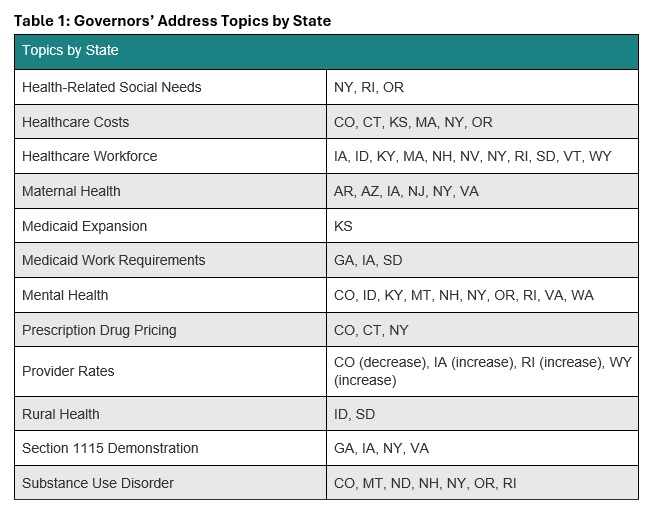
In all, 24 governors delivered a State of the State Address between January 6, 2025, and January 16, 2025. Many gubernatorial leaders have similar areas of priority and concern, with some continuing multiyear initiatives to address unmet behavioral health needs and control healthcare costs. Table 1 identifies the themes emerging from the first group of addresses.
Governors also are considering possible policy changes under the new Trump Administration. For example, some governors reported that their state is looking to strengthen or add Medicaid work requirements to their programs, resuming initiatives that were initially pursued during the first Trump Administration. Though not directly related to healthcare, governors’ decisions to mirror President Trump’s Department of Government Efficiency, with Iowa as an example, could indirectly affect local programs and markets. Other states are considering the implications of possible changes to federal Medicaid funding. A deeper look into the priorities in Georgia, Iowa, New York, and Oregon follows.
Georgia
Gov. Brian Kemp delivered Georgia’s State of the State address on January 16, 2025, during which he focused his healthcare remarks on the state’s Pathways to Coverage Section 1115 demonstration. Georgia’s waiver extends Medicaid coverage to able-bodied adults who earn up to the federal poverty level if they meet certain work requirements. The governor emphasized that he intends to work with the Trump Administration to further advance innovative approaches to healthcare access.
Governor Kemp stated that his administration is making it easier to apply for Medicaid coverage and will submit an amendment to the Centers for Medicare & Medicaid Services (CMS) that would extend the Pathways demonstration for five years beyond the current expiration date of September 30, 2025. The state plans to request several changes to the demonstration, including:
Changing the reporting requirements for qualified work activities
Adding more activities that qualify for program eligibility
Adding a retroactive coverage policy
Removing premiums and Member Reports Accounts
The governor’s proposed fiscal year (FY) 2026 budget includes $324 million to fully fund projected Medicaid enrollment and utilization growth and $36 million in additional support for pharmacy benefits, including recently approved gene therapy treatments for sickle cell disease.
Iowa
Iowa Gov. Kim Reynolds delivered the Condition of the State Address on January 14, 2025, during which she called for increased Medicaid reimbursement rates for OB/GYNs and primary care physicians who provide care to people with complex pregnancy cases, as well as certified nurse midwives. The governor also said she was in favor of adding doula services as a covered Medicaid benefit. Governor Reynolds is one of several governors who have announced plans to pursue a Section 1115 demonstration for Medicaid work requirements for able-bodied adults.
Governor Reynolds’s proposed FY 2026 budget includes investing $642,000 in newly unbundled Medicaid maternal rates, and more than double investments in five existing state healthcare loan repayment programs. The governor also proposes to establish a Medicaid Graduate Medical Education enhanced payment to draw down more than $150 million in federal dollars for more residency spots in Iowa’s teaching hospitals.
New York
New York Gov. Kathy Hochul delivered her State of the State Address on January 14, 2025, at which time she also released a State of the State Book. Addressing behavioral health is one of her chief priorities, and proposals include:
Allowing more involuntary commitments for people with severe mental illness
Developing programs to support youth mental health through after school programs
Expanding peer support programs
Improving the diagnostic process for children with complex needs
Supporting mental wellness in historically marginalized neighborhoods
Expanding Mobile Medication Units to bring opioid treatments to underserved areas
Governor Hochul intends to expand support for the state’s healthcare safety net. This part of her agenda would provide financial assistance to struggling medical facilities and hospitals through expansion of the state’s Safety Net Transformation Program and participation in the US Food and Drug Administration’s program that allows states to import lower-cost drugs from Canada.
The governor’s proposed $252 billion budget for FY 2026 would allocate $35.4 billion for the state Health Department’s Medicaid budget—a 14 percent increase from last year. Governor Hochul plans to offset some of the spending hike with revenue from the newly approved managed care organization tax, which is expected to raise $3.7 billion to help balance the state budget over three years.
Oregon
Gov. Tina Kotek delivered Oregon’s 2025 State of the State Address on January 13, 2025. The governor has a significant focus on mental health and substance use disorder treatment, as well as housing as an HRSN. Governor Kotek wants to strengthen the behavioral health system and proposed adding new treatment beds, increasing treatment capacity, eliminating backlogs at the state’s health licensing boards to improve access to qualified counselors, improving the provider pipeline, and increasing worker retention. During her speech, the governor also called for improved frontend care coordination to decrease the overflow of people at the Oregon State Hospital.
In addition, the governor intends to work toward improving care for the civil commitment population (i.e., people who are involuntarily detained in a psychiatric hospital) by dedicating permanent supportive housing funds to expanded residences with onsite services. Governor Kotek has directed her team to develop a new intensive permanent supportive housing model to more effectively support people with serious mental health needs.
Governor Kotek’s proposed budget for the 2025−2027 biennium includes $39.6 billion for the Oregon Health Authority, representing a 10.4 percent increase from the approved budget for 2023−2025. This budget includes $29.6 billion for the state Medicaid program and $1.6 billion for the Behavioral Health Division, in addition to $732.4 million for the division from the General Fund.
Connect With Us
HMAIS has prepared a comprehensive report summarizing each State of the State Address, which is available to HMAIS subscribers. The report also examines proposed budgets, highlighting key financial commitments and allocations that underscore these priorities for the upcoming year. The first iteration of the report covers AR, AZ, CO, CT, GA, IA, ID, KS, KY, MA, MT, ND, NE, NH, NJ, NV, NY, OR, RI, SD, VA, VT, WA, and WY. The document will be updated periodically as speeches occur.
Contact our experts below for more information about the report or to connect with one of HMA’s state policy and market experts.