Insights

HMA Insights: Your source for healthcare news, ideas and analysis.

HMA Insights – including our new podcast – puts the vast depth of HMA’s expertise at your fingertips, helping you stay informed about the latest healthcare trends and topics. Below, you can easily search based on your topic of interest to find useful information from our podcast, blogs, webinars, case studies, reports and more.

Show All | Podcast | Blogs | Webinars | Weekly Roundup | Videos | Case Studies | Reports | News | Spotlight

Filter by topic:

Receive timely expert insights on topics you care about.

Select Topics

1307 Results found.

Brief & Report

Substance Use Disorder in California – A Focused Landscape Analysis

Download

HMA found that the substance use disorder treatment system, which sits outside of specialty mental health and mild-to-moderate mental health services, results in an inconsistent and siloed system. The delivery of programs and services across the state vary because of differences in geography (rural, suburban, and urban densities) as well as county participation in the Drug Medi-Cal Organized Delivery System (DMC-ODS). This landscape analysis provides a deeper exploration into the challenges and opportunities specific to addressing substance use disorder.

The analysis was produced with support from the California Health Care Foundation.

Webinar

Webinar Replay: 2025 Medicare Advantage Bids Are Over. Now What?

Watch Now

This webinar was held on September 5, 2024.

The Medicare Advantage (MA) market has had an eventful year, and the chaos is expected to continue. As plans begin their preparation for the upcoming 2026 Plan Year, what are the emerging trends in benefits, STARS, revenue optimization and the regulatory environment? Are you a Medicare Advantage health plan leader overwhelmed with all the changes in the industry? Check out this webinar for some helpful information.

Learning Objectives:

  • Review recent high-level challenges in the MA market.
  • Gain an understanding of several “hot topics” that MA plans should be thinking about as they begin planning for 2026.
  • Learn from HMA experts on recommended actions for each of these topics
Blog

Improving healthcare for justice-involved populations: key insights on Medicaid Section 1115 reentry demonstrations

Read Blog

This week, our In Focus section considers state and local initiatives centered on the intersection of carceral care and state Medicaid programs.

The Health Management Associates (HMA) team includes clinicians and leaders who bring extensive expertise in justice healthcare, Medicaid, managed care, administration and operations, quality and accreditation, and information technology. Drawing on this wealth of experience, we provide five key insights for states, industry professionals, and other stakeholders aiming to improve healthcare access and related services for justice-involved populations.

Community Reentry: A Pivotal Point to Impact Health Outcomes

The Centers for Medicare & Medicaid Services (CMS) designed the Medicaid Section 1115 Reentry Demonstration Opportunity to improve access to community resources that address the healthcare and health-related social needs of people who are preparing to reenter their communities after incarceration. Medicaid enrollment assistance and prerelease coverage for certain services can help ensure successful care transitions during reentry. This demonstration allows states to provide Medicaid-reimbursable services up to 90 days before release from carceral facilities. These services include care management, behavioral health consultations, and peer support designed aiming to smooth the transition back into the community.

States and their partners are using these Medicaid regulatory flexibilities to develop—and eventually implement—programs that focus on the critical point of transition and reduce emergency department visits and inpatient hospital admissions for both physical and behavioral health issues once individuals are released and return to the community.

Recent State Activity Interest in Medicaid Reentry Initiatives

In July 2024, CMS approved Medicaid Section 1115 reentry demonstration proposals from Illinois, Kentucky, Oregon, Utah, and Vermont. These states join California, Washington, Montana, and Massachusetts in their work to develop the operational details and implementation plans to cover some services prior to release, increasing access to and continuity of care for returning individuals. According to HMA’s monitoring and analysis, another 13 states and the District of Columbia have reentry proposals pending CMS review.

Roles for Medicaid Partners

With 41 states, including the District of Columbia, using managed care for specific Medicaid populations, local and regional managed care organizations (MCOs) are integral to this landscape. The Medicaid Reentry Section 1115 Demonstration highlights the importance of early engagement with state partners and MCOs in preparing to serve the justice-involved population effectively.

By understanding these demonstrations and strategically developing their policy and operational plans, states and MCOs can enhance their services and improve outcomes for individuals transitioning out of carceral facilities. The continued focus on integrating comprehensive care models reflects a commitment to advancing the quality of healthcare for justice-involved individuals and ensuring their successful reentry into the community.

Key Considerations for States and Partners

CMS approval of state reentry demonstration proposals is the first of several critical steps required to improve access to services and health outcomes. Based on their real-world strategy, policy, and operational experience in Medicaid and correctional systems, the HMA team identified the following key considerations for states and their partners pursuing reentry initiatives:

  • Successful reentry programs require breaking down longstanding silos and challenges in policy, funding, contracting, systems/IT, bias, and other aspects integral to reentry.
  • All stakeholders will benefit from operationalizing best practices that use data metrics and reporting to demonstrate compliance with federal and state oversight and monitoring across carceral, public health, and Medicaid programs.
  • State and local carceral facilities may need to change their contracts with healthcare vendors to meet contractual and quality standards and best practices, including, in some cases, transitioning to provision of care to public health systems and university partners.
  • Build a team that will support successful state reentry programs. For example, government and their partners need expertise in the intersection of healthcare and correctional systems, skills in delivery system transformation, and knowledge of the publicly funded healthcare industry. The team will benefit from comprehensive experience with state prison systems, county and municipal jails, drug courts, and probation and parole, including implementing and coordinating medications for addiction treatment along a continuum of care in response to the substance abuse and opioid use disorder crisis facing communities nationwide.
  • Prepare to collaborate with new entities that have a range of experiences and perspectives.

Connect with Us 

The July 2024 edition of HMA’s Podcast, Vital Viewpoints, features a discussion with HMA Managing Director for Justice-Involved Services Linda Follenweider about her insights on this pivotal moment in carceral healthcare. Linda, an advanced practice registered nurse and board-certified family nurse practitioner, discusses the critical gaps in continuity of care for incarcerated individuals. She emphasizes how many people receive necessary medical care while in jail or prison but struggle to maintain these services upon release. The episode showcases the opportunities presented by adopting routine screening questions about incarceration history to ensure better health outcomes and resource utilization.

The upcoming conference, Unlocking Solutions in Medicaid, Medicare, and Marketplace, hosted by HMA, will offer more opportunities to engage with fellow executives, policymakers, and thought leaders across multiple sectors and industries advancing policy and programmatic innovations in carceral care and reentry. Notably, HMA experts Tonya Moore and Stuart Venske offer invaluable insights from their involvement in the development and execution of the CMS Section 1115 demonstration policies, including the reentry opportunity.

For more information about HMA’s work at the intersection of carceral care and Medicaid, contact our featured experts below.

HMA Weekly Roundup

August 21, 2024

Improving Healthcare for Justice-Involved Populations: Key Insights on Medicaid Section 1115 Reentry Demonstrations

Read Roundup
Brief & Report

State Approaches to Managing the Medicaid Pharmacy Benefit

Download

Millions of Americans rely on Medicaid drug coverage to treat acute illnesses and manage chronic and disabling conditions. Though optional, all states provide pharmacy benefits under Medicaid but administer the benefit in different ways in accordance with federal guidelines. To better understand how states across the country administer the Medicaid pharmacy benefit, as well as states’ planned priorities and anticipated future challenges, HMA surveyed all 50 states and the District of Columbia in early 2024. A total of 46 states and the District of Columbia participated.

The report includes survey findings addressing a variety of topics including how states administer the pharmacy benefit and use of pharmacy benefit managers, state containment and utilization management strategies, payment and rebate approaches, value-based arrangements, planned policy changes, priorities and challenges in managing the pharmacy benefit in FY 2025 and beyond, and more. The HMA authors are Kathy Gifford, Aimee Lashbrook, and Constance Payne.

The report authors will also be discussing this paper and presenting their findings at a pre-conference workshop “Paying for Innovative Pharmaceuticals: State and Federal Trends Shaping Public Programs” at HMA’s Unlocking Solutions in Medicaid, Medicare, and Marketplace conference, October 7-9. Register today!

Blog

HMA conference keynote speaker discusses innovation in Medicaid, Medicare, and Marketplaces

Read Blog

Given that 50 percent of Americans have publicly funded health insurance—including Medicare, Medicaid, or Affordable Care Act Marketplace plans in which many premiums are subsidized—the need is growing for innovations that will yield better quality at lower total cost. The Health Management Associates (HMA) Fall Conference, Unlocking Solutions in Medicaid, Medicare, and Marketplace, offers an agenda that dives deeply into the latest innovations and opportunities in these critical programs. Focused on improving collaboration and information sharing, the event will explore strategies and practical solutions to reduce health disparities and enhance outcomes for aging, disabled, and chronically ill people.

The federal government recently created the Advanced Research Projects Agency for Health (ARPA-Health), which is charged with supporting the development of high-impact solutions to improve health outcomes. We are fortunate to have as our keynote speaker Dr. Darshak Sanghavi from ARPA-H. We have asked him to share his thoughts on why innovation in the public healthcare space is critical.

Dr. Sanghavi will kick off the HMA conference with a discussion on how ARPA-H initiatives are intended to support new solutions to modernize today’s healthcare landscape—not only with technology, but also through changes in our approaches to healthcare delivery and payment.

Only a month before the November elections, the HMA conference presents a valuable opportunity to engage with healthcare leaders across the public and private sectors to hear how they are thinking about potential policy and regulatory changes that could affect publicly funded programs and supplemental coverage. Attendees will take home insights and actionable ideas to drive improvements in health and well-being. Join us to shape the solutions that will impact the future of healthcare!

Case Study

Helping North Carolina create a sustainable public health workforce

Download

THE CLIENT

North Carolina Association of Local Health Directors Region 7 comprises seven Local Health Departments (LHDs) in north/central North Carolina. Participating counties include Franklin, Granville, Johnston, Nash, Vance, Wake, Warren, and Wilson representing 1.78 million residents. T he Lead LHD for Region 7 is Granville Vance Public Health, a district health department which serves both Granville and Vance counties. Region 7 is representative of North Carolina in terms of county population, population density, and economic viability.

BACKGROUND

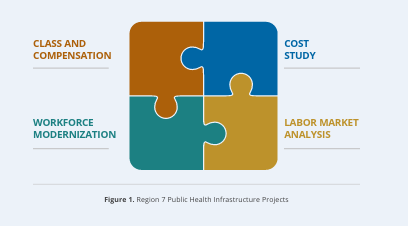
Beginning in March 2023, Health Management Associates (HMA), Evergreen Solutions, LLC, and Trailhead Strategies (collectively, the “HMA team”) partnered with Region 7 to assist with efforts to improve its public health workforce. These partnered projects included the (1) Workforce Investment and Modernization Study, which aimed to improve the competitiveness and retention of the public health workforce in Region 7; (2) the Cost Study to assess Region 7’s capacity to provide public health services and estimate total costs associated with delivering Foundational Public Health Services and Capabilities (FPHSCs); and (3) a supplementary Labor Market Analysis which collected data on the current state and projected needs of the public health workforce. These projects (shown in Figure 1) provide support for each county within Region 7 to create a scalable and flexible approach for implementing future changes in its public health workforce.

APPROACH

To complete the Workforce Investment and Modernization Study, the HMA team implemented a multi-phased approach to develop a set of workforce retention recommendations, including conducting a class and compensation assessment, market survey, qualitative interviews with regional staff to assess workforce perceptions, and a literature review of peer-reviewed best practices and cost methodologies to develop two reports. The effort required bringing together experts in public health workforce and services, as well as local staff who understand the unique nature of North Carolina’s individual counties. The strong partnership and rapport established throughout the project allowed everyone to effectively tailor recommendations and final products to ensure that they would be effective and actionable for Region 7 to both invest in and sustain a public health workforce.

For the Cost Study, HMA expanded on one such recommendation which advised that Region 7 counties develop a 5- to 10-year plan to promote public health workforce class and compensation competitiveness. To help accomplish this, HMA developed the Cost Study Tool to assess Region 7 LHDs’ current capacity for providing FPHSCs and support each county within the Region to create a scalable and flexible approach for implementing future changes in its public health workforce. To develop the Cost Study Tool, the HMA team conducted a literature review of various public health cost methodologies to determine the most applicable one for use in this work, resulting in the development and refinement of the Cost Study Tool to estimate the 5-year costs of providing FPHSCs.

Finally, the HMA team also conducted the Labor Market Analysis to enhance Region 7’s understanding of the current state and projected needs in the North Carolina public health system and, as a result, inform long-term decision-making and strategic planning (e.g., taking proactive measures to address potential shortages or shifts in skill requirements).

TESTIMONIAL

“HMA provided Region 7 with a carefully constructed evaluation of LHDs’ recruitment and retention practices, recommendations for modernization efforts, and the tools and data needed to quantify current and future costs and staffing to provide FPHSCs. HMA’s subject matter expertise and understanding of our individual health departments resulted in an integrated plan for modernizing our health departments as we advocate for and support an incredible public health workforce in North Carolina now and in the future.”

Lisa Macon Harrison, Health Director, Granville Vance Public Health

RESULTS

For each project, the HMA team developed a robust report of quantitative and qualitative findings associated with the project’s objectives.

For the Workforce Investment and Modernization Study, this included summaries of the class and compensation results for each county in Region 7 and qualitative interviews with public health staff. The report also included 15 recommendations related to: class and compensation; strategic planning, evaluation, and continuous quality improvement; recruitment and human resource practices; retention and workplace culture; local and regional partnerships and shared services; and technology, equipment, and physical location.

For the Cost Study, the report summarized HMA’s literature review of public health cost methodologies and described how the HMA team applied the selected methodology to develop and refine a prototype data-driven tool to estimate the costs of providing FPHSCs in each Region 7 county. Concurrent with the report, the HMA team also developed a user guide to accompany the Cost Study Tool, both of which are to be distributed for Region 7 LHDs’ use. Finally, the HMA team provided a report detailing the following Region 7 factors:

  • Region Overview
  • Occupation Selection
  • Labor Market Growth and Occupation Trends
  • Job Posting Data
  • Major Employers
  • Demographics (Race and Ethnicity, Gender, Age)
  • Skill Analysis
  • Occupation Forecasting
  • 10-Year Analysis
  • Educational Alignment
  • Aging Population

HMA believes that, in partnership, these studies will provide each LHD of Region 7 with the tools necessary to develop a sustainable, actionable public health workforce that will be prepared to continuously serve and improve the health of all North Carolinians now and in the future.

Blog

FY 2025 Medicare hospital inpatient final rule to affect hospital margins and administrative procedures

Read Blog

This week, our In Focus section reviews the policy changes that the Centers for Medicare & Medicaid Services (CMS) finalized on August 1, 2024, in the fiscal year (FY) 2025 Medicare Hospital Inpatient Prospective Payment System (IPPS) and Long-Term Acute Care Hospital (LTCH) Final Rule (CMS-1808-F). This year’s IPPS final rule will impact hospital margins and administrative processes beginning October 1, 2024. 

The remainder of our article delves into five of the key policy changes included in the final rule. 

Key provisions in the FY 2025 Hospital IPPS and LTCH Final Rule 

For FY 2025, CMS will modify several hospital inpatient payment policies. We highlight five of these policies because they will have the most significant impact on Medicare beneficiaries, hospitals and health systems, payors, and manufacturers:  

  1. The annual inpatient market basket update and changes to the standardized payment amount  
  2. New technology add-on payment (NTAP) policy changes 
  3. Implementation of the Transforming Episode Accountability Model (TEAM) bundled payment model in 2026 
  4. Hospital wage index changes and labor market adjustments 
  5. Severity of illness increase for housing insecurity social determinants of health (SDOH) codes  

Several of these and other policy changes for FY 2025 will become effective October 1, 2024.  

Market basket update 

Final rule: Overall CMS’s Medicare 2025 Hospital IPPS Rule will increase hospital inpatient payments to acute care hospitals by 2.9 percent from 2024 to 2025, an estimated increase of approximately $2.9 billion after other policy changes are included.  

Health Management Associates (HMA) analysis: CMS’s 2.9 percent increase is largely based on an estimate of the rate of increase in the cost of a standard basket of hospital goods—the hospital market basket. For beneficiaries, this payment rate increase will lead to a higher standard Medicare inpatient deductible and increase out-of-pocket costs. The finalized payment increase (2.9 percent) is larger than the increase included in CMS’s IPPS Proposed Rule (2.6 percent) but continues to fall below economy-wide inflation over the past year (3.5 percent).1,2 Importantly, after accounting for the various policy changes made within the final rule (e.g., wage index reclassifications) we anticipate individual cases will experience an average payment increase of 1.7 percent.  

Transforming Episode Accountability Model 

Final rule: CMS finalized the creation of a new mandatory episode-based CMS Innovation Center methodology—TEAM. Under TEAM, selected acute care hospitals will coordinate care for people with traditional Medicare who undergo one of the following surgical procedures: 

  • Lower extremity joint replacement 
  • Surgical hip femur fracture treatment 
  • Spinal fusion 
  • Coronary artery bypass graft 
  • Major bowel procedure 

Hospitals in the model will assume responsibility for the cost and quality of surgical care through the first 30 days after a Medicare beneficiary leaves the hospital. Hospitals also must refer patients to primary care services to support optimal long-term health outcomes. Hospitals will be assigned to different risk tracks to allow a graduated path to ease in to full-risk participation.  

HMA analysisThe mandatory nature of this model requires hospitals in the selected geographic areas to begin to prepare for implementation of the model requirements in 2026. TEAM builds on and combines previous models such as the bundled payment for care improvement (BPCI) and the comprehensive care for joint replacement (CJR) models. Hospitals in roughly 23 percent (188 of 925) of the nation’s core-based statistical areas (CBSAs) are required to participate in this advanced payment model, with some exceptions, such as hospitals in Maryland and Sole Community Hospitals. Participating hospitals will be required to report various quality measures, and payment will be based on spending targets and include retroactive reconciliation. Reimbursement under the model will follow four different tracks, which vary by the level of upside and downside risk that the hospital accepts and with a specific track for safety net hospitals. 

Hospital Wage Index Adjustments and Labor Market Changes  

Final rule: CMS finalized two wage index policies for FY 2025. First, CMS extended the temporary policy finalized in the FY 2020 IPPS/LTCH PPS final rule for three additional years to address wage index disparities affecting low wage index hospitals, which includes many rural hospitals. Second, as required by law, CMS revised the labor market areas used for the wage index based on the most recent CBSA delineations issued by the OMB based on 2020 Census data. 

HMA analysis: The two wage index policy changes for FY 2025 will have important positive and potentially negative consequences on hospital payment. The policy to extend the low wage index policy for three more years will allow many hospitals with low wage indexes to increase their wage index and their payment rates across all Medicare severity diagnosis-related groups (MS-DRGs). 

Specifically, the roughly 800 hospitals with wage indexes below 0.9007 (the 25th percentile across all hospitals) will automatically receive an increase in their wage index and payment rates for all inpatient cases. This policy will bring additional millions of dollars to individual rural hospitals in FY 2025. The second policy is a statutorily required update to the labor markets used to establish CMS’s hospital wage indexes. To implement this policy, CMS will use US Census Bureau data to redefine urban and rural markets. As a result, CMS will redefine 53 urban counties as rural and will newly redefine 42 rural counties containing a hospital as urban. These changes will disrupt various hospital payment policies for hospitals in these counties. The overall impact of both geographic policy changes for FY 2025 will be to increase inpatient payment rates to rural hospitals.  

Revision to Social Determinants of Health Housing Insecurity Diagnosis Coding 

Final rule: CMS finalized a change in the severity designation of the seven ICD-10-CM diagnosis codes that describe inadequate housing and housing instability. Under the final rule, these codes are changing from non-complication or comorbidity (non-CC) to complication or comorbidity (CC) based on the higher average resource costs of cases compared with similar cases without these codes.  

HMA analysis: This new policy will enable hospitals to receive higher inpatient payment rates when they provide care for patients with inadequate housing or housing instability are served. Specifically, this policy change will result in assigning cases involving patients with one of these codes to a higher-level MS-DRG. Hospital staff will want to ask patients about their housing upon admission and discharge to accurately document this critical SDOH characteristic.  

New technology add-on payments 

Final rule: CMS finalized three changes to the NTAP program and approved several products for NTAPs in FY 2025.  

HMA analysisCMS seems willing to increase NTAP payments in certain limited situations to boost selected policy goals but rejects comments seeking to increase the percentage for sickle cell products or expand the higher payments to other medical conditions. In addition, portions of the final rule indicate that CMS is applying some of the criteria for NTAPs more strictly than in recent years. If this trend continues, it may be more difficult for future new technologies to be approved for NTAPs. 

Connect with Us

HMA’s Medicare Practice Group works to monitor legislative and regulatory developments in the inpatient hospital space and assess the impact of inpatient payment, quality, and policy changes on the hospital sector. We will continue to follow these and other changes happening to hospitals and are available to provide additional detail on these or other policies in the final rule. If you have any questions, please contact our featured experts below.


HMA Weekly Roundup

August 7, 2024

FY 2025 Medicare Hospital Inpatient Final Rule Will Alter Hospital Margins and Change Administrative Procedures

Read Roundup
Case Study

Enabling County Governments to Plan for Use of Opioid Settlement Funds

Download

THE CLIENT

Cabarrus County, NC, located in the south-central part of the state, is the ninth most populous county in North Carolina with a population around 226,000 people as of the 2020 census. It stands to receive approximately $22 million in opioid settlement funds over the next 18 years.

BACKGROUND

Cabarrus County engaged HMA to support the development of a strategic plan that will guide the use of the County’s opioid settlement funds. In partnership with applicable cities and municipalities, the collaborative planning process provided opportunities to engage the community—both professionals working in and around the opioid space as well as those with lived experience—to hear the needs of residents, understand current services offered and existing strengths, and explore barriers to accessing care.

APPROACH

HMA supported all aspects of this project – from process design to research to stakeholder engagement. Below is a brief summary of the key areas of HMA’s support:

Process Design

HMA met with Cabarrus County’s Assistant County Manager, Dr. Aalece Pugh, early in the process to finalize the strategic planning approach, establish protocols for project management and oversight, and identify stakeholders to engage.

Stakeholder Engagement

HMA coordinated and facilitated a series of stakeholder engagement efforts to solicit feedback from key constituencies. HMA facilitated a series of interviews and 14 focus groups – including four focus groups with individuals with lived and living experience. HMA also designed, administered, and analyzed a community survey that received 250+ responses.

Decision-Making

Overseeing the planning process was a team of county leaders – called the Community Response Team – that included representatives from the board of commissioners, county administration, behavioral health, emergency medical services, and the county jail. HMA facilitated four meetings of this group to review data, discuss stakeholder engagement findings, and prioritize strategies to fund.

Deliverable Development and Presentation

Based on the input from the Community Response Team, HMA developed a robust strategic plan deliverable. In addition to developing the document, HMA also supported a presentation to the Board of Commissioners seeking approval of the plan. SUBJECT MATTER EXPERTISE HMA assembled a team that was uniquely qualified to support this work. The team included individuals with the functional strategic planning and stakeholder engagement expertise required to complete this work, as well as subject matter experts in medications for addiction treatment and harm reduction which proved valuable. HMA’s team also included individuals with a depth of county government experience in North Carolina. They were responsive and worked together seamlessly to provide high-quality support throughout the engagement. HMA provided a clear plan and direction to successfully accomplish Cabarrus County’s intended goals, while also demonstrating an ability to adapt as needs and circumstances changed.

TESTIMONIAL

“Nine months ago, and through a rigorous and competitive selection process, HMA was selected to lead our opioid settlement strategic planning efforts. I am very pleased with the final product and the work of HMA’s team of professionals to help Cabarrus develop a strategic roadmap. HMA’s levels of professionalism, expertise, and engagement were above reproach.”

Dr. Aalece Pugh, Assistant County Manager, Cabarrus County Government

RESULTS

The final deliverable was a five-year Opioid Settlement Collaborative Strategic Plan. Cabarrus County wanted to assure that the voice of the community, persons with lived experience, providers, and key stakeholders were elevated to inform the final priorities. T he document provides an overview of the crisis and settlement funds, highlights the strategic planning process and input received, and describes the prioritized strategies and implementation plan. The strategic plan will serve as a guide for the use of opioid settlement funds for years to come, providing a clear roadmap while offering enough flexibility to make adjustments as the crisis continues to evolve. The plan was presented and approved by the Board of Commissioners in June 2024. The plan document can be viewed at cabarrus-county-strategic-plan-opioidsettlements.pdf (cabarruscounty.us)

Ready to talk?