Insights

HMA Insights: Your source for healthcare news, ideas and analysis.

HMA Insights – including our new podcast – puts the vast depth of HMA’s expertise at your fingertips, helping you stay informed about the latest healthcare trends and topics. Below, you can easily search based on your topic of interest to find useful information from our podcast, blogs, webinars, case studies, reports and more.

Show All | Podcast | Blogs | Webinars | Weekly Roundup | Videos | Case Studies | Reports | News | Spotlight

Filter by topic:

Receive timely expert insights on topics you care about.

Select Topics

1307 Results found.

Case Study

Helping a Medicare Advantage Plan Identify Gaps in Part D Benefit Quality

Download

THE CLIENT

The client for this project is a health plan that provides both traditional Medicare Advantage (MA) plans and those that address chronic conditions and social determinants of health, to reduce healthcare disparities among historically underserved populations in the central and eastern United States. Their plans integrate Medicare Part A and Part B benefits with Part D prescription drug coverage, along with providing robust extra benefits.

BACKGROUND

MA Plans are assuming bigger risk in their Part D benefit spending than in previous years due to recent changes in MA rules. Audits of the program, a requirement to participate in MA, will mean that there are increased compliance and operational risks in how plans go about serving their members with the Part D benefit. As the regulatory environment changes, guarantees in pharmacy benefit manager (PBM) contracts need solidifying, and will require rigorous oversight by the plans to reduce risk. MA plans need to ensure alignment and collaboration across their organizations and with vendors to optimize initiatives in quality and Stars. It is also important to establish alignment and engagement early within the yearly bid cycle. T he client engaged HMA due to our diverse expertise in Part D plans including operations, PBM and vendor oversight, health plan leadership, Stars and quality programs, financial and actuarial analysis, and compliance.

APPROACH

HMA performed an assessment to analyze and measure the effectiveness of Part D operations, including a comprehensive review of the plan’s Part D benefit, and identified gaps in Part D policies, procedures and staffing. The effort also documented operational efficiencies, quality improvement recommendations and opportunities for the client to increase their Part D Star ratings. HMA identified areas of improvement and provided actionable insights to guide future decisions. The assessment utilized a combination of data, documents and interviews to cover various dimensions such as performance, compliance, effective oversight, and collaboration.

RESULTS

The final report recommended a series of organizational changes and quality improvements to enable the client to optimize their Part D operations. Recommendations were made in the following areas:

  • Policies and procedures: Identified gaps in the client’s internal policies and procedures, and provided recommendations to cure the deficiencies, including the development of desk-level guides.
  • Comprehensive oversight: Identified oversight gaps in vendor management and provided recommendations to improve.
  • Part D strategic leadership & proposed new staffing model: HMA drafted a best-in-class organization and staffing plan that permits the client to scale up with a delineated staffing structure designed to ensure optimal oversight of Part D quality.
  • Collaboration: Identified gaps in PBM contracts and provided recommendations for negotiating and bolstering account management. The new plan also recommends expanding the Part D team’s role and involvement with provider engagement teams in order to increase overall CAHPS results to improve Star ratings.
  • Financial/actuarial analysis: Identified changing regulatory reporting (Direct and Indirect Remuneration) and capturing required information related to Manufacturer Discount Program (MDP) and Medicare Prescription Payment Plan (M3P).

HOW HMA CAN HELP YOUR ORGANIZATION

If your organization wants to undertake a similar review of your Part D organization, we encourage you to engage with your teams to review and prioritize findings and recommendations to build out best practices and best in class plan operations. HMA can help you develop a plan and guide you through the processes, identify issues that might not otherwise be identified internally, and provide recommendations for ways to optimize your efforts. Our team brings together expertise in Medicare Advantage, Part D, pharmacy, quality and accreditation programs, on the ground leadership experience in health plans, financial and actuarial expertise, with in-depth insider knowledge from our work in states across the country. Contact us to learn more about how HMA can help.

Blog

Turning HR 1 Medicaid Work Requirements into Workforce Development Opportunities: Lessons from HMA’s Recent Webinar

Read Blog

As State Medicaid Agencies prepare for the operational and policy shifts introduced by HR 1’s Medicaid Work Requirements, the stakes could not be higher. While the intent of these provisions is to encourage workforce participation, their real-world implementation risks leaving behind those who already face systemic barriers—particularly rural communities, people of color, and individuals with chronic conditions.

In a recent HMA webinar, Work That Works: Creating Sustainable Employment Pathways for Medicaid-Enrolled Communities,” Shannon Joseph, Senior Consultant and Workforce Development expert at Health Management Associates (HMA), and Dr. Alicia Johnson, Managing Principal and strategic advisor on Medicaid transformation at HMA, led a dynamic conversation for state leaders and Medicaid stakeholders. Their core message was clear: with thoughtful design, states can transform work requirements from punitive compliance metrics into powerful tools for workforce development and economic mobility.

The Policy Landscape: HR 1 and State Readiness

HR 1 establishes new federal standards that require states to verify that certain Medicaid enrollees are meeting minimum work or community engagement hours as a condition of continued coverage. While exemptions exist for specific populations, the administrative lift, data infrastructure, and interagency coordination needed to operationalize these requirements are significant.

Historically, states that have experimented with work requirements, such as Arkansas, Kentucky, and New Hampshire, have seen coverage losses not because beneficiaries were unwilling to comply, but because systems were unprepared to support them. Barriers such as limited broadband access, low literacy rates, unstable employment markets, and health disparities disproportionately impacted rural residents and people of color.

Key Challenge #1: Avoiding Disproportionate Impact on Vulnerable Communities

One of the most pressing concerns is that work requirements may exacerbate disproportionate access. In rural communities, jobs that meet hour thresholds are often scarce, transportation options are limited, and childcare access is inconsistent. For people of color, historic and systemic barriers to employment persist, from lack of work credentials, to lack of tailored workforce programs. For individuals with chronic conditions or disabilities not formally classified as exempt, participation can be difficult or intermittent.

Dr. Johnson emphasized the importance of a community-based approach that leverages local resources and local social safety nets to increase participation and outcomes but developing targeted strategies that address the varying needs of the Medicaid community.

“We cannot simply apply a one-size-fits-all model. States must design implementation strategies that close population health gaps and overcome the social structural gaps in their systems, not widen them. Social Determinants of Health are not just passive background factors; they actively shape people’s ability to achieve and maintain good health and life outcomes.”

Best Practice: Conduct community-level impact assessments prior to implementation to identify geographic, demographic, and health-related disparities. Use this data to tailor outreach, exemptions, and workforce partnerships accordingly.

Key Challenge #2: Shifting from Compliance to Workforce Integration

Too often, states have approached work requirements as a compliance exercise—tracking hours, verifying exemptions, and ensuring federal reporting—without connecting to broader workforce development ecosystems. This narrow focus misses the opportunity to align Medicaid with labor, education, and economic development systems.

Shannon Joseph pointed to states like Louisiana, where cross-agency partnerships have begun to link Medicaid beneficiaries to workforce boards, training programs, and supportive services, “The most successful models are those where Medicaid is not working alone. When states braid resources and align objectives, work requirements can become a springboard for meaningful employment.”

Best Practice: Develop formal MOUs between Medicaid agencies, state workforce boards, Departments of Labor, and community colleges to share data, coordinate referrals, and leverage federal funding streams like SNAP E&T and WIOA.

Key Challenge #3: Building Administrative Infrastructure and Data Systems

Another central theme of the webinar was the need for robust data infrastructure. Many states lack integrated eligibility systems capable of tracking employment hours, exemptions, and participation across multiple programs. Without this integration, states risk errors, delays, and unnecessary disenrollments.

HMA highlighted the value of interoperable data systems and FHIR-based architecture that allow Medicaid agencies to exchange information with workforce agencies in real time. Digital equity must also be part of the conversation, especially in rural areas where broadband access remains a challenge.

Best Practice: Prioritize system modernization investments and interoperability pilots to build the technical backbone for equitable and efficient implementation such as the one in Georgia launched for the Pathways program.

Key Challenge #4: Partnering with Communities for Culturally Responsive Implementation

Dr. Johnson underscored that states cannot achieve equitable implementation from the statehouse alone. Partnerships with community-based organizations (CBOs), faith institutions, and local employers are critical to reaching populations who may be distrustful of government systems or unaware of new requirements.

Community partners are trusted messengers. They can bridge gaps in communication, help with navigation, and ensure that people understand both their obligations and opportunities,
– Dr. Alicia Johnson

Best Practice: Create local implementation collaboratives that include Medicaid staff, CBOs, workforce entities, and providers to co-design outreach and support strategies tailored to community needs.

Key Challenge #5: Aligning Metrics with Meaningful Outcomes

Finally, both speakers cautioned against relying solely on compliance metrics (e.g., hours reported, exemptions processed) to evaluate success. Instead, states should track workforce and health outcomes, such as employment stability, income growth, retention in coverage, and health status improvements. Shannon Joseph noted, “If our only measure of success is whether someone uploads their work hours, we’ve missed the point. The goal should be sustainable pathways to economic mobility and improved health.”

Best Practice: Develop a multi-dimensional performance dashboard that blends compliance data with workforce outcomes, health equity indicators, and beneficiary experience measures.

Solutions & Strategies for States: A Roadmap

Drawing from the discussion, HMA outlined a set of strategic recommendations for state Medicaid agencies:

  1. Conduct Equity Impact Assessments: Identify populations at risk of adverse impacts and tailor exemptions and support services accordingly.
  2. Align with Workforce Systems: Establish data-sharing agreements and coordinated referral pathways with workforce boards and community colleges.
  3. Invest in Data Modernization: Build interoperable systems to reduce administrative burden and ensure real-time verification.
  4. Engage Trusted Community Partners: Leverage CBOs and local institutions for outreach, navigation, and culturally responsive engagement.
  5. Shift Metrics to Outcomes: Measure employment stability, economic mobility, and health outcomes—not just compliance.
  6. Pilot, Learn, Scale: Start with targeted pilots in high-need communities, evaluate rigorously, and scale strategies that work.

HMA’s Role: Strategic Partner to States Developing Public/Private Partnerships to Build Genuine Pipelines of Work

HMA has deep expertise helping states design, implement, and evaluate Medicaid work requirement policies in ways that are operationally sound, legally defensible, and Medicaid Member-centered. Our team has supported states in:

  • Conducting 1115 waiver design and evaluation,
  • Integrating Medicaid and workforce systems,
  • Designing targeted outreach strategies for rural and underserved populations,
  • Implementing digital modernization projects, and
  • Developing performance dashboards that focus on outcomes.

HMA brings both policy acumen and on-the-ground implementation experience, enabling states to navigate complex regulatory landscapes while advancing population health and real-world outcomes.

Learn More & Partner with HMA

If you missed the live webinar, you can watch the replay here.

You might also be interested in attending the HMA National conference, Adapting for Success in a Changing Healthcare Landscape.in New Orleans October 14-16, for our session on Making Medicaid Work Requirements Work, where we will draw on lessons from states like Georgia.  Panelists will explore what to watch for in program design, including strategies to support workforce readiness, reduce administrative burden, and maintain access to care.  Speakers include:

Online registration closes October 10, but if you act now, you can use the code FLASH25 for up to $475 off the standard registration fee for the full conference. 

For more information about how HMA can support your state in strategic planning, operational design, impact analysis, and workforce integration, please contact our experts below.

Blog

HMA Enrollment Update: Medicaid Managed Care Organizations See Drop in Enrollment in 2Q25

Read Blog

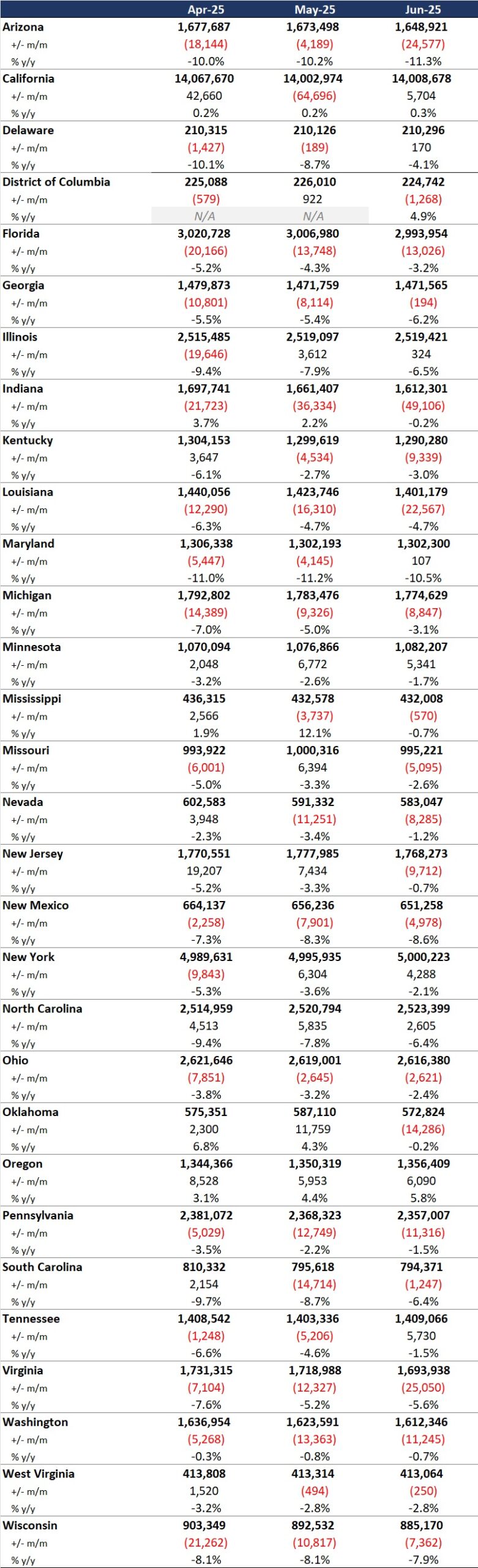
This week, our second In Focus provides insights into Medicaid managed care enrollment in the second quarter of 2025. Health Management Associates Information Services (HMAIS) obtained and analyzed monthly Medicaid enrollment data in 30 states,[1] offering a reliable baseline and timely view of the immediate impact of the current policy landscape as new federal policies take effect.

This analysis presents a snapshot of HMAIS’s comprehensive detailed quarterly Medicaid managed care enrollment report (available by subscription), which includes plan-level information for nearly 300 health plans in 41 states, corporate ownership, for-profit versus not-for-profit status, and similar information regarding publicly traded plans. Table 1 provides a sample of enrollment trends, representing 57 million Medicaid managed care enrollees of a total of 66 million Medicaid managed care enrollees nationwide. Data reporting periods and program coverage vary by state, so figures may not be fully comparable.

Key Insights from 2Q25 Data

The 30 states included in our review have released monthly Medicaid managed care enrollment data—via a public website or in response to a public records request from HMAIS—for April through June of 2025. This report reflects the most recent data posted or obtained from states. HMA has made the following observations regarding the enrollment data:

  • Year-over-year decline. As of June 2025, in the 30 states reviewed, Medicaid managed care enrollment declined by 1.6 million members year-over-year, a 2.7 percent drop from June 2024.
  • Widespread decreases. Of the 30 states, 27 experienced enrollment declines in June 2025 compared to June 2024. Oregon and the District of Columbia saw modest growth, while California remained flat (Table 1).
  • Sharpest contractions. Arizona and Maryland reported double-digit percentage drops in enrollment in June 2025 (Table 1), underscoring the uneven impact of redeterminations and eligibility policy changes.
  • Difference among expansion and non-expansion states. Among the 24 states included in the analysis that expanded Medicaid, enrollment fell by 1.2 million—a 2.5 percent drop—to 49.2 million. The six non-expansion states saw a steeper proportional decline of 4.2 percent, to a total of 8 million enrollees.

Table 1. 2Q25 Monthly MCO Enrollment by State, April–June 2025

Note: “+/- m/m” refers to the enrollment change from the previous month, and “% y/y” refers to the percentage change in enrollment from the same month in the previous year.

The data in Table 1 should be viewed as a sampling of enrollment trends across these states rather than as a comprehensive comparison, which cannot be established based solely on publicly available monthly enrollment data. It is also important to note the limitations of the data presented. For example, not all states report data at the same time during the month, resulting in a range of snapshots from the beginning to the end of the month. Second, in some instances, the data cover all Medicaid managed care programs, while in others they reflect only a subset of the broader managed Medicaid population, depending on what data is publicly available.

Market Share and Plan Dynamics

HMAIS’s report includes plan-level details for nearly 300 plans, covering corporate ownership, program participation, and tax status. As of June 2025, Centene continues to lead the national Medicaid managed care market with 17.8 percent share, followed by Elevance (10.4 percent), United (8.6 percent), and Molina (6.2 percent; see Table 2).

Table 2. National Medicaid Managed Care Market Share by Number of Beneficiaries for a Sample of Publicly Traded Plans, June 2025

What to Watch

The OBBBA (P.L. 119-21) calls for significant changes to Medicaid eligibility and enrollment policies, including work requirements and more frequent eligibility redeterminations. Projections indicate that Medicaid and Children’s Health Insurance Program enrollment could decline by up to 7.5 million people by 2034. In addition, the Centers for Medicare & Medicaid Services (CMS) has announced that it will not approve or extend waivers for multi-year continuous eligibility for adults or children.

As these policies are implemented, state governments and healthcare organizations should prepare for increased administrative complexity, potential coverage disruptions, and the resulting effect on MCO revenue and value-based care arrangements.

Connect with Us

HMA is home to experts who know the Medicaid managed care landscape at the federal and state levels. As the Medicaid landscape continues to evolve, HMAIS equips stakeholders with timely, actionable intelligence, including enrollment data, quarterly by-plan and by-state enrollment reports, financials, Medicaid demonstration and Rural Health Transformation program tracking, and a robust library of publicly available Medicaid-related documents. HMAIS combines publicly available information with HMA expert insights on the structure of Medicaid in each state, as well as our comprehensive, proprietary State Medicaid Overviews.

For questions about the HMAIS enrollment report and information about the HMAIS subscription, contact our experts below.

Blog

The Rural Health Transformation Program: Options to Address the Maternity Care Crisis

Read Blog

This article is part of HMA’s Weekly Roundup series on the RHT Program, highlighting key opportunities and considerations for states and healthcare organizations.

The Centers for Medicare & Medicaid Services (CMS) recently launched the Rural Health Transformation (RHT) Program, which is intended to help states reimagine and rebuild rural healthcare delivery. As outlined in our earlier In Focus article, Rural Health Transformation Program Represents a One-Time Opportunity to Reshape Rural Care, this historic $50 billion federal investment provides states with flexibility to design and implement strategies that improve access, quality, and outcomes in rural communities.

As states develop their RHT applications, they can consider a range of approaches to address persistent gaps in care particularly in maternal health, where rural residents often face limited access to local services. A range of solutions is needed to expand and stabilize access to maternal care, given the shortage of close-to-home birthing care. This article explains one such option: investing in midwifery.

Maternity Care in Rural Communities

Maternity Care Deserts Driving a National Maternal Health Crisis

Families in rural communities—and some urban communities—face “maternity care deserts,” meaning they do not have access to a birthing facility or obstetric clinician. Hospital closures are another reality in rural communities, with additional closures projected. Even in larger communities where a hospital is open, obstetric services could be shut down. These deserts are a key driver of the national maternal health crisis. In Nowhere to Go: Maternity Care Deserts in the US, the March of Dimes (MOD) reported that “two in three maternity care deserts are rural counties (61.5%)” and that “counties with low access to telehealth were 30% more likely to be maternity care deserts.” 

Midwifery as an Option for Rural Communities

Midwives are trained healthcare professionals who specialize in supporting women through typical, low-risk pregnancies. They provide care during pregnancy, labor, and the postpartum period. There are several types of midwives, each with different training and credentials. States determine which types of midwives may practice and under what conditions.

Expanding the midwifery workforce can be part of a broader strategy to improve access, particularly in rural areas where hospitals and obstetric providers are scarce. In some places, midwives already serve as a critical access point for maternal care in rural communities, with midwives attending to 30 percent of deliveries in rural hospitals.

The Rural Health Transformation Program Can Help Address the Crisis

The strategic goals of the RHT, as outlined in the CMS application materials and Notice of Funding Opportunity (NOFO), are designed to guide states in transforming rural healthcare delivery. These goals are grounded in the statutorily approved uses of funds and must be explicitly addressed in each state’s RHT application.

Midwives have long contributed to expanding access to maternal care across diverse settings. For example, midwives can support preventive health by providing prenatal and postpartum care in community settings. Their integration into rural care teams may help sustain access to maternity services where hospitals and obstetric providers are limited. States may also consider workforce development strategies, such as expanding midwifery training and retention programs, and innovative care models—including hub-and-spoke systems—that incorporate midwives to improve coordination and person-centered experiences (Figure 1).

According to Ginger Breedlove, PhD, CNM, founder of Grow Midwives, one of the nation’s leading midwifery organizations, “midwifery aligns with all strategic goals of the RHT program.”

States may consider midwifery as one of many options to help build sustainable, community-centered maternity care systems that reflect the RHT Program’s vision for rural health transformation.

Figure 1. Midwifery Alignment with RHT Strategic Goals

RHT Strategic GoalsMidwifery Alignment
Make Rural America Healthy AgainMidwives support preventive, community-based maternal care and contribute to improved outcomes, such as higher rates of spontaneous vaginal delivery and breastfeeding and lower rates of preterm birth and low birthweight.
Sustainable AccessMidwives can serve as consistent local access points for maternity care, particularly in areas with limited obstetric services. States with midwifery care more fully integrated have better maternal and infant health outcomes.
Workforce DevelopmentMidwifery workforce initiatives expand the pool of high-skilled providers practicing at the top of their license, aligning with goals to strengthen recruitment, retention, and licensure flexibility in rural areas.
Innovative CareMidwives can be integrated into flexible care arrangements—hub-and-spoke or CMS’ Transforming Maternal Health model—alongside doulas and community health workers, improving care coordination and patient experience.
Tech InnovationMidwives can leverage telehealth, remote monitoring, and data-sharing and digital care platforms to extend the reach of maternal care in rural communities and connect patients to the broader maternal care system, including remote specialist consultations. Tech innovations ensure that women receive the appropriate level of care for their risk and needs.

Connect with Us

Health Management Associates (HMA) has deep expertise in supporting states and healthcare organizations across all phases of rural health transformation. Our team can assist with strategy and writing grants, program design, and implementation plans tailored to specific state goals and approaches. Whether states choose to explore midwifery or other care delivery models, HMA can help define the approach that best fits the needs of rural communities and support organizations in transforming workflows and operations, implementing new initiatives, and enhancing the systems and IT enhancements that sustains them.

HMA brings together experts in maternal health, finance, rural communities, and delivery systems, contact our experts below.

Brief & Report

Coding, Coverage, and Reimbursement: Considerations for Women’s Health Access

Download

Persistent gaps in women’s health research, funding, clinical outcomes and access are increasingly well-studied, however less emphasis is placed on the role of coding, coverage, and reimbursement and whether male or female gaps exist in each of these key market access domains. The paper, Coding, Coverage and Reimbursement: Considerations for Women’s Health Access, examines challenges in these areas and offers recommendations to increase awareness, establish evaluative processes, and collaborative action to achieve incremental policy changes that can have a significant impact over time.

Blog

Navigating the Government Shutdown: Safeguarding the RHT and “Make Rural America Healthy Again” Initiatives

Read Blog

As of October 1, 2025, federal budget negotiations have led to a temporary government shutdown, prompting healthcare leaders to monitor potential impacts on programs administered by the Centers for Medicare & Medicaid Services (CMS). While federal agencies have contingency plans in place, to date CMS has not announced any potential impacts, including to the timelines for the application and award dates for the Rural Health Transformation (RHT) Program.

State governments and healthcare leaders should continue to develop and prepare to submit their applications for the RHT program, which provides a significant opportunity to revitalize rural healthcare infrastructure through strategic investments in access, workforce, innovation, and technology.

Strategies for States to Efficiently Develop Winning Applications

To maintain momentum and optimize their resources during this period of uncertainty in federal government funding and operations:

1. Strengthen Internal Coordination

  • Establish cross-agency working groups to manage RHT program planning and execution
  • Use internal policy experts to interpret the Notice of Funding Opportunity (NOFO) guidance and align initiatives with CMS priorities

2. Leverage Existing Data and Evidence

  • Use state-level health data to identify high-impact areas for investment
  • Prioritize initiatives that align with the RHT program’s five strategic goals:
    • Prevention and chronic disease management
    • Sustainable access
    • Workforce development
    • Innovative care models
    • Technology innovation

3. Utilize Project Management Tools

To support strategic planning and initiative tracking, Health Management Associates (HMA) is offering a free RHT Project Management Tool. This resource helps states:

  • Organize and manage initiative development
  • Cross-reference projects with NOFO categories
  • Track progress and performance metrics
  • Facilitate collaboration across stakeholders

Access the RHT Project Management Tool from HMA:

Complete the form to download
the RHT Project Management Tool

Engage with CMS Resources Proactively

States and their partners can continue to refer to key CMS resources:

States can also submit questions to [email protected].

Final Thoughts

While the government shutdown presents challenges for many federal programs, it remains unclear whether there will be any direct impact on CMS’s engagement with states regarding the Rural Health Transformation Program. Regardless of federal circumstances, this moment highlights the value of state-level leadership and innovation. By leveraging tools like HMA’s project management platform and aligning with CMS’s strategic goals, states can continue advancing rural health transformation and position themselves for success, even in uncertain times.

Blog

Big changes ahead for ACA marketplace plan enrollment and premiums

Read Blog

With changes to ACA subsidies included in H.R. 1, the healthcare industry could face the biggest change since the passage of the ACA.

Health insurance coverage is likely to be disrupted by changes in ACA marketplace financing, particularly due to the projected reductions in ACA subsidies, as well as the impacts of eligibility and enrollment changes in Medicaid. At a recent HMA webinar, our ACA marketplace experts detailed a number of challenges that health plans participating in the ACA will face in the coming months and years due to these new policies, and some of the thinking behind ways that plans can take action now while Congress debates whether to extend any of the subsidies. 

The webinar touched on areas including:

  • How the recent policy and funding changes will affect strategic planning, longer term goals, and 2027 plan year rate setting;
  • Actuarial analysis/rate setting/risk adjustment insights from HMA’s actuaries;
  • Changes likely to occur in plan and marketplace operations in both state exchanges and on the healthcare.gov federal platform;
  • The importance of effective communications to avoid creating consumer confusion, and ideas on stakeholder engagement strategies;
  • And, how all of this will impact workforce/access to care, and the likelihood of changes to in-network care

The ACA marketplace is bracing for impacts for the 2026 plan year, depending upon potential Congressional actions in the remaining months of 2025.  In May 2025, CMS put out a rate filing bulletin for plan year 2026 that gave technical directions for submissions and urging states and issuers to be prepared to react to Congressional action. This was a signal that the administration anticipated potential policy changes between May when they put this out and the rate filing window in the fall.

This is reminiscent of the ACA changes that happened in 2017, when there was litigation around cost-sharing reduction (CSR) subsidies that needed to be appropriated. (This was during the “repeal and replace” debate in Congress, in that same July-August timeframe.) When repeal efforts failed in Congress, the Administration decided not to pay CSRs, necessitating a bipartisan agreement to address this new financing issue.  Changes to CSRs were dropped from this year’s law but could be addressed before the end of the year in upcoming appropriations bills in Congress.

“ACA plan strategies need to change to ensure that they are considering different outcomes in the market composition and competitor changes to pricing strategies. Expect more policy changes and potential for market churn, making pricing difficult in 2027 given the limited information on what happens in 2026.”Michelle Anderson

A recent Wakely report analyzing the early draft of HR 1 before passage (Future of the Individual Market: Impact of the House Reconciliation Bill and Other Changes on the ACA Individual Market) details estimated reductions in the individual market enrollment with potential reduction anywhere from 47 to 57% or 11.2 to 13.6 million enrollment enrollees by 2028. The attrition estimates include the loss of both federally subsidized individuals, as well as the unsubsidized due to premium increases. This paper was quoted in a recent NY Times piece, Why Obamacare Bills May Double Next Year”.

“Changes are coming for Healthcare.gov and state marketplace consumers in 2026. The (likely) expiring enhanced premium tax credits, as well as provisions within HR 1 and the Marketplace Integrity and Affordability rule will all be rolled out to marketplace consumers this coming Open Enrollment. In addition to the marketplaces, state departments of insurance, issuers, enrollment assistance professionals, and other stakeholders will play a critical role in helping consumers navigate the coming eligibility and affordability changes.” – Zach Sherman

Impacted marketplace consumers need to be made aware of these coming changes. States and issuers should undertake a broad, aggressive, and coordinated communication effort around the overall rate changes. Ensuring consumers understand how their net premium is changing due to expiring enhanced premium tax credits as well as the other operational changes will be crucial to their ability to stay covered. We expect to see considerable consumer plan switching this coming open enrollment as a result. Some consumers may need to buy-down to silver or bronze plans to be able to afford to maintain their coverage. Marketplaces will need to ramp up customer service and navigation support. States with reinsurance programs or premium subsidies should consider ramping up funding to mitigate the affordability gaps that are likely to occur.

“It’s really important for folks in the ACA marketplace community to be active when it comes to policymaking and advocacy.”  – Liz Wroe

These issues are part of the government funding debates underway right now as a government shutdown looms. Depending upon the outcome with the September funding deadline, or the possibility of a supplemental funding bill this year, these ACA marketplace issues could be addressed in several sets of negotiations.  Now is the time to talk to your state officials, insurance commissioners, associations and contacts in the Federal government to ensure they have a good understanding of how these ACA marketplace changes will impact coverage in your state.

To hear the full discussion, you can find the replay and materials for the ACA webinar here, and download the full Wakely paper at Future of the Individual Market: Impact of the House Reconciliation Bill and Other Changes on the ACA Individual Market.

Brief & Report

Finding a Path to Support Aging in Place in California 

Download

New HMA report discusses the unmet needs of older adults in low-income housing, highlighting the challenges of siloed programs and the difficulty in blending services

Research consistently shows that more than 70 percent of Americans want to age in place, remaining in their own homes. Yet the country’s shifting demographics, rising costs for long-term services and supports, and changing financing landscape make achieving this goal more challenging than ever, especially for low-income older adults. In fact, more than one-quarter million older Californians live in senior affordable housing developments that range in size from a few dozen apartments to over a thousand units in large high rises. Most striking was the finding that while many of these residents are not only low-income and disproportionately burdened with chronic disease and also dually eligible for Medicaid and Medicare—a group shown in countless studies to represent a considerable proportion of Medicare and Medicaid costs, but that few residents appear to participate in aligned Medicare and Medicaid special needs plans (D-SNPs) or to access Medi-Cal waiver services.

The report gathers direct input from older adults, including Asian populations, in eight languages, addresses critical funding gaps, and identifies policy priorities that if implemented offer innovative recommendations for California to reduce duplication and better serve older adults using current resources.

Brief & Report

Medicaid Financing for Social Health: A Resource Compendium for Illinois Community-Based Organizations & Networks

Download

Health Management Associates (HMA) prepared this compendium in September 2025 on behalf of the Chicago Department of Public Health. It was developed at a pivotal moment, as Illinois was poised to take action on multiple program initiatives of critical importance to community providers: reprocure its Medicaid Managed Care system, initiate provider training for 1115 Medicaid Waiver services that address social determinants of health (SDOH), prepare a new Community Health Worker (CHW) benefit, continue implementation of Doula services as a Medicaidcovered benefit, and establish a Third Party Administrator (TPA) support system to promote statewide access to new services, potentially via regional hubs.

A team of subject matter experts with deep experience in Illinois’s social health and healthcare sectors, as well as national social health integration efforts, created this resource to help organizations evaluate how these program initiatives will affect the services they provide, understand their opportunities to successfully participate in the Medicaid delivery system, and support their ability to effectively serve the needs of their communities. The team brings extensive knowledge of how community-based organizations (CBOs) deliver Medicaid-financed CHW and SDOH services, as well as the alternative payment methodologies managed care organizations (MCOs) use as they engage CBOs to promote population health.

In this context, this compendium is intended to address the following targeted needs identified by stakeholders across the Illinois community-based social health service ecosystem:

  • Guidance to support CBOs’ understanding of their value in advancing population health improvement goals, aligning with regional healthcare providers and payers, and identifying opportunities to sustainably fund social health services through Medicaid
  • Insights for CBOs, CBO networks, and emerging CBO hubs and Community Care Hubs (CCHs), with a focus on governance, shared IT infrastructure, financing and integration into the healthcare delivery system
  • Strategic considerations for contracting with Managed Care Organizations to provide social health care services Information to clarify the roles, scopes, and opportunities for collaboration/dual certifications within the community-based workforce that delivers Medicaid services, specifically CHWs, Doulas, and Peer Support Specialists
  • Information from other states on their Doula benefits implementation and Doula hubs to support Medicaid service delivery

Complete the form to receive a copy of the report

Blog

Navigating the Post-Subsidy Cliff – Mitigating Premium Increases After Enhanced ACA Subsidies Expire

Read Blog

As the end of 2025 approaches, the future of enhanced premium subsidies for Affordable Care Act (ACA) Marketplace coverage remains uncertain. These subsidies, extended by the Inflation Reduction Act (IRA), are set to expire December 31, 2025. Without congressional action, millions of Americans will face a sudden and significant increase in out-of-pocket premium costs, reintroducing the “subsidy cliff” and raising the percentage of income that they will need to direct toward health insurance premiums. More than 16 million consumers who now receive subsidies will be affected, making this a critical issue for policymakers, payers, and consumers.

A new white paper from Wakely, an HMA Company, offers a timely and detailed analysis of the potential impacts and strategic considerations for stakeholders navigating this uncertain terrain.

How ACA Subsidies Are Calculated: The Mechanics Behind Premiums

The white paper explains that advance premium tax credits (APTCs) are designed to cap a household’s health insurance premium contribution at a specific percentage of income. The calculation is based on household income, size, the cost of the benchmark Second Lowest Cost Silver Plan (SLCSP), and age. The expiration of enhanced subsidies will revert contribution percentages to higher levels, increasing costs for all income brackets.

Premium Shock: Quantifying the Impact of Subsidy Expiration

Wakely’s analysis shows that the expiration of enhanced subsidies will result in a substantial increase in monthly premium contributions. For example, a hypothetical single 40-year-old at 150 percent of the federal poverty level (FPL) will see monthly premiums jump from $0 to $81.97 in order to keep the same plan.

Mitigation Strategy: Buying Down to the Lowest Cost Silver Plan

Consumers may offset part of the premium increase by switching from the SLCSP to the Lowest Cost Silver Plan (LCSP). The difference in premiums between these two plans translates directly into monthly savings, independent of income. In Raleigh, NC, a hypothetical 40-year-old could save $53.03 per month by buying down, mitigating about two-thirds of the premium shock. For older consumers, the savings are even greater; however, in highly competitive markets like Charlotte, NC, the premium gap—and the savings—will be much smaller, offsetting only a modest portion of the increase.

Consumer Savings

After applying the buy-down strategy, the net premium increase for a hypothetical single 40-year-old at 150 percent of the FPL in Raleigh will be $28.94 per month rather than $81.97 without mitigation. Depending on age and location, consumers can offset 37‒100 percent of the premium increase in less competitive markets, but only 7‒28 percent in highly competitive ones.

Market Dynamics: Why Local Competition Matters

The effectiveness of mitigation strategies depends on local market dynamics and competition. In markets with fewer carriers and larger premium gaps, consumers have greater opportunities to offset premium increases. In competitive markets, options are more limited. The paper notes that the 2026 landscape may shift due to carrier exits and price changes, underscoring the need for ongoing monitoring and adaptive strategies.

Recommendations for Payers, Regulators, and Brokers

  • Payers should consider product design strategies that create meaningful premium gaps between Silver plans, where actuarially justified, to maximize consumer savings.
  • Regulators can collaborate with insurers to support these strategies and, in state-based Marketplaces, may play an active role in limiting Silver offerings that erode premium gaps.
  • Brokers and Carriers may want to market Bronze plans as a last-resort coverage option, as some consumers can access Bronze plans for free, which is preferable to going uninsured.

 Connect with Us

Wakely is experienced in all facets of the healthcare industry—from carriers to providers to government agencies. Wakely actuarial and policy experts continually monitor and analyze potential changes to inform healthcare organization strategies and advance effective solutions to propel their success.

For questions about this analysis or to discuss strategies for navigating the post-subsidy cliff, contact our expert below.

Ready to talk?