Blog

CMS CRUSH Proposed Rule Would Expand Medicare and Medicaid Program Integrity Oversight: What Healthcare Organizations Need to Know

The Centers for Medicare & Medicaid Services (CMS) on November 16, 2026, proposed a broad set of program integrity changes that would significantly expand federal oversight across Medicare, Medicaid, the Children’s Health Insurance Program (CHIP), and the Health Insurance Marketplace. The proposal is a significant step in the administration’s broader focus on program integrity, particularly in healthcare, where federal officials are emphasizing earlier detection of fraud, waste, and abuse and stronger safeguards before payments are made. 

Health Management Associates (HMA) interdisciplinary teams of experts are reviewing the proposed policies and have identified the key issues and considerations addressed in this article. Stakeholders should consider how the proposed changes  could affect provider enrollment, ownership information, documentation, billing oversight, and timely identification of overpayments, all of which have implications for operational and financial risk management. 

CMS CRUSH Proposed Rule Signals a Broader Program Integrity Strategy 

The Comprehensive Regulations to Uncover Suspicious Healthcare (CRUSH) proposed rule (CMS-6098-P) would tighten provider enrollment requirements, improve payment and fraud oversight, create new Medicaid overpayment obligations, and give federal and state agencies additional tools to identify and act against providers and suppliers considered higher risk. Unlike CMS’s annual rulemaking processes for the Medicare and ACA Marketplace programs, CRUSH is a stand-alone program integrity regulation, spanning multiple public programs. CMS has indicated that it intends to engage in this type of program integrity rulemaking annually. 

The breadth of the proposal reflects a larger shift at CMS. The agency is seeking to identify potential issues earlier through better enrollment screening, expanded data collection and information sharing, greater use of prepayment oversight, and more closely coordinated federal and state enforcement activities. 

CMS estimates that the quantified provisions in the proposed rule would produce nearly $90 billion in federal savings between 2027 and 2036, although a substantial share of that estimate is tied to proposed Medicare Advantage Risk Adjustment Data Validation (RADV). These projected federal savings largely reflect changes in payments rather than necessarily reductions in underlying healthcare costs. 

CMS will accept comments on the proposed rule for 60 days following publication in the Federal Register. Organizations that may be affected by these proposals should use the comment period to provide data, operational examples, and policy recommendations that will inform the final rule and shape CMS’s ongoing program integrity initiatives. 

Changes that Matter to Healthcare Providers and Plans 

1. Medicare Provider Enrollment Requirements Would Become More Stringent 

CMS proposes to require all Medicare providers and suppliers to report changes in enrollment information within 30 calendar days. Currently, providers and suppliers have up to 90 days for certain changes. More significant modifications, including new ownership, practice location, and adverse legal actions, already have shorter reporting periods. 

The rule also would give CMS a new basis for denying or revoking Medicare enrollment when it cannot confirm the identity of certain owners, managers, partners, officers, or directors, including foreign or domestic executive personnel, or when CMS determines that an individual or organization presents an undue risk of fraud, waste, or abuse. In addition, the proposal would expand CMS’s discretion to deny or revoke enrollment in connection with certain ownership transactions, potentially introducing additional regulatory considerations for mergers, acquisitions, and other organizational changes. 

HMA Analysis: These proposals increase the necessity of accurate and current enrollment and ownership documentation. Healthcare systems with complex organizational structures, transactions, management changes, or multiple enrollment records may need to consider whether their compliance processes can consistently identify and report changes within the proposed timeframe. 

2. Medicare Advantage Provider Screening Would Move Closer to Original Medicare 

Another consequential change would affect providers that participate in Medicare Advantage (MA). CMS generally does not require a provider that bills an MA plan to maintain approved enrollment in Original Medicare. Instead, CMS uses tools such as its preclusion list to restrict certain providers from receiving MA reimbursement. 

Under the proposed rule, eligible providers and suppliers furnishing services to MA enrollees, including both in-network and out-of-network providers, generally would be required to enroll in Original Medicare using an approved status, with an exception for providers that participate in Program of All-Inclusive Care for the Elderly (PACE) plans. CMS says this approach would allow the agency to apply Medicare enrollment screening requirements, including identity verification, licensure review, site visits, and fingerprint-based background checks, before they furnish MA services. 

The proposal also has implications for MA organizations. CMS would require plans and Part D sponsors to report referrals involving substantiated or suspicious fraud, waste, and abuse and would extend requirements to report payment suspensions associated with credible allegations of fraud to not only pharmacies, but also other types of providers and suppliers. 

HMA Analysis: If finalized as proposed, the requirement would take effect on the first day of the plan year beginning two years after publication of the final rule. Providers and plans may want to consider whether this timeframe will allow them to identify affected network participants and resolve enrollment gaps.

3. Medicare Advantage Risk Adjustment Oversight Would Intensify 

The proposed rule also would strengthen CMS oversight of Medicare Advantage risk adjustment through changes to the Risk Adjustment Data Validation (RADV) program. These changes could have significant financial implications for MA organizations by expanding CMS’s ability to identify and recover payments associated with unsupported diagnoses. 

HMA Analysis: Increased RADV scrutiny reinforces the importance of accurate clinical documentation, diagnosis coding, and internal validation processes. MA organizations should assess their risk adjustment compliance and audit readiness, while providers participating in MA networks should consider whether existing documentation and coding practices adequately support reported diagnoses. 

4. Medicaid Providers Would Face a 60-Day Overpayment Requirement 

One of the most important operational proposals would establish a regulatory framework for reporting and returning self-identified Medicaid fee-for-service (FFS) overpayments within 60 calendar days. Similar requirements already apply in Medicare FFS, Medicare Parts C and D, and Medicaid managed care. 

HMA Analysis: If finalized, providers will need compliance systems to reliably identify potential overpayments, investigate the issue, quantify the amount, determine whether the problem extends to other claims, and make the appropriate report and repayment within the required timeframe. Organizations operating across Medicare, Medicaid FFS, and managed care also will need processes that account for differences in payer contracts, state Medicaid requirements, and federal rules. 

5. Home Health and Personal Care Services Face Additional EVV Scrutiny 

Federal law requires states to use Electronic Visit Verification (EVV) for specified personal care and home health services. CMS proposes to require states to incorporate EVV information into Medicaid prepayment claims review and preliminary fraud, waste, and abuse investigations. 

HMA Analysis: For home and community-based providers, this change would amplify the need for accurate and consistent EVV information. Greater reliance on EVV data in prepayment review could increase the risk of payment delays or denials when visit records do not align with claims, authorizations, or other supporting documentation. Providers may need to strengthen reconciliation processes and procedures for resolving EVV discrepancies before claims are submitted. 

Why the CMS CRUSH Rule Matters for Healthcare Providers 

CMS increasingly is seeking to connect information across enrollment, claims, ownership, provider identifiers, managed care plans, state Medicaid agencies, and federal oversight activities. 

This policy direction is particularly pertinent for organizations with large public program portfolios or complex provider networks. Increased scrutiny could have consequences beyond claims repayment, including payment suspensions, enrollment actions, operational disruption, and access to care, if providers lose their ability to participate in public programs. 

Healthcare organizations can use this period to assess which provisions have material implications for their organizations and whether CMS should consider operational, access, or implementation issues before finalizing the rule. Key questions to consider include: 

  • Is provider enrollment information accurate and current? Organizations should understand where responsibility sits for updating enrollment records after ownership, management, address, practice location, or other organizational changes. 
  • Can the organization identify and return overpayments quickly? Finance, revenue cycle, compliance, legal, and operational teams need clear escalation pathways when a potential Medicaid or Medicare overpayment is identified. 
  • Do documentation and billing records align? For services subject to heightened scrutiny, including home health, personal care, DMEPOS, laboratory, and behavioral health services, organizations should be able to connect the billed service with medical necessity, authorization, provider credentials, and service documentation. 
  • Could an issue in one program create broader exposure? As CMS strengthens information sharing and aligns enrollment authorities across Medicare and Medicaid, organizations operating across programs should assess risk on an enterprise basis. 
  • Are compliance and program integrity functions positioned to prevent problems, not simply respond to audits? Earlier screening, prepayment review, analytics, and coordinated enforcement increase the value of identifying vulnerabilities before they produce significant repayment or enforcement exposure. 

More broadly, healthcare executives should view CRUSH alongside CMS’s other 2026 program integrity actions. The agency has expanded its focus on provider enrollment, strengthened scrutiny of high-risk provider types, increased Medicaid analytics and federal-state coordination, and emphasized preventing questionable payments before they occur. CMS’s decision to pursue recurring program integrity rulemaking suggests these issues will remain prominent in 2027. 

How HMA Can Help Healthcare Organizations Prepare for Increased Program Integrity Oversight 

Health Management Associates (HMA) works with healthcare providers, health plans, and state Medicaid agencies to identify program integrity vulnerabilities before they become financial, compliance, or operational problems. 

For healthcare providers, HMA can assess Medicare and Medicaid enrollment processes, ownership and disclosure requirements, coding and documentation, overpayment identification and response processes, audit readiness, and high-risk service lines. Our teams combine Medicaid and Medicare policy expertise with clinical, operational, payment integrity, compliance, and data analytics experience to translate federal requirements into practical changes organizations can implement. 

Connect with HMA to assess your program integrity readiness, identify the provisions most relevant to your organization, and prioritize actions that can strengthen compliance and reduce financial and operational risk as CMS’s oversight strategy evolves. 
Medicaid Community Engagement Requirements: CMS Offers States Six-Month Hold Harmless Period

Implications for States, Health Plans, and Providers 

The Centers for Medicare & Medicaid Services (CMS) has announced new flexibility for states implementing Medicaid community engagement requirements under P.L. 119-21, commonly known as the One Big Beautiful Bill Act and referred to by CMS as the Working Families Tax Cut (WFTC) legislation. In a November 13, 2026, State Medicaid Director letter (SMD #26-006), CMS established an optional six-month “hold harmless” transition period during which states may suspend eligibility denials and disenrollments when otherwise eligible individuals fail to demonstrate that they satisfy community engagement requirements or qualify for an exclusion or exception. 

The guidance follows an October 29, 2026, federal court decision that struck down part of CMS’s approach to determining who qualifies for the medical frailty exclusion. 

As a result, states may temporarily suspend eligibility denials and disenrollments for community engagement noncompliance through June 30, 2027, but must continue to prepare for full implementation. So while this flexibility is meaningful for states with unfinished systems work, new verification processes, data limitations, and the prospect of significant beneficiary confusion, it is not a six-month delay of the January 1, 2027, effective date.

In this article, Health Management Associates (HMA) addresses the implications the guidance carries for Medicaid managed care organizations (MCOs), healthcare providers, and other organizations seeking to minimize coverage disruptions and maintain access to care. 

Medicaid Hold Harmless Period: What CMS’s Optional Six-Month Transition Allows 

The WFTC Act mandates that adults ages 19–64 enrolled in the Medicaid expansion group or certain Section 1115 demonstrations meet community engagement requirements unless they qualify for an exclusion or exception. Individuals can satisfy the requisites by completing 80 hours per month of employment or community service, enrolling at least half-time in an educational program, participating in other qualifying activities, or earning a monthly income equivalent to at least 80 hours of work at the federal minimum wage. Individuals who are pregnant, caregivers, medically frail, or included in other specified populations, are excluded from the requirements. 

CMS’s November guidance allows states to request a transition period from the implementation date of January 1, 2027, through June 30, 2027. During an approved period, a state could process an application or renewal and determine that an individual did not meet the community engagement requirements but nevertheless can retain their Medicaid coverage.

Notably, states have the option of not using the full six months or opting out entirely. States considering a January 1, 2027, start to the hold harmless period, however, must notify CMS by December 11, 2026. States also need CMS approval of their mitigation plans. 

States are making this decision while facing another important change in the implementation landscape. In last week’s article, HMA addressed a federal district court’s decision in Massachusetts v. Oz to strike a provision of CMS’s interim final rule requiring people with qualifying medical conditions to demonstrate that their condition significantly impairs their ability to comply with community engagement requirements. 

The court separately granted the plaintiff jurisdictions a six-month stay of federal enforcement related to determinations of whether individuals qualify as medically frail. That plaintiff-specific relief is distinct from CMS’s SMD guidance, which makes an optional hold harmless period available to all states with populations subject to the community engagement requirement. CMS acknowledges the court ruling and clarifies that states are not expected to implement the invalidated medical frailty provision.

Also of note, CMS advises states that eligibility determinations made consistent with an approved mitigation plan will not be treated as inaccuracies under the Payment Error Rate Measurement (PERM), Medicaid Eligibility Quality Control (MEQC), or other CMS Medicaid beneficiary eligibility audits. This regulatory approach provides states more latitude to work through implementation problems without simultaneously increasing federal eligibility audit exposure. 

Decisions about hold harmless will differ by state. Medicaid organizations operating in multiple states will need state-specific strategies to track these decisions and the implementation environment. 

State Medicaid Agency Implementation Activities During the Hold Harmless Period 

CMS’s announcement may have the immediate effect of fewer coverage losses in states that select the hold harmless option, but state Medicaid agencies will still need to work through substantial implementation initiatives, including: 

  • Developing eligibility systems capable of checking exclusions before assessing community engagement activities 
  • Establishing usable data connections for verifying employment, income, education, and other qualifying activities 
  • Confirming medical frailty policies and system rules need reflect the court decision 
  • Explaining increasingly complicated eligibility rules in ways Medicaid enrollees can use 
  • Preparing appeals and customer service operations for cases that do not fit neatly into automated processes 

State Medicaid agencies that elect the hold harmless period and provide a specific timeline to full implementation will have an opportunity to test eligibility systems, improve automated verification, strengthen member communications, and identify administrative barriers before they result in coverage losses. States must also ensure that their medical frailty policies and verification procedures reflect the court’s ruling. These considerations are particularly relevant for states that have yet to complete necessary system modifications or data-sharing arrangements. 

Implications of the CMS Hold Harmless Period for Health Plans and Providers 

The combined effect of CMS’s guidance and the court ruling creates both opportunities and challenges for states and their Medicaid partners as they prepare for implementation. CMS’s November guidance may have the immediate effect of fewer coverage losses in states that elect the hold harmless option. 

Medicaid MCOs. The hold harmless period may reduce the number of near-term disenrollments that Medicaid health plans were projecting, although the timing and extent of those effects will vary by state. Plans should be looking closely at which states use the hold harmless option, when each state expects to begin full enforcement, how MCO members will be identified and notified, and where plan data or member engagement capabilities could resolve eligibility issues. Plans also should prepare for possible enrollment volatility when the transition period expires. 

Healthcare Providers. For providers, particularly hospitals, community health centers, and other safety-net organizations, the hold harmless period may help preserve continuity of coverage and care in the near term. The court’s elimination of the additional functional impairment test could also simplify medical frailty determinations by removing the need to document how a qualifying condition affects an individual’s ability to meet community engagement requirements. Providers may nevertheless become a front door for questions when patients receive notices, cannot document compliance, or believe they qualify for an exclusion. Hospitals, health centers, behavioral health organizations, and other safety-net providers also should be considering how eligibility changes could affect uncompensated care, revenue cycle operations, patient navigation, and continuity of treatment. 

Looking Ahead: Preparing for Medicaid Community Engagement Requirements 

The coming months will be critical for states and their Medicaid partners as they work to implement community engagement requirements while minimizing unnecessary coverage disruptions. The effectiveness of the hold harmless period will depend on how states use the additional time to strengthen eligibility verification, data sharing, and beneficiary communications before full enforcement begins. 

Senior leaders in Medicaid organizations should therefore be asking a series of specific questions, including: 

  • What is our state planning to do? 
  • When will adverse actions begin? 
  • Which populations are most likely to be affected? 
  • What will happen to enrollment when the transition ends? 
  • And where could weaknesses in data, systems, communications, or consumer support create avoidable coverage loss? 

Those questions are critical to organizations’ planning and operations as January 1, 2027, approaches. 

How HMA Can Help 

HMA is helping state Medicaid agencies, health plans, providers, and other stakeholders navigate evolving community engagement requirements and prepare for implementation. Our policy, operational, actuarial, and analytics experts can assist organizations with the following: 

  • Implementation Readiness and Planning. Assess operational readiness, evaluate the implications of the optional hold harmless period, and identify priorities for systems, eligibility processes, and implementation planning 
  • Enrollment and Financial Impact Analysis. Model potential changes in Medicaid enrollment, coverage disruptions, and financial implications for states, health plans, and providers under different implementation scenarios 
  • Eligibility Verification and Coverage Safeguards. Review verification processes, medical frailty exclusions, and operational safeguards to help minimize unnecessary coverage losses 
  • Stakeholder Communications and Outreach. Develop targeted communications and outreach strategies to help beneficiaries understand requirements, exclusions, and available assistance 

Contact HMA’s Medicaid experts to discuss how your organization can prepare for these federal and state developments. 

CY 2027 Physician Fee Schedule Finalizes Major Changes for Physician Payment, Primary Care, Digital Healthcare, and Value-Based Care

The Centers for Medicare & Medicaid Services (CMS), on November 4, 2026, announced the final rule for the calendar year (CY) 2027 Medicare Physician Fee Schedule (PFS), affirming payment policies proposed earlier this year. The rule continues the administration’s focus on modernizing physician payment, recalibrating reimbursement, strengthening accountable care incentives, and preparing Medicare for evolving care delivery models. 

The final rule implements immediate policy changes and signals several areas on which CMS might focus its attention in future rulemaking. Through its responses to public comments and the rationale provided for finalized policies, CMS highlights potential shifts in priorities and emerging directions for Medicare payment policy, reflecting the views of the Trump Administration moving forward. Stakeholders should be attentive to these signals, as they provide valuable insights into where CMS could direct further reforms and adjustments in the coming years. 

Health Management Associates (HMA) Medicare experts are reviewing the finalized policies and have identified the highlights outlined in this article. Stakeholders should consider the effect on payment in 2027 as well as the longer-term practice reforms, investments, and analysis that may be required to deliver high-quality services and remain financially sustainable. 

Reimagining Primary Care Reimbursement and Care Management Within Traditional Medicare 

CMS received feedback on its request for information on how to “reimagine” primary care payment in Original Medicare, including alternatives to existing coding and fee-for-service (FFS) reimbursement. The agency is considering prospective primary care payment; outcomes-based approaches, including permanent prospective primary care payment within the Medicare Shared Savings Program; and how to include technology in primary care. CMS plans to consider the comments received in the development of future policies. 

HMA Analysis: CMS is signaling that primary care reform remains central to its long-term strategy of shifting the US healthcare system toward a focus on preventive rather than reactive medicine. Although the final rule does not immediately respond to stakeholder feedback, it does signal CMS’s desire to redesign primary care in future rulemaking. Estimates from the Medicare Payment Advisory Commission (MedPAC) highlight that previous CMS reforms including care management codes and changes in evaluation and management (E/M) relative value units (RVUs) have increased revenue for primary care providers. 

CMS Finalizes Stronger Incentives for Accountable Care and Value-Based Models 

CMS continues to promote value-based care by incentivizing participation in accountable care organizations (ACOs). First, the agency finalized its proposal to replace the flat dollar payment for code G2211 (an add-on code to capture complexity associated with longitudinal primary care) with a percentage-based modifier. Under the finalized policy, visits furnished in eligible accountable care arrangements would receive double the payment adjustment than for similarly complex visits furnished outside an ACO setting (32% vs. 16% increase in payment). 

CMS also finalized broader Medicare Shared Savings Program (MSSP) changes to strengthen participation in two-sided risk, encourage new entrants, refine beneficiary assignment, and improve the financial methodology. 

In addition, CMS finalized its proposal to allow approved ACOs to reduce or eliminate Part B cost sharing for eligible items and services for assigned beneficiaries. Part B drugs, as well as durable medical equipment, prosthetic devices, prosthetics, orthotics, and supplies (DMEPOS) are excluded from this policy as CMS has determined they pose a higher risk for fraud. CMS will collect applications in early 2027 and approve participation by the second quarter of 2027, to allow ACOs to begin offering cost sharing support beginning April 1, 2027. 

CMS finalized several technical and operational refinements to the Innovation Center’s Ambulatory Specialty Model designed to test specialty-specific value-based payment arrangements. 

The agency also continues to move quality reporting toward more focused, clinically meaningful measures. CMS finalized the sunsetting of the Merit-based Incentive Payment System (MIPS), which has been in place for many years, and the transition to specialty-specific MIPS Value Pathways (MVPs). The agency’s rationale is that MVPs are more streamlined and would reduce physician burden. CMS also finalizes three more MVPs in diabetes, hypertension, and hospital-based care to increase the opportunities for physicians to report relevant MVPs. 

HMA Analysis: CMS is using the PFS to drive the healthcare system toward rewarding higher-value, longitudinal care and away from isolated FFS encounters. Although the payment differential for complex visits in accountable care arrangements could strengthen the business case for ACO participation, it also creates operational and financial questions for clinicians and organizations that remain outside these models. CMS also continues to refine its quality reporting structures and seeks to reduce burden on physicians to better measure the quality of care delivered to Medicare beneficiaries. 

Physician Payment Would Decline Overall, Despite Statutory Updates 

Despite a positive statutory update of 0.75% for qualifying alternative payment model (APM) participants or 0.25% for nonqualifying clinicians, the finalized Medicare PFS conversion factor (CF) will decline in CY 2027 because of a slight negative 0.12% budget neutrality adjustment to account for RVU changes and because the one-time statutory 2.5% increase Congress provided for CY 2026 expires before CY 2027. 

Continuing the structural change from the CY 2026 update to the fee schedule, CMS will pay CY 2027 services at different rates depending on whether the physician or practitioner who furnished the service participates in a qualifying APM. Services furnished by providers who participate in qualifying APMs will be paid under the finalized conversion factor of $32.9548, representing a decrease of 1.83% (or $0.61) benchmarked against the 2026 CF ($33.5675). Services furnished by providers who do not participate in a qualifying APM will be paid under the finalized CF of $32.6286, representing a decrease of 2.31% (or $0.77) compared with CY 2026. Both finalized conversion factors are slightly less than CMS estimated in the proposed rule. 

CMS also projects significant specialty-level variation from RVU changes. Clinical social workers and clinical psychologists would receive the largest aggregate increases at 11% and 9%, respectively, while otolaryngology and orthopedic surgery would see the largest estimated reduction at −5% and −6%, respectively. The impact of changes RVUs on allowed charges are aggregate projections. 

HMA Analysis: Although the CF reductions are relatively modest, the cumulative effect of annual updates, budget neutrality adjustments, and specialty-specific RVU changes remains material. The effect on practices and clinicians will vary by service mix, specialty, payer mix, and Medicare FFS volume. 

CMS Finalizes Targeted Payment Recalibration for Procedures, Visits, and Practice Expenses 

CMS finalized several changes to the service/procedure payment methodology to improve accuracy, transparency, and consistency in PFS rate setting. One notable policy reduces payment when the same physician or another clinician in the same group practice furnishes a separately identifiable office or outpatient E/M service the same day as a 0-day global procedure by the same physician or another clinician in the same group practice. 

Under the policy, Medicare will pay the highest-priced service at 100% and all other same-day surgical procedures or E/M visits at 80%. In response to stakeholder comments, CMS dampened the originally proposed cut from 50% to 20% and restricted the policy to 0-day global codes (i.e., minor procedures with no preoperative or postoperative days). CMS states that efficiencies occur when the same practitioner or a practitioner in the same group practice provides an E/M service in conjunction with a procedure that already includes preservice, intraservice, and post-service work through a global period. 

HMA Analysis: These policies reflect CMS’s continued interest in updating payment methods that the agency views as outdated or misaligned with care delivery. The same-day E/M and procedure policy could create meaningful revenue pressure for certain procedural specialties. 

CMS Aligns PFS Payment with Technology, Prevention, and Program Integrity Priorities 

The final rule includes several policies that signal CMS’s interest in modernizing Medicare payment for technology-enabled healthcare while improving outcomes and strengthening program integrity. Remote patient monitoring is an area of particular focus for CMS. Consistent with recent Office of Inspector General reports and recommendations calling for additional oversight, CMS finalized guardrails for currently reimbursed technologies, including remote physiologic monitoring (RPM) and remote therapeutic monitoring (RTM). 

After a delayed implementation granted in this final rule, the guardrails will require that these services be furnished only to established patients and only to allow payment for RPM or RTM services performed by clinical staff employed by the practice—not when those services are delivered by contractors. The agency is granting practices two years to adapt to the guardrails; the policy will take effect January 1, 2029. In addition, CMS finalized reduced work and direct practice expense (PE) inputs for several RPM/RTM codes (HCPCS 99445, 99453, 99454, 98975-98977, 98984, and 98985) to more accurately capture the resource costs involved with the devices typically used in remote monitoring. 

Finally, the agency notes that in response to its expressed concerns over the lack of data to inform valuation of these services, the American Medical Association (AMA)/Specialty Society RVS Update Committee (RUC) will review the practice expense inputs for all 19 RPM and RTM codes during the January 2027 RUC meeting. 

CMS also finalized a policy to shift reimbursement for software as a medical service (SaMS) analysis of laboratory tests from the Clinical Laboratory Fee Schedule (CLFS) to a crosswalk to the outpatient prospective payment system (OPPS) rates. 

Consistent with broader prevention and Make America Healthy Again priorities, CMS also finalized national pricing for health and well-being coaching services, payment for diagnosis and management of suspected adverse vaccine reactions, and increased reimbursement for smoking and tobacco-use cessation services. CMS also finalized a proposal to recognize diabetes self-management training and medical nutrition therapy as qualified preventive services covered and paid as stand-alone billable visits under the Rural Health Clinic benefit. 

HMA Analysis: The finalized changes signal CMS’s interest in distinguishing between technology that supports integrated, clinician-led care and arrangements the agency believes may increase fragmentation or inefficient or concerning billing practices. Digital health, remote monitoring, software, laboratory, and AI interest-holders should consider the payment opportunities and compliance priorities CMS signals. Prevention-focused providers and rural health organizations also should assess how coverage and payment changes could expand access to services that historically have been difficult to scale. 

CMS Finalizes Payment Rule for Unbundling Maternity Services 

In the final rule, CMS is following American College of Obstetricians and Gynecologists (ACOG) and AMA guidance to move away from the maternity global codes. CMS finalized deleting 17 legacy Current Procedural Terminology (CPT) codes, creating 12 new CPT codes, and revising 9 codes for maternity care services. CMS is enacting the redistribution of RVUs from prenatal visits to labor and delivery codes that the agency outlined in the proposed rule, which would reallocate approximately 15% of the relative value of services from prenatal visits to labor and delivery. 

CMS did not finalize the creation of the HCPCS G-codes it had originally proposed, although the agency may consider the creation of bundled codes describing maternity care services in future rulemaking using the information on the billing patterns associated with the unbundled visit codes. 

HMA Analysis: With services and payment unbundled across the course of care, this change may shift additional reimbursement toward providers that offer labor and delivery services, although it is not intended to affect the number of prenatal visits provided. 

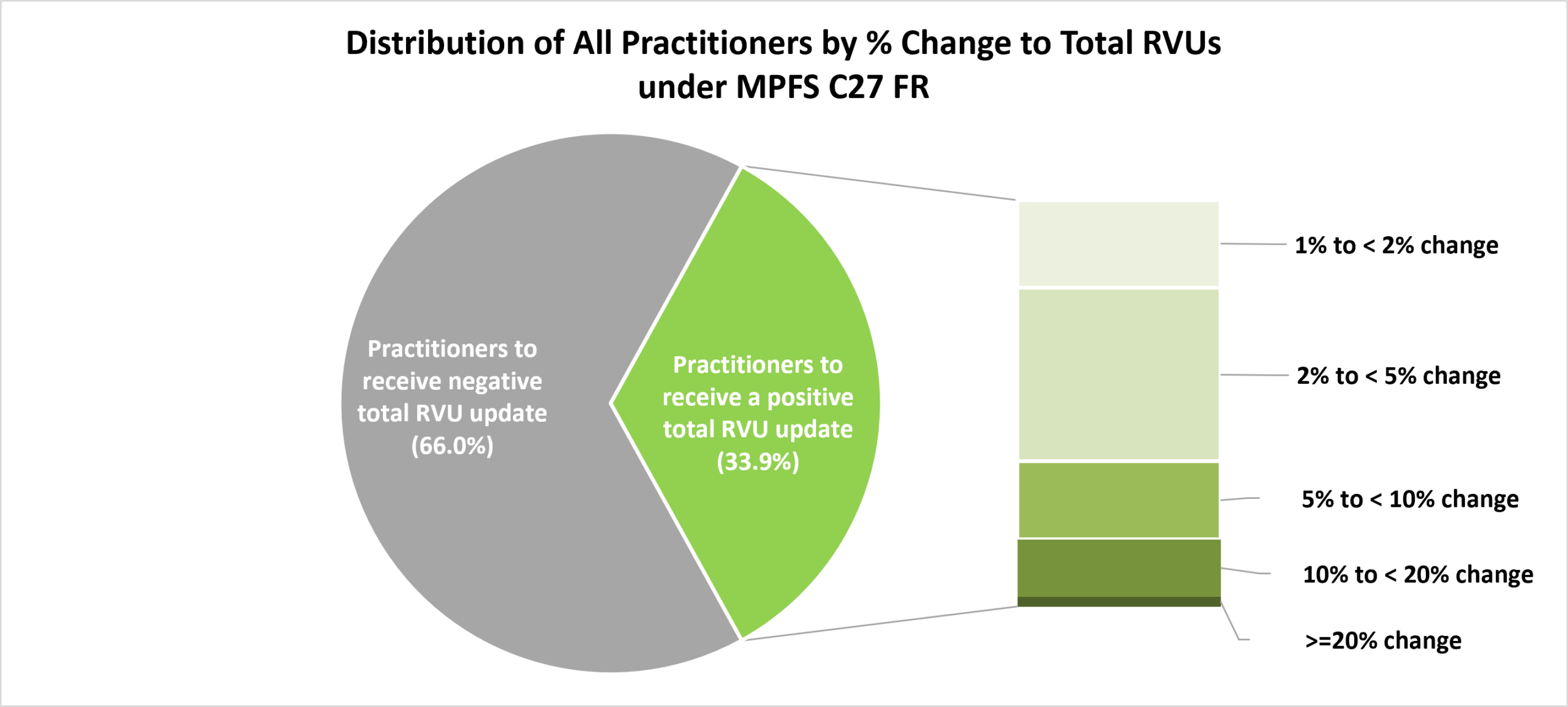
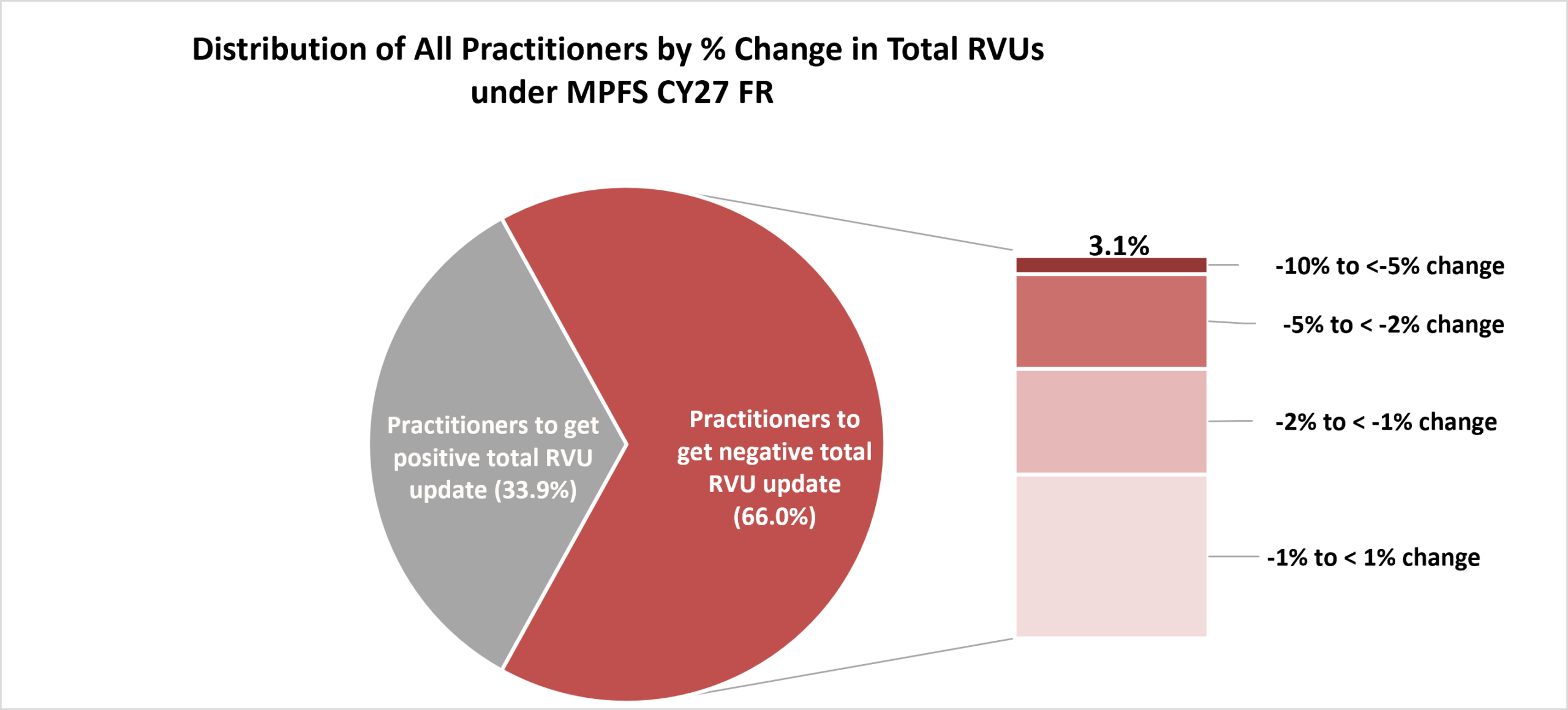
Distribution of All Practitioners by % Change in Total RVUs
Distribution of All Practitioners by % Change in Total RVUs under MPFS C27 FR

Contact an HMA Medicare Expert Today 

Health Management Associates, Inc. (HMA), policy and rate setting experts are analyzing the details and impacts of the final rule. Our team can support policy and reimbursement strategy in the context of this final rule; provide actuarial and strategic services; design, implementation, and evaluation of APMs; and data analytics using Medicare 100 Percent FFS and Encounter Data.  

Contact us to discuss the impact of this rule and the broader Medicare program dynamics affecting your organization.  

What the 2026 Election Results Mean for Healthcare Policy in 2027

The 2026 midterms reshaped the political landscape at a consequential moment for healthcare. Voters changed control of Congress and elected a large class of new governors and state officials, while affordability, including healthcare costs, remained a persistent concern across campaigns. Healthcare was rarely the headline issue, but questions about premiums, Medicaid, prescription drug costs, rural access, and the cost of care were embedded throughout the debate. 

The Leavitt Partners team at Health Management Associates (HMA), together with colleagues across the enterprise, hosted a post-election webinar November 10, 2026, examining what those changes likely mean for healthcare policy in 2027. The insights in this article are drawn from that webinar, which featured HMA experts Loren Anthes, Principal, HMA; Carter Kimble, Principal, HMA; Alicia Johnson, Regional Director, HMA; Sara Singleton, Principal, Leavitt Partners; and Liz Wroe, Principal, Leavitt Partners.  

This article examines how the new Congress and the administration are likely to shape the federal healthcare agenda, how new state leaders may respond within their fiscal and political constraints, and where healthcare organizations can engage most effectively. 

How the New Congress Will Shape Healthcare Policy in 2027 

Before the new Congress begins, lawmakers have unfinished business. The lame duck session is expected to focus on a relatively narrow agenda, including the December 11, 2026, government funding deadline, healthcare extenders, and confirmation of pending administration and judicial nominees. 

Democrats will enter the 120th Congress with substantial majorities in both the House and the Senate, though still short of the 60 Senate votes needed to advance legislation subject to the filibuster. Even so, the margins give Democratic leaders more room to manage differences within their caucus and will keep healthcare high on the agenda over the next two years. 

Committee control also allows Democrats to set hearing agendas, move legislation, and direct oversight. Likely oversight priorities include implementation of the One Big Beautiful Bill Act (OBBBA), also called the Working Families Tax Cut Act (WFTCA); vaccine policy; restructuring and funding decisions by the US Department of Health and Human Services (HHS); Medicaid program integrity actions; and the administration’s most favored nation drug agreements and direct-to-consumer initiatives. 

Why Budget Reconciliation Matters for Healthcare, Even if Congress Passes No New Laws 

Budget reconciliation is one of the things to watch in early 2027. Congress could consider reinstating enhanced Affordable Care Act (ACA) subsidies, creating new coverage pathways in Medicaid non-expansion states, exploring a Medicare-like Marketplace option, expanding Medicare drug-price negotiation, and revisiting portions of WFTCA. With Republicans holding the White House, the process is unlikely to produce sweeping healthcare legislation that President Trump would sign. Democrats could still use it to test their policy ideas and establish a future governing agenda. 

Bipartisan policies will be addressed, but they may stall until later in the next Congress. The debt limit, annual appropriations, healthcare extenders, and the September 2027 Food and Drug Administration (FDA) user fee reauthorization will keep both parties at the table. Notably, though, the coalitions that were key to earlier deals will be hard to rebuild given the extensive turnover in Congress. Many Republicans who were part of past bipartisan conversations about ACA subsidies or changes to WFTCA will not return in 2027. 

How the Trump Administration Can Advance Its Healthcare Agenda Without Congress 

The Trump Administration is expected to continue implementing the WFTCA, emphasizing waste, fraud, and abuse in Medicaid and pursuing its healthcare agenda through authorities that are exempt from congressional approval. In terms of coverage, examples could include broader use of individual coverage health reimbursement arrangements, health savings accounts, association health plans, short-term limited-duration plans, Section 1332 waivers, and potential changes related to silver loading. 

Drug pricing is one area in which Congress and the administration may share goals but take very different approaches. Democrats are expected to consider expanding Inflation Reduction Act (IRA) negotiation while scrutinizing the administration’s most favored nation agreements. This approach differs from the administration’s focus on securing new deals and implementing its existing drug pricing authorities.

Over the next two years, healthcare organizations should be prepared for many of the most consequential decisions to emerge through regulation, guidance, waivers, enforcement, and implementation. 

State Elections and Healthcare: New Governors Face Fiscal and Policy Constraints 

The state elections were historic, producing a significant shift in political control and an unusually large number of new governors. 

Many of these governors campaigned on making life more affordable; however, they are taking office as states face tighter budgets and fewer policy options. New Medicaid eligibility changes are scheduled to take effect January 1, 2027, and changes to provider taxes and state directed payments will put added pressure on state budgets, providers, employers, and consumers. Federal savings driven by people losing coverage are expected to shift costs to states, providers, employers, and families, including in the form of higher premiums. 

Although voters throughout the nation shared similar concerns, the responses are likely to be very different across the states. Ohio, Texas, and Georgia show how differences in political control, fiscal capacity, and legislative dynamics can lead new leaders down distinct paths. 

State Healthcare Policy Outlook: Ohio, Texas, and Georgia 

Ohio elected Democrat Amy Acton governor while retaining Republican control of both legislative chambers. Governor-Elect Acton’s agenda combines Medicaid access and administrative simplification with prescription drug purchasing through OhioRx, medical debt relief, price transparency, prior authorization reform, rural access, and program integrity. Federal financing changes and legislative control, however, limit what the new administration can do. The governor’s first budget proposal will reveal her initial priorities. 

In Texas, Governor-Elect Gina Hinojosa supports Medicaid expansion, but a Republican Senate is likely to continue resisting this policy. A state-based ACA Marketplace could be a more realistic near-term means of addressing coverage in a state where approximately 16 percent of residents are uninsured. Healthcare organizations should consider which policy lever is likely to align with their goals in the context of the governor’s limited tools. 

Georgia may be able to move more quickly. Bipartisan support appears to be growing for replacing Georgia Pathways with full Medicaid expansion, and state leaders expect action in the legislative session that runs from January through April. 

The contrast between these states illustrates that party control indicates direction, but it does not determine outcomes. Fiscal capacity, legislative coalitions, administrative readiness, federal approvals, existing healthcare infrastructure, and the willingness of governors to spend political capital will determine how quickly campaign positions become policy. 

How Healthcare Organizations Can Shape the Policy Agenda Before It Solidifies 

This period of transition creates risk for healthcare organizations, but it also opens a window to engage while new members of Congress are joining committees, governors are assembling their administrations, and legislative staff and agency leaders are still deciding which problems to tackle and how. Organizations that engage now, rather than waiting for fully formed proposals, have a better chance of informing that thinking. 

The most practical approach is a simple one: Be selective about where to engage, arrive with evidence, and look for partners rather than acting alone. Because policymakers’ attention will be hard to win, organizations that can quantify what a policy choice means for costs, coverage, access, workforce, state budgets, or local markets will be better positioned to make their case, and coalitions of providers, plans, employers, advocates, and others can amplify that evidence where their interests align. 

Timing is also critical. Engagement with new officials and their teams should begin before legislative sessions, budgets, rules, and political positions are fully formed. Once January arrives, many new administrations and legislatures will already be consumed by governing. 

Although the election determined who will hold office, the healthcare agenda they pursue is still being shaped. For organizations with a stake in what comes next, knowing where officials have control, where they need partners, and where policy remains open to influence may matter as much as understanding the election results themselves. 

Access the full replay of the webinar. Learn more about federal policy actions and the state policy and strategy that can position your organization for success over the next 12–18 months and beyond. 

Medicaid Work Requirements: What the Court Ruling and CMS’s Appeal Mean for Your January 1 Implementation Plan

States are preparing to implement the Medicaid work and community engagement requirements set forth in the Centers for Medicare & Medicaid Services (CMS) interim final rule issued on June 2, 2026. States are expected to implement the mandates by January 1, 2027, leaving Medicaid agencies, health plans, providers, and community partners with a compressed window to develop, test, and deploy new policies, systems, notices, and verification processes. As states develop their plans and final details continue to take shape, this article builds on ongoing Health Management Associates (HMA) analysis of how states are putting these policies into practice. 

Two recent developments add to the complexity of implementing the Medicaid community engagement requirements. The first is the October 29, 2026, federal court decision on the interim final rule, which CMS plans to appeal. The second is a compliance checklist CMS shared with states to help them identify where they may need more time or support and to plan mitigations. 

Together, the decision, the planned appeal, and the checklist raise new questions about implementation, process, and compliance, and the approaches will vary by state. In a situation this fluid, states and their partners will need to be innovative and diligent at each step between now and January 1, 2027, and beyond. In the remainder of this article, HMA experts discuss the court decision and what it means for Medicaid agencies and their partners, as well as the compliance considerations related to the checklist. 

What the Court Decided About Medical Frailty in Medicaid Community Engagement Requirements 

The One Big Beautiful Bill Act (P.L. 119-21), also known as the Working Families Tax Cut legislation, generally requires certain adults ages 19–64 in the Medicaid expansion group or certain section 1115 demonstrations to meet community engagement requirements unless they qualify for an exclusion or exception. Individuals can satisfy the requirement through 80 hours per month of work or community service, half-time enrollment in an educational program, or monthly income equivalent to 80 hours at the federal minimum wage. Medically frail individuals are excluded, and Congress specified five groups within that provision. 

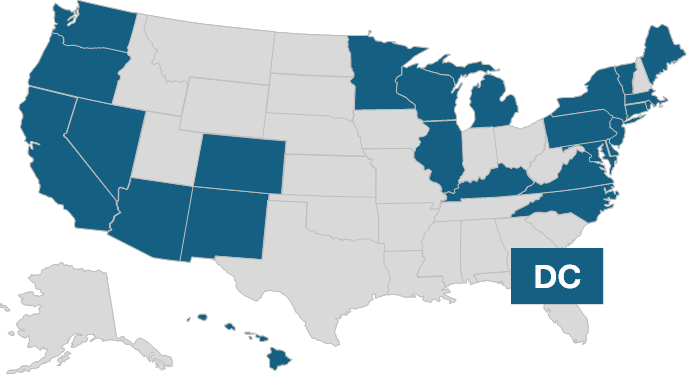
CMS’s June 2026 interim final rule required individuals to fall within one of those five categories and to show that a physical, mental, or behavioral health condition significantly impairs their ability to comply with community engagement requirements. Half the states (25) and the District of Columbia challenged the second requirement (see Figure 1). 

The US District Court for the District of Massachusetts issued a decision on October 29, 2026, Commonwealth of Massachusetts, et al. v. Oz, et al., which stated that CMS lacks the authority to add a work-related functional test to the criteria Congress established. The court vacated the challenged language and prohibited CMS from applying the additional test to the plaintiff states. 

Figure 1. State Plaintiffs in the Medicaid Medical Frailty Determination Lawsuit

Map of the USA

Recognizing that the plaintiff states may need time to revise their medical frailty verification systems and processes, the court also gave them six months of protection from CMS penalties for implementation errors or delays, including those arising from medical frailty determinations. 

What Stays the Same: Medicaid Work Requirement Timeline and Verification Rules 

The decision does not invalidate the community engagement requirements, and the 80-hour standard and the January 1, 2027, timeline stand. States are unlikely to pause broader implementation, but some design and operational decisions may remain provisional. 

The court also rejected the states’ challenges to two CMS verification policies: the 12-month limit on claims and encounter data used to verify medical frailty and, beginning January 1, 2028, the limit of self-attestation to once per continuous enrollment period. In 2027, however, states may accept self-attestation each time medical frailty status is determined or redetermined, which offers useful flexibility as they revise their processes. 

Open Questions: What CMS’s Planned Appeal Means for Medicaid Community Engagement Implementation 

On November 3, 2026, CMS Administrator Mehmet Oz, MD, said that CMS will appeal the decision, describing the definition of medical frailty as a fundamentally important question that could ultimately reach the Supreme Court. CMS is working on additional guidance that is expected in November. In the meantime, states must make interim choices on verification processes, notices, and systems logic that may later require revision. 

The court removed the added test without saying the change applies only to the plaintiff states. However, the court order blocking CMS from using it, along with the six-month protection from penalties, covers only those states. CMS guidance will be critical to clarify how non-plaintiff states should apply the statutory categories and how plaintiff states should operate during the relief period. In light of the ongoing litigation, states will be making decisions without knowing how the appeal may affect the order, and impacts will vary by state and organization; hence, state-specific monitoring is essential. 

What the Ruling Means for State Medicaid Agencies, Health Plans, and Providers 

State Medicaid Agencies: Revise Medical Frailty Processes Without Pausing Implementation 

With fewer than two months before the January 1, 2027, deadline states should identify and revise policy, system, and operational materials to incorporate the vacated functional test. Documenting interim decisions and legal assumptions will make later adjustments easier. Plaintiff states must also decide how to operationalize the six-month relief across adverse actions, verification timelines, notices, appeals, and federal reporting. 

Medicaid Health Plans: Reassess Member Identification, Outreach, and Audit Readiness 

Plans that built member identification strategies around the two-part test should reassess them and revisit their models to estimate how many additional members may fall within a statutory category. Auditable records of rule changes, member matches, and data limitations will support state oversight and program integrity reviews. 

Providers and Community Organizations: Update Documentation and Support Members at Risk of Losing Coverage 

Providers are likely to see changes in the information requested to establish medical frailty. Documentation may still be needed, particularly after a permitted self-attestation, to establish whether an individual falls within a statutory category. Providers and community-based organizations also are positioned to identify patients at risk of coverage loss and connect them to application assistance, appeals support, and continuity of care resources. 

CMS Compliance Checklist: Mitigation Plans to Address Gaps in Medicaid Community Engagement Implementation 

In October 2026, CMS shared “Proposed State Mitigation and Optional Strategies to Support Implementation of Community Engagement and Other Eligibility & Enrollment Provisions of the Working Families Tax Cut (WFTC) Legislation.” The checklist is intended to help states assess readiness and plan mitigations before January 1, 2027. States that do not expect to meet a community engagement requirement at launch can identify the gap, propose a mitigation, and set a timeline for reaching full compliance. CMS may approve each mitigation under an authority such as a state plan option or enforcement discretion, which allows states to avoid formal compliance action. States with approved plans provide quarterly updates on progress and emerging risks, and CMS plans to begin meeting with states about their plans in November. 

The checklist focuses on the areas where implementation is most likely to be tested: updating applications and renewal forms in every format, connecting to the data sources needed for verification, checking for exclusions before assessing qualifying activities, reporting new data to CMS, and updating eligibility and hearing notices. It also covers outreach, notices of noncompliance, notification when exclusion status changes, and short-term hardship exceptions. Because community engagement adds to state workloads, CMS also anticipates asking for plans that outline the existing timeliness standards for applications, renewals, and fair hearings. Each state will need to determine which mitigation strategies best fit its systems and capacity. 

Preparing for January 1: How HMA Supports Medicaid Community Engagement Implementation 

HMA is helping Medicaid agencies, health plans, providers, and partners turn the decision and the checklist into practical next steps including: 

  • Assess impacts and safeguards. Inventory the policies, business rules, system logic, contracts, notices, and analytics that were already built to incorporate the second medical frailty test. States can then prioritize what must change before January 1, 2027, what interim procedures can cover, and where they need further guidance while reviewing adverse-action controls to reduce avoidable coverage loss. 
  • Estimate affected populations. Pair HMA’s by state, by year coverage, and enrollment models with medical frailty modeling based on published state methodologies to estimate affected populations and implications for enrollment, continuity of care, and operational workload. 
  • Monitor developments and supporting communications. Provide state-specific monitoring and scenario planning for CMS guidance, appeals, and further litigation, and develop clear communications for members, providers, plans, vendors, and legislators. 

Contact HMA today to work with our policy, actuarial, operations, and communications experts on a defensible, well-documented implementation plan. 

This article reflects information available as of November 4, 2026, and is not legal advice. 

Beyond Compliance: Turning Medicaid Requirements into Stronger State Programs

Key Insights from the 2026 NAMD Fall Conference and What They Mean for Your Organization 

Medicaid leaders have never had the luxury of focusing on one issue at a time, but even by their standards, the current environment is unusually demanding. 

Health Management Associates (HMA) leaders attended the National Association of Medicaid Directors (NAMD) Fall Conference, October 21-23, 2026, during which federal and state leaders shared their priorities and implementation plans. Several themes stood out: 1) preparing for community engagement requirements, 2) strengthening program integrity, 3) adapting to major changes in Medicaid financing, 4) demonstrating value and accountability in managed care, and 5) improving quality and outcomes for Medicaid enrollees. 

These priorities are arriving alongside revisions to Section 1115 demonstration policy, budget pressures, and, in many states, leadership transitions. Many also reflect long-standing Medicaid challenges, including fragmented data, complex eligibility processes, uneven coordination across agencies, and difficulty connecting payment to outcomes. The insights below highlight how the work in progress can also build the capabilities that Medicaid programs will need in 2027 and beyond. 

What We Heard at NAMD 

Community Engagement Implementation Can Build Lasting Infrastructure 

Community engagement implementation was among the most prominent topics discussed at the conference, highlighting the scale of the work ahead for states and partners. Although the community engagement requirement is an eligibility policy, it touches nearly every part of the Medicaid enterprise, including: verifying eligibility and exemptions, using data from other programs, updating systems and workflows, communicating with beneficiaries, and defining roles for managed care plans, providers, workforce agencies, and community organizations. A process that looks straightforward in policy can still create significant burdens for members and the organizations that support them. In HMA’s work with states, much of the effort goes into connecting policy choices to the realities of data, systems, budgets, and the member experience. 

What it means for states and Medicaid partners 

Many implementation investments can deliver value well beyond what is prescribed in the requirement itself. Integrating Medicaid and workforce data can streamline verification now and support other cross-program initiatives later. Clear beneficiary notices can improve renewals, and operational dashboards can give leaders early visibility into enrollment disruptions, processing backlogs, and disparities. States and partners that approach implementation strategically can build capabilities that outlast any single federal mandate. 

Program Integrity Works Best When It Is Built into the Program 

Fraud, waste, and abuse is receiving heightened attention as federal and state leaders focus on payment accuracy, provider and vendor oversight, and the stewardship of public dollars. Medicaid leaders emphasized that the strategic value of program integrity extends well beyond audit and recovery, spanning finance, eligibility, provider oversight, analytics, operations, technology, compliance, and executive decision-making. 

Federal officials also signaled a commitment to shift from reactive enforcement to prevention, encouraging states to bring solutions forward and share what they are learning. The challenge, however, is balancing closer scrutiny with protecting access in services where it is already fragile, including behavioral health, personal care services, nonemergency medical transportation, and applied behavior analysis. 

What it means for states and Medicaid partners 

As states redesign processes and programs, program integrity is most effective when it is embedded in the design from the outset, rather than added later as another layer of oversight. Furthermore, collaboration across states is already driving changes in state approaches. For example, states are increasingly flagging provider enrollment concerns and sharing that information with one another. Clear documentation, robust data, provider education, well-designed payment controls, and meaningful monitoring can reduce improper payments while revealing where policies produce unintended consequences or where services are not reaching members. 

Managed Care Value Has to Be Defined Before It Can Be Demonstrated 

Discussions at NAMD were candid that managed care has yet to is not yet deliver its full potential, partly because the data needed to show that care is truly being managed are often incomplete. Rather than questioning whether to keep managed care, Centers for Medicare & Medicaid Services (CMS) officials encouraged states leaders to focus on accountability, which also requires reliable encounter data. 

Health plans are increasingly expected to demonstrate value beyond managing benefits and financial risk, whether through better access, fewer avoidable hospitalizations, improved maternal health, more effective behavioral healthcare, a better member experience, or lower total cost. What plans can realistically deliver, however, depends on reimbursement levels, financial risk, incentives, available data, partner capabilities, and the time needed to show results, a point that also came through clearly at HMA’s 2026 National Conference. 

What it means for states and Medicaid partners 

Adding performance measures to managed care contracts is rarely enough on its own. States get further when procurements start with a clear answer to what the state is buying, rate setting is grounded in transparent data, and contracts focus on the outcomes the state most wants to improve. States can then decide what needs to change in payment, what data will show progress, and whether plans, providers, and other partners have the resources, information, incentives, and time to influence results. 

Better Outcomes Depend on Doing Fewer Things Well 

Quality discussions at NAMD centered on the need for greater focus, as states use 250 unique state-designed quality measures, and 38 states have signed on to CMS’s national Medicaid Quality Pledge. Trying to do everything accomplishes little, especially as burden flows from states to health plans, providers, and vendors. The priority is the conditions driving much of Medicaid spending, including hypertension, diabetes, behavioral health, and maternal health, and whether investments are keeping people healthy and out of the hospital. 

What it means for states and Medicaid partners 

States that concentrate measures, data collection, and investments on the outcomes that matter most can reduce burden across the system. Federal officials want data treated as core infrastructure and greater standardization so states have the information needed to develop sound policy. 

Partnerships Depend on Clearly Defined Roles 

Partnership, a hallmark of NAMD meetings, was again a defining theme this year. Medicaid agencies cannot achieve their goals alone, and leaders were focused on practical, shared solutions that deliver better outcomes for members. Community engagement, for example, may require coordination with state labor and workforce agencies, Supplemental Nutrition Assistance Program (SNAP) and Temporary Assistance for Needy Families (TANF) programs, community colleges, employers, community-based organizations, providers, and managed care plans, each with its own systems, responsibilities, and funding streams. 

What it means for states and Medicaid partners 

Tighter budgets make it more important to be clear about what each partner contributes. For states, health plans, and providers, reaching that understanding requires honest decisions about which capabilities to keep in-house, where a partner is better positioned to deliver, and how those roles fit together around shared goals. 

Looking Ahead: Using Today’s Requirements to Build for Tomorrow 

Meeting new federal requirements on time remains essential, but how states meet them will determine whether the work creates lasting value. Decisions made early in implementation will shape those results, and they carry added weight as administrations and agency leadership change. 

Work on the community engagement requirement will continue well beyond the January 2027 effective date as states, health plans, providers, and community partners monitor results and adapt to evolving federal policy. HMA’s interdisciplinary team brings policy, actuarial, operations, data, and technology expertise to each stage of that work. Our experts help organizations design workable verification processes, model enrollment and financial impacts, build data and program integrity safeguards, align managed care contracts and partner roles, and track outcomes over time. Connect with our experts to discuss your organization’s priorities. 

Minnesota’s Medicaid Balancing Act: Protecting Coverage While Fighting Fraud

Minnesota’s efforts to keep people covered while addressing Medicaid fraud were central to discussions at the September 30, 2026, Health Policy Conference in Minneapolis. Hosted by State of Reform, an HMA company, the conference brought together lawmakers, state officials, providers, community-based organizations, and policy experts to discuss the healthcare landscape. Specific topics covered included how to respond to the 2025 budget reconciliation legislation (commonly referred to as OBBBA or the Working Families Tax Cut Act [WFTCA]) and address fraud, waste, and abuse (FWA) without disrupting coverage or weakening provider capacity. 

Particularly for the Medicaid program, discussions connected immediate implementation decisions with how healthcare leaders could introduce more accountability into the program without making healthcare harder to access or weakening an already strained delivery system. 

Key Discussions: Coverage, Oversight, and Continuity of Care 

Federal Medicaid changes put pressure on coverage continuity. 

An estimated 140,000 Minnesotans could lose Medicaid coverage as provisions of the WFTCA take effect, including work requirements, six-month redeterminations, and cost-sharing for the expansion population, and coverage changes affecting some lawfully present immigrants. State lawmakers, including Sen. Alice Mann, Vice Chair of the Health & Human Services Committee, and Rep. Mohamud Noor, Co-Chair of Human Services Finance & Policy, shared their concerns about the coverage losses and steps they are taking to soften the effects; for example, requiring a one-month lookback period for the work requirements instead of three. 

Discussions at the conference also made clear that Minnesota leaders are focused on how people experience Medicaid changes in practice. Representative Noor emphasized the need for practical support, including guidance around work requirements, help for people who qualify for emergency medical assistance, and attention to people in long-term care. He also stressed the importance of keeping counties involved because they will experience much of the operational and financial impact of federal policy changes. 

In Minnesota, the state can set policy and build eligibility systems, but counties, health plans, providers, and community organizations are the ones that recognize when someone is at risk of losing coverage. Former Minnesota Department of Human Services Deputy Commissioner Chuck Johnson suggested that, as Minnesota implements federally required eligibility changes, it should also think about redesigning the eligibility process itself and using the federally-driven eligibility changes as an opportunity to make the state’s system easier to navigate. 

Program Integrity Activities Earlier 

Minnesota’s Medicaid fraud concerns have brought greater scrutiny to how the state manages providers and protects public funds. In December 2025, the Centers for Medicare & Medicaid Services (CMS) requested a corrective action plan (CAP) to address concerns regarding FWA within the state’s public benefits programs. The Minnesota Department of Human Services (DHS) submitted a CAP on December 31, 2025 and CMS approved a revised version of the plan March 19, 2026. The state’s response has included revalidating high-risk Medicaid providers, establishing a moratorium on new service providers in certain high-risk areas, creating a public program integrity dashboard, and discontinuing the Housing Stabilization Services benefit. Minnesota also secured funding to expand DHS’s program integrity workforce by more than 400 positions over two years. 

Speakers at the conference agreed that addressing those problems also means helping providers build stronger operations. Mr. Johnson acknowledged both the fraud that needs to be stopped and the politically charged perceptions surrounding it. He also encouraged offering support to providers so they can improve integrity within their own operations. 

That emphasis on prevention carried into the discussion with Health Management Associates (HMA) Associate Principal Jen Bridgeforth and Regional Director Clint Eisenhower. Both focused on the work that happens before an improper payment is made—from everyday compliance practices within provider organizations to the way states design programs. 

Written compliance procedures, staff with the right expertise, and technology that supports oversight can help organizations identify risks earlier. Ms. Bridgeforth emphasized that responsibility extends across an organization. Those safeguards take time and money, she noted, but the administrative burden and costs increase substantially when audits uncover fraud. Mr. Eisenhower connected that day-to-day work to policy decisions, adding that program integrity needs a place in program design. 

Speakers also emphasized that Minnesota’s anti-fraud efforts should account for what happens to people receiving care, noting, for example, ongoing behavioral health provider capacity gaps and the risk of deepening access challenges. This theme of involving providers in discussions extended into conversations about medical respite, homelessness, and complex discharge where problems have emerged when healthcare and community systems are misaligned. 

The Bottom Line: Practical Solutions, Collaboration, and Shared Responsibility 

The key takeaway from the conference was that Minnesota’s healthcare coverage and delivery system challenges require practical solutions. These efforts should focus on: 1) cross-sector approaches to helping people retain Medicaid coverage, 2) a more systematic statewide approach to program integrity, and 3) new initiatives to improve complex discharge for children and adults, which could provide lessons for broader policy change. 

Another theme that emerged across sessions was the need for shared responsibility in designing, implementing, and sustaining responses to changes and pressures stemming from the WFTCA, as well as other pressures on the healthcare system. This coordinated response calls for respecting each other’s unique roles and perspectives while recognizing the interconnected nature of the work. For example, Minnesota counties will need support from the state as Medicaid eligibility requirements change. Health plans, providers, and community organizations can reach people before administrative issues turn into coverage losses. State program integrity officials can work with providers to identify vulnerabilities upstream instead of relying primarily on audits after payments have been made. Hospitals, behavioral health providers, housing organizations, and community partners can build clearer pathways for people who otherwise become caught between systems. 

Looking Ahead 

If you are looking for strategies and solutions to address urgent healthcare policy and operational challenges, HMA experts are available to help you identify practical paths forward. 

Through the HMA National Conference, State of Reform partnership events, and other HMA convenings across the country, we connect state leaders, providers, health plans, and community stakeholders to share insights, elevate lessons, and advance solutions. Join us at one of our next SOR events—November 10, 2026, in Raleigh, NC, or November 17, 2026, in Chicago, IL—or explore additional opportunities to engage with HMA and access the full schedule of conferences and resources. 

State of Reform develops its conference agendas through collaboration with HMA subject matter experts/market leads and stakeholders across the public and private sectors, including state officials, community-based organizations, providers, payers, and more. 

What Comes After 988? A New National Roadmap for Behavioral Health Crisis Care

Why HMA and NAMI Are Building the Next Chapter of Crisis Care

Key Takeaways

  • In October 2026, the National Collaborative for Crisis Systems Innovation, a partnership between HMA and NAMI, released its Strategic Plan & Implementation Roadmap.
  • The plan focuses on four priorities (Awareness, Access, Capacity, and Quality) to strengthen the 988 Suicide & Crisis Lifeline and the full behavioral health crisis continuum through early 2028.
  • Launched in May 2026, the Collaborative brings together advocates, government leaders, philanthropic organizations, providers, people with lived experience, families, researchers, and technical experts to turn crisis policy into practice.

When the 988 Suicide & Crisis Lifeline launched in July 2022, I had the privilege of serving as the inaugural director of the 988 & Behavioral Health Crisis Coordinating Office at SAMHSA. I saw firsthand what three simple digits could mean for someone on the worst day of their life. I also learned something every crisis leader eventually comes to understand: A number is only as strong as the system behind it.

Four years later, communities across the country are still working to build that system. States and localities face inconsistent access to robust crisis lines, workforce shortages, financing challenges, gaps in coordination across systems, and uncertainty around policy, leadership, and funding transitions. Too many people still can’t get the full continuum of crisis care when they need it most.

That’s why I’m so proud that HMA and NAMI joined forces in May 2026 to launch the National Collaborative for Crisis Systems Innovation. The Collaborative is a national hub for alignment, learning, and action in behavioral health crisis care. It gives partners a shared forum to identify common priorities, elevate what’s working, and turn vision into practice.

Our mission is clear: Ensure that every person experiencing a behavioral health crisis can access timely, compassionate, and effective support by advancing connected, sustainable crisis systems and driving collaboration and innovation across the full crisis continuum.

What Are the Four Priorities of the Crisis Care Strategic Plan?

This month, the Collaborative released its Strategic Plan & Implementation Roadmap, which lays out how we’ll move from concept to action through early 2028. The plan is built around four mutually reinforcing priorities, namely:

  • Awareness: People know what to do and where to turn in a crisis.
  • Access: The system people reach out to is fully available in every community.
  • Capacity: There are enough crisis responders to help every person in need.
  • Quality: Every person gets quality care, no matter how they enter the crisis system.

None of these priorities stands on their own. Awareness means little if help isn’t available when someone calls, texts, or chats. Access falls short without a workforce to answer. And capacity only matters if people receive high-quality care. Moving all four forward together is how we build a crisis system that people can trust.

What Is HMA’s Role in Strengthening Crisis Systems?

At HMA, our behavioral health team works alongside state agencies, communities, providers, and payers to turn crisis policy into services people can actually reach. Through the Collaborative, we bring that on-the-ground perspective together with NAMI’s deep connection to people with lived experience and their families. Together, we convene advocates, government leaders, philanthropic organizations, providers, people with lived experience, families, researchers, and technical experts, so the people closest to the work help shape where it goes next.

Our goal is to provide a stable, trusted platform for shared learning, cross-sector coordination, and forward-looking leadership. Over the long term, that means boosting national awareness of the 988 Lifeline, catalyzing innovation, ensuring continuity through periods of change, and leading with consistency. That last point matters now more than ever. Crisis systems can’t afford to start over every time leadership, policy, or funding shifts.

The Work Continues

Helping bring 988 to communities across the country was one of the greatest honors of my career. But 988 was never meant to be the finish line. It was the starting point for a crisis care system that is coordinated, equitable, sustainable, and trusted. I’m grateful to our partners at NAMI and to my HMA colleagues for carrying this work forward. The work continues, and I hope you’ll join us.

Frequently Asked Questions

What is the National Collaborative for Crisis Systems Innovation?

The National Collaborative for Crisis Systems Innovation is a national hub for alignment, learning, and action in behavioral health crisis care. HMA and NAMI launched it in May 2026 to help partners identify common priorities, elevate what’s working, and turn vision into practice.

What does the Strategic Plan & Implementation Roadmap include?

The plan outlines the Collaborative’s vision, mission, priorities, and early focus areas, and shows how the Collaborative will move from concept to action through early 2028. It is built around four mutually reinforcing priorities: Awareness, Access, Capacity, and Quality.

How does the plan support the 988 Suicide & Crisis Lifeline?

The 988 Suicide & Crisis Lifeline made crisis support easier to locate, but a number is only as strong as the system behind it. The plan is designed to boost national awareness of 988 and strengthen access, workforce capacity, and quality across the full crisis continuum, so people get effective care no matter how they enter the crisis system.

Who participates in the Collaborative?

The Collaborative convenes advocates, government leaders, philanthropic organizations, providers, people with lived experience, families, researchers, and technical experts, so the people closest to the work help shape where crisis care goes next.

How does HMA help states and communities strengthen crisis systems?

HMA’s behavioral health team works alongside state agencies, communities, providers, and payers to turn crisis policy into services people can actually reach. Through the Collaborative, HMA provides a stable, trusted platform for shared learning, cross-sector coordination, and continuity through periods of leadership, policy, or funding change.

Learn More

Download the National Collaborative for Crisis Systems Innovation Strategic Plan & Implementation Roadmap to explore the Collaborative’s vision, mission, priorities, and early focus areas through early 2028. For more information, visit the Crisis Systems Innovation website.

To talk with HMA about strengthening crisis systems in your state or community, connect with our behavioral health team.

By Monica Johnson, MA, LPC, Managing Director, Health Management Associates

2027 Medicare Advantage Star Ratings: Quality Bonus Payment Impacts

The Centers for Medicare & Medicaid Services (CMS) released the 2027 Medicare Advantage (MA) and Part D Star Ratings on October 8, 2026. CMS reported little change in the number of contracts earning at least 4 Stars and an increase in enrollment in higher-performing plans. Wakely Consulting Group, an HMA Company, found more year-over-year change than those figures suggest.  

Wakely’s new white paper, Stars Gone Wild: Summary of 2027 Medicare Advantage and Part D Star Ratings, examines how plan performance changed and what the 2027 results mean for Medicare Advantage (MA) organizations’ quality strategies and future quality bonus payments (QBPs).  

2027 Star Ratings: Rising Cut Points and Quality Bonus Payments 

Achieving 4 Stars has a direct financial implications for Medicare Advantage plans. Contracts rated at 4 Stars and higher receive a 5% increase in benchmark rates through the QBP. Even a small ratings change that moves a contract above or below that threshold can significantly affect payment. The 2027 Overall Star Ratings will determine QBPs for the 2028 payment year.  

Wakely found that plan performance in general improved between the measurement years underlying the 2026 and 2027 Star Ratings, but Star Rating cut points rose slightly faster. After adjusting for enrollment changes, crosswalks, and plan terminations, the enrollment-weighted average Overall Star Rating fell from 4.08 in 2026 to 4.01 in 2027. The share of enrollment in contracts rated at least 4 Stars also fell from 73.2% to 71.7%. 

CMS and Wakely present different perspectives on enrollment trends. CMS’s figures reflect enrollment at the time each year’s Star Ratings are published. Wakely’s year-over-year analysis uses updated enrollment information for both years and accounts for known plan crosswalks and terminations. Under Wakely’s approach, the 2026 baseline for enrollment in 4+ Star plans is approximately 73% versus approximately 67% in CMS’s published figures. Using that baseline, Wakely’s analysis shows a decline in 2027.  

The 2026 Star Ratings determine QBPs for the 2027 payment year. Using current enrollment information helps plans estimate how many members will be affected by the associated rate adjustments and how those changes will influence QBP revenue.  

Medicare Advantage Star Ratings Results by Insurer 

National averages mask large differences among insurers. 

Wakely examined the 10 largest parent organizations, which account for 27.8 million members (~ 80%) of MA-PD enrollment. Humana’s share of enrollment in 4+ Star contracts increased by 53% in 2026–2027. Much of that increase came from a single contract, which covers more than 2 million members and improved from 3.5 to 4 Stars. Kaiser maintained 100 percent of its membership in 4+ Star plans for the third consecutive year.  

Health Care Service Corporation’s enrollment in 4+ Star contracts declined by 47.6%. United and CVS each saw approximately 15% of their membership drop below the 4-Star threshold, representing roughly 2 million members combined.  

Special Needs Plans: Enrollment in 4+ Star Contracts Declines 

Wakely’s analysis of Special Needs Plans (SNPs) analysis covers more than 10.7 million members. The share of enrollment in 4+ Star SNP contracts fell from 78% in the 2026 Star Ratings to 55% in 2027, a 23% decline. Of the five largest SNP parent organizations, only Humana saw an increase. United, which has more than 3.7 million SNP enrollees, experienced a 27% decline in 4+ Star SNP contract enrollment.  

MA Star Ratings Trends by State 

Some states saw steep declines in enrollment among plans with higher ratings, whereas others saw large gains. Rhode Island, Louisiana, and Georgia had the largest declines in enrollment in 4+ Star contracts, while Montana, South Dakota, and North Dakota had the greatest increases. Among the states highlighted in Wakely’s paper, Rhode Island experienced the steepest decline, from 94.6% to 35.0%. South Dakota rose from 37.8% to 100%. These state-level differences show why national trends alone may tell plans little about what is changing in their own markets. 

Quality Improvement Strategies for Medicare Advantage Star Ratings 

Star Ratings connect the care members receive with the bonus funding plans can use to support benefits and other priorities. That makes it important to know whether investments in provider engagement and member outreach are closing gaps in care, improving outcomes, and helping plans perform better on the measures that drive their ratings.  

Health Management Associates (HMA) work on quality improvement and Wakely’s Star Ratings analysis reinforce the connection between care outcomes and financial decisions. Clinical, quality, member engagement, and provider strategy teams have developed an understanding of what members need; actuarial, data, and financial consultants help assess the results and financial implications. Together, they can use those findings to guide spending, set clear responsibility for improvement, and focus resources as rating standards and regulations change. 

Star Ratings Litigation and Potential Methodology Changes 

CMS recalculated ratings across the market following litigation over the 2026 ratings, including Clover Health’s challenge, but used the previously finalized measure set for 2027. Wakely estimates that measures representing approximately two-thirds of the program’s current weight remain subject to legal uncertainty.  

Wakely anticipates significant program changes, leaving plans to meet current requirements while preparing for shifts in measures and methodology, including those that could result from litigation.  

Medicare Advantage Star Ratings Support from HMA and Wakely 

Understanding what drives a plan’s Star Ratings is only part of the work. HMA and Wakely bring together actuarial analysis, risk adjustment, rate setting, quality strategy, payment policy, and competitive positioning to help plans turn those findings into an improvement strategy. 

Our integrated teams connect the clinical and operational work of improving quality with the financial and market decisions plans face. We support plans in their efforts to analyze performance and forecast payment impacts, set priorities, implement quality strategies, and track progress as rating standards change. 

For a closer look at the findings, read Wakely’s Stars Gone Wild: Summary of 2027 Medicare Advantage and Part D Star Ratings and join the November 5, 2026, Stars Gone Wild webinar for a discussion of the results and the policy and methodology changes ahead. 

Contact HMA and Wakely to discuss the factors that are driving your plan’s Star Ratings and how our teams can help improve performance, prepare for payment changes, and strengthen your competitive position. 

What the NDC-12 Transition Means for the US Healthcare Ecosystem

Key Takeaways on the 12-Digit NDC Transition from the September 2026 Quarterly Forum

The NDC Coordination and Implementation Forum is organized by the Leavitt Center for Alliances, an initiative of Leavitt Partners, an HMA Company, that develops and supports consensus-based alliances to address complex, cross-sector healthcare challenges.

On September 26, more than 350 industry leaders representing government, life sciences, health plans, providers, standards organizations, and technology partners came together at the first quarterly meeting to discuss how the healthcare ecosystem can prepare for the transition by the Food and Drug Administration (FDA) to a uniform 12-digit National Drug Code, or NDC-12. The change will affect manufacturers, distributors, pharmacies, providers, payers, technology companies, regulators, and other healthcare stakeholders.

Key takeaways from the Forum:

1. The transition will affect the entire healthcare ecosystem

The new NDC format will require updates across drug data, business systems, shared infrastructure, standards, barcodes, billing, reimbursement, surveillance, and supply chain processes. Organizations will need to understand how their work aligns with the timelines and dependencies of other stakeholders.

2. Dual operability will be a central implementation challenge

Organizations will need to simultaneously manage 10-digit, 11-digit, and 12-digit NDCs during the transition. This period of dual operability makes data mapping, system testing, historical-data management, and cross-sector coordination especially important.

3. The shared roadmap provides a common view of readiness

The NDC Forum’s ecosystem-wide roadmap tracks major milestones, dependencies, decision points, and readiness risks. It identifies foundational work beginning in 2026, with important milestones for standards, NDC conversion, FDA data systems, pharmacy and provider readiness, testing, and the planned go-live date of March 7, 2033.

4. Early action is essential

The forum emphasized that the implementation timeline is front-loaded. Impact assessments, ownership decisions, standards updates, data foundations, and system planning need to begin well before NDC-12 enters production.

5. Collaboration will drive successful implementation

The NDC Forum brings together stakeholders to share information, identify cross-sector risks, and coordinate execution. Short-duration “Strike Forces” will focus on issues such as roadmap validation, regulatory clarity, label-data alignment, post-2036 NDC-10 management, and UPC-A barcode replacement.

The NDC-12 transition is a multi-year effort that requires shared visibility, coordinated planning, and sustained participation across healthcare. Organizations can help shape the implementation by joining the NDC Forum and contributing their perspective.

Strike Force participation is available to NDC Forum members. By joining now, your organization can bring its perspective directly into these discussions, learn how other stakeholders are approaching the same challenges, and help shape solutions before implementation decisions become difficult or costly to change.

Become a member and get involved

Ready to talk?