
December 7, 2022
The Impact of the 340B Program on Drug Prices Charged by Manufacturers and Covered Entities
HMA Insights—including briefs, webinars, and our podcast—gives you easy access to HMA’s deep expertise, helping you stay current on the latest healthcare trends and topics. Search for a topic of interest or browse the latest insights below.

The Impact of the 340B Program on Drug Prices Charged by Manufacturers and Covered Entities

This week, our In Focus reviews the Oklahoma Medicaid managed care SoonerSelect Program request for proposals (RFP) and the SoonerSelect Children’s Specialty Program RFP released by the Oklahoma Health Care Authority (OHCA) on November 10, 2022.
Background
Oklahoma currently does not have a fully capitated, risk-based Medicaid managed care program. The majority of the state’s 1.3 million Medicaid members are in SoonerCare Choice, a Primary Care Case Management (PCCM) program in which each member has a medical home. Other programs include SoonerCare Traditional (Medicaid fee-for-service), SoonerPlan (a limited benefit family planning program), and Insure Oklahoma (a premium assistance program for low-income people whose employers offer health insurance).

Prior efforts to transition to Medicaid managed care have encountered roadblocks, starting in 2017 with a failed attempt to move aged, blind, and disabled members to managed care.
More recently, in June 2021, the Oklahoma Supreme Court struck down a planned transition of the state’s traditional Medicaid program to managed care, ruling that the Oklahoma Health Care Authority does not have the authority to implement the program without legislative approval.
Contracts had been awarded to Blue Cross Blue Shield of Oklahoma, Humana, Centene/Oklahoma Complete Health, and UnitedHealthcare. Centene/Oklahoma Complete Health also won an award for the SoonerSelect Children’s Specialty Program.
In May 2022, Governor Kevin Stitt signed a new Oklahoma law to implement Medicaid managed care by October 1, 2023.
SoonerSelect RFP
Oklahoma will award contracts to at least three entities to provide medical, behavioral, and pharmacy coverage to nearly one million eligible children, pregnant women, newborns, parents and caretake relatives, and the expansion population. However, enrollment in these populations is expected to drop following the end of the public health emergency (PHE).

At least one of the contracts may be awarded to a provider-led entity (PLE). PLEs would need to provide proof that a majority of their ownership is held by Oklahoma Medicaid providers or the majority of the governing body is composed of individuals who have experience serving Medicaid members and are licensed providers. PLEs would also be able to bid on urban regions if the PLE agrees to develop statewide readiness within a timeframe set by the OHCA. If no PLEs meet OHCA standards, Oklahoma can choose not to award a PLE.
Goals of the program will include:
Timeline
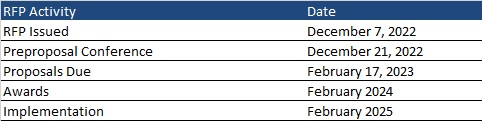
Proposals will be due on February 8, 2023, and contract implementation is scheduled for October 1, 2023. The contract is expected to run through June 30, 2024, with five, one-year options.

Evaluation
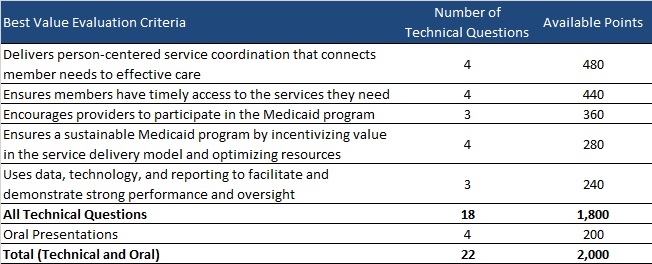
Bidder’s technical proposals will be scored out of a total 1550 points. OHCA will award PLEs an additional 50 points for qualifying, bringing the total up to 1600 points. OHCA may also choose to conduct oral presentations for an extra total of 50 points.

SoonerSelect Children’s Specialty Program RFP
Oklahoma will select one of the awarded SoonerSelect plans for a separate statewide contract to provide comprehensive integrated health coverage to foster children, former foster children up to 25 years of age, juvenile justice-involved children, and children receiving adoption assistance. Contract terms will be the same as the main SoonSelect procurement, running from October 1, 2023, through June 30, 2024, with five one-year renewal options.


Should You Put the PHE’s Medicaid Unwinding at the Top of Your To-Do List?

While the current federal COVID-19 Public Health Emergency (PHE) declaration could be in place through the winter months, HMA’s team of experts see many reasons to put the PHE’s Medicaid unwinding planning at the top of your list now.
Without an extension, the PHE declaration will expire on January 11, 2023. U.S. Department of Health and Human Services (HHS) officials pledged to provide 60-days’ notice before ending the PHE. As a result, since HHS did not announce an extension by November 12, we can assume that HHS Secretary Xavier Becerra will extend the PHE beyond January.
However, congressional leaders are again considering proposals that would impact the PHE’s Medicaid policies. Such a change could advance during the lame duck session of Congress. For a variety of reasons, lawmakers could seek a statutory change that would de-link Medicaid’s continuous enrollment requirement, the 6.2 percentage point increase in the federal Medicaid match, and other Medicaid maintenance of effort policies from the PHE declaration. Congress could set a specific date for ending these Medicaid policies. Doing so would provide more certainty for planning for the end of the continuous Medicaid enrollment policy and its downstream implications for health insurance programs.
What can Medicaid agencies, health plans, providers and other stakeholders do now?
The transition from Medicaid’s continuous enrollment requirement to normal eligibility operations involves a myriad of policy decisions and operational changes that will impact enrollees. In turn, the end of Medicaid’s continuous coverage policy will also have great bearing on the business and operational strategies of managed care plans, providers and other stakeholders participating in the Medicaid and Marketplace programs.
HMA’s experts are working with state agencies, health plans, hospitals and health systems, and other stakeholders to identify options and workable solutions to prepare for these major changes. This work touches policy, organizational workstreams, systems, and payment. There are issues specific to Medicaid as well as the intersection with Marketplace, the Supplemental Nutrition Program (SNAP), and other public programs.
Combining our collective on-the-ground experience in states with our federal policy insights, experts from across the HMA family of companies list below themes and immediate actions stakeholders can consider. These action steps are focused on ensuring states, managed care plans, providers and other stakeholders are prepared to immediately respond to the end of the Medicaid continuous enrollment policy and work with individuals to provide information and other support they may need to stay enrolled in a coverage program.
5. Develop strategies to translate experiences from Medicaid to Marketplace. Medicaid agencies, managed care plans, and providers have gained valuable insights about the needs of individuals who have remained continuously enrolled in Medicaid during the COVID-19 PHE. This is particularly true for Medicaid enrollees diagnosed with a mental illness, substance use disorder, or both. Medicaid providers and health plans have gained valuable insight on effective clinical care models, whole person care, partnerships with community-based organizations and reimbursement strategies that can better meet the needs of complex populations. Providers and plans can utilize these experiences to better support the millions of individuals who are expected to become eligible for Marketplace coverage after Medicaid’s continuous enrollment policy ends.
The HMA team continues to monitor the dynamic state and federal policy landscapes, including state planning documents and new federal guidance and informational tools. We have the ability to support stakeholders to prepare for the end of PHE and to support state and communities by modeling projected enrollment and payer mix changes across health coverage categories. Stakeholders should be using this time to address gaps in their plans for PHE unwinding and continue to identify and evaluate new options that may emerge to support beneficiaries in retaining health coverage.
For more information, contact our experts below.

HMA Community Strategies conducted an assessment of unmet mental health needs of people living with HIV in Los Angeles County. The study aimed to understand behavioral health service utilization and the role that facility staff and institutional structures play in charting the trajectory of clients. The assessment includes the breadth of experiences and perspectives represented by each facet of the delivery system to inform stakeholders and funders of the best approach for future success.

This week, our In Focus section reviews highlights and shares key takeaways from the 22nd annual Medicaid Budget Survey conducted by The Kaiser Family Foundation (KFF) and Health Management Associates (HMA). Survey results were released on October 25, 2022, in two new reports: How the Pandemic Continues to Shape Medicaid Priorities: Results from an Annual Medicaid Budget Survey for State Fiscal Years 2022 and 2023 and Medicaid Enrollment & Spending Growth: FY 2022 & 2023. The report was prepared by Elizabeth Hinton, Madeline Guth, Jada Raphael, Sweta Haldar, and Robin Rudowitz from the Kaiser Family Foundation and by Kathleen Gifford, Aimee Lashbrook, and Matt Wimmer from HMA; and Mike Nardone. The survey was conducted in collaboration with the National Association of Medicaid Directors (NAMD).
This survey reports on policies in place or planned for FY 2022 and FY 2023, including state experiences with policies adopted in response to the COVID-19 pandemic. The conclusions are based on information provided by the nation’s state Medicaid Directors.
Key Report Highlights
In the following sections, we highlight a few of the major findings from the reports. This is a fraction of what is covered in the 50-state survey reports, which include significant detail and findings on policy changes and initiatives related to delivery systems, health equity, benefits, telehealth, provider rates and taxes, and pharmacy. The reports also look at the opportunities, challenges, and priorities facing Medicaid programs.
Medicaid Enrollment and Spending Growth
The COVID-19 pandemic created significant implications for Medicaid. During this time, Medicaid enrollment has reached record highs due to the Families First Coronavirus Response Act (FFCRA), enacted in March 2020, which authorized a 6.2 percentage point increase in the federal match rate, or Federal Medical Assistance Percentage (FMAP), retroactive to January 1, 2020, and until the Public Health Emergency (PHE) ends. The increase was available to states that meet certain “maintenance of eligibility” (MOE) requirements. Since the survey, the PHE was extended to mid-January 2023, somewhat delaying the anticipated effects described in survey.
Medicaid enrollment growth slowed to 8.4 percent in FY 2022, after a sharp increase in FY 2021 (11.2 percent). Almost all responding states reported that the MOE continuous enrollment requirement was the most significant factor driving FY 2022 enrollment growth. Responding states expect Medicaid enrollment growth to decline (-0.4 percent) in FY 2023, based largely on the assumption that the PHE and the related MOE requirements would end by mid-FY 2023. States anticipate larger declines as Medicaid redeterminations and renewals resume.
In FY 2022, total Medicaid spending is expected to reach a peak growth of 12.5 percent, with enrollment growth as the primary driver. For FY 2023, total spending growth is expected to slow to 4.2 percent, assuming slower enrollment growth after the unwinding of the PHE. State Medicaid spending grew by 9.9 percent in FY 2022 and is projected to increase by 16.3 percent in FY 2023 once enhanced federal fiscal relief expires. If the PHE is extended, state spending increases and enrollment decreases that states anticipated for FY 2023 could occur later.
Figure 1 – Percent Change in Medicaid Spending and Enrollment, FY 1998-23

SOURCE: FY 2022-2023 spending data and FY 2023 enrollment data are derived from the KFF survey of Medicaid officials in 50 states and DC conducted by Health Management Associates, October 2022. 49 states submitted survey responses by Oct. 2022; state response rates varied across questions. Historic data reflects growth across all 50 states and DC and comes from various sources.
Delivery Systems
Figure 2 – MCO Managed Care Penetration Rates for Select Groups of Medicaid Beneficiaries as of July 1, 2022

SOURCE: KFF survey of Medicaid officials in 50 states and DC conducted by HMA, October 2022.
Medicaid Managed Care and Delivery System Changes
Health Equity
Figure 3 – MCO Requirements to Address Health Equity, FYs 2022-23

SOURCE: KFF survey of Medicaid officials conducted by HMA, October 2022; n=37 states.
Benefits
Figure 4 – Select Categories of Benefit Enhancements or Additions, FYs 2022-23

SOURCE: KFF survey of Medicaid officials conducted by HMA, October 2022; Arkansas and Georgia did not respond.
Telehealth
Figure 5 – Changes to FFS Medicaid Telehealth Policy, FY 2022 or FY 2023

SOURCE: KFF survey of Medicaid officials conducted by HMA, October 2022; n=48 states.
Provider Rates and Taxes
Figure 6 – FFS Provider Rate Changes Implemented in FY 2022 and Adopted for FY 2023

SOURCE: KFF survey of Medicaid officials in 50 states and DC conducted by HMA, October 2022.
Pharmacy
Key Opportunities, Challenges, and Priorities in FY 2023 and Beyond
When asked to identify the top challenges for FY 2023 and beyond, Medicaid directors listed the following:
Medicaid directors stated that future priorities shaped by COVID-19 include:
Medicaid directors note that COVID-19 has presented both new opportunities and challenges and has also shifted and shaped ongoing Medicaid priorities.
Links to Kaiser/HMA 50-State Survey Reports

Health Management Associates (HMA) has a rich history of serving the healthcare infrastructure needs of Native American and Alaska Native communities – through healthcare IT support, clinical governance for change management, culturally competent stakeholder engagement, and revenue cycle management that implements an approach that is tailored to the provider and payer entities that deliver care in Native American and Alaska Native communities.
American Indian and Alaska Native (AI/AN) people experience disproportionately poorer health status compared to Americans as a whole. AI/ANs born today have a life expectancy that is 5.5 years less than the national average for all races. HMA has expertise with healthcare issues that uniquely impact American Indian and Alaska Native populations and is experienced in addressing these issues through American Indian and Alaska Native leadership engagement that is culturally sensitive and respectful.
Examples of HMA’s work with tribal health providers include:
HMA provided training and technical assistance to Skokomish Indian Tribal Health Center in Skokomish, Washington. This support includes the provision of clinical oversight services by one of HMA’s clinicians as Interim Medical Director.
HMA: (1) assessed the Tribal Health Center’s billing practices and assisted in the development of a procurement and contract with a new third-party billing vendor; (2) developed a screening and intervention program for medications for addiction treatment (MAT) of opioid and alcohol use disorders, including training for providers and administrative and medical staff; (3) established policies and procedures to support the clinic to move to a primary care medical home model of care, including development of a back office manual and trainings to clinic staff and providers; and (4) provided technical assistance to the Tribal Health Center as it developed telehealth programs for both video visits and remote patient monitoring (RPM), including development of policies and procedures for maintaining operations during emergencies, procedures and workflow approaches for working with IT vendors and potential purchase and implementation of a new electronic health record.
HMA conducted a feasibility assessment to determine how best Fort Belknap Tribal Health Department could take over administration of behavioral health services through a 638 contract with the Indian Health Service (IHS) agency. To do this, HMA conducted a review of select documentation, contracts, and data sets, including clinical and financial data. Through site visits, HMA conducted focus groups and interviews with tribal, IHS, and community stakeholders. HMA also provided research of other tribal behavioral health programs and interviews with tribes successfully delivering comprehensive behavioral health services.
HMA provided consultation regarding integration of behavioral health into primary care sites, sharing expertise and advice on privacy and confidentiality regulations and integrated care, how to manage during the transition from traditional behavioral health to integrated care, ideas for including medical family therapy more broadly in patient care, and the implementation of patient assessments.
The Montana Healthcare Foundation (MHCF) convened tribal health care leaders to develop shared priorities to jointly pursue with the Montana Department of Public Health and Human Services (DPHHS) and the Legislature. HMA was engaged by MHCF to help the group assess implementation options related to the Centers for Medicare and Medicaid Services’ (CMS) revised interpretation of the 100 percent federal match for state Medicaid programs for American Indian Medicaid enrollees for services. HMA proposed options for how DPHHS can use the new match funding to support IHS and tribal health facilities as they implement these new processes and support shared priorities. Priorities identified by the tribal health leaders included operational and policy issues such as improving health information technology capacity; identifying opportunities to compact aspects of health care delivery from IHS; and improving clinic operations through business management training.
HMA served as the independent evaluator for Montana Office of Public Instruction (OPI) Substance Use and Mental Health Services Administration (SAMHSA) Tribal Systems of Care Evaluation. The five-year evaluation assesses the impact of High-Fidelity Wraparound services being provided to American Indian students in schools on six tribal reservations throughout the state. Evaluation activities include tracking quantitative data to measure progress toward grant goals and tracking qualitative data to assess impact of wraparound activities through key informant interviews, small group listening sessions, and site visits. Evaluation findings are regularly reported to SAMHSA and presented locally to key stakeholders.
HMA worked in coordination with the American Indian Health Leaders (AIHL) workgroup, a group made up of leadership from Montana’s seven tribes representing tribal health departments and urban Indian health centers, to develop a SUD Continuum of Care Concept brief, describing potential approaches for design and financing of a jointly tribally operated SUD treatment facilities. This work was conducted through a contract with Montana Healthcare Foundation.
HMA provides technical assistance and facilitation and consulting expertise to support the development of a statewide joint tribally operated SUD Continuum of Care. HMA facilitated discussions with AIHL and Chemical Dependency Center (CD) directors. HMA provided subject matter expertise on the various design options available based on American Society of Addiction Medicine (ASAM) service needs criteria as well as analysis support. HMA is also providing consulting support on financial and operational planning for the development of new facilities. This work could include methods for short-term and long-term forecasting and scenario modeling, identification, and negotiation of capital and operational financing for construction and start-up phase, and technical assistance on revenue cycle best practices to ensure satisfactory patient experience and sustainable revenue. This work is being conducted through a contract with the MHCF.
HMA consultants have worked with the following organizations associated with American Indian health policy and advocacy issues:
A tribally driven non-profit organization with a mission of improving health outcomes for American Indians and Alaska Natives through a health policy focus at the Washington state level. AIHC works on behalf of the 29 federally recognized Indian tribes and two urban Indian health organizations.
An Alaska Native-owned, nonprofit health care delivery and advocacy organization serving nearly 65,000 Alaska Native and American Indian people living in Anchorage, Matanuska-Susitna Borough and 55 rural villages. Southcentral Foundation and the Alaska Native Tribal Health Consortium own and manage the Alaska Native Medical Center that serves the entire Alaska Native and American Indian population in the state.
Engaged in many areas of Indian health, including legislation, policy analysis, health promotion and disease prevention, as well as data surveillance and research. The Northwest Portland Area Indian Health Board (NPAIHB) is a non-profit tribal advisory organization serving the forty-three federally recognized tribes of Oregon, Washington, and Idaho.
A non-profit organization located on the Apsáalooke (Crow) Reservation in Montana whose mission is to improve the health of individuals on the Crow Indian Reservation and outlying areas through community-based projects that empower communities to assess and address their own unique health-related challenges.
For more information about HMA’s Native American and Alaska Native support services, contact [email protected].

This week, our In Focus section reviews the remaining Medicare payment and policy rules, finalized over the last several days by the Centers for Medicare & Medicaid Services (CMS), that will shape the landscape for the Medicare program in 2023 and beyond. These include the Physician Fee Schedule (PFS), the Hospital Outpatient Prospective Payment System (OPPS) and Ambulatory Surgical Center (ASC) Payment System, the Home Health Prospective Payment System and Home Infusion Therapy Services updates, and the End Stage Renal Disease (ESRD) payment rules.
The final Medicare rules are directionally aligned with the agency’s policy priorities, including improving health equity and addressing the health and health-related needs of rural and underserved communities, promoting value-based, whole-person care, and removing barriers to behavioral health services, among other issues.
Across these rules, CMS took some steps where they have authority to mitigate reductions in payment rates for some provider types. Final payment and policy changes, however, will inform stakeholders’ federal advocacy efforts with Congress. Specifically, as part of an end of year legislative package lawmakers are considering legislative proposals to address the 2023 payment levels and their relationship to general inflation and the scheduled payment cuts for physicians. These issues and Medicare program solvency are expected to remain hot topics throughout 2023.
For today’s blog our HMA experts highlight a few of the finalized policy changes contained in the aforementioned regulations that will take effect on or after January 1, 2023. The HMA Medicare team will continue to analyze these policies for their immediate implications. Additionally, final policies and CMS’ response to commenters offer important insights that providers, vendors, and other stakeholders will want to incorporate in their future policy, financial, and operational strategies.
Medicare Physician Fee Schedule Final Rule
On November 1, 2022, CMS released final updates and policy changes for Medicare payments under the PFS, and other Medicare Part B issues. This rule largely finalizes many of the policies described in HMA’s earlier summary of the PFS proposed rule. Notably, CMS finalized updates to the Medicare Shared Savings Program (MSSP) largely as proposed. The agency expects these changes will renew and broaden provider interest in participating in the Medicare Shared Savings Program (MSSP). The new MSSP opportunities will support CMS’ work towards its goal that by 2030 100 percent of Medicare beneficiaries will be in a care relationship with accountability for quality and total cost of care. As expected, CMS also finalized proposals intended to enhance access to behavioral health services and strengthen the behavioral health model within the Medicare program. The changes represent a major shift in traditional Medicare’s coverage of services to identify and treat mental health conditions and substance used disorders. CMS plans to address payment for new codes that describe caregiver behavioral management training in CY 2024 rulemaking.
Notable policies that will be of interest to Medicare stakeholders include:
This cut to the conversion factor is driven by statutory requirements. The physician community is actively advocating to Congress that they need an update to their payments given the high levels of inflation and the lack of automatic updates built in to the PFS.
CMS also updated the information under the PFS to account for current trends in the delivery of health care, especially concerning independent versus facility-based practices. CMS indicated the updates and improved public use files respond to requests the agency has received to provide more granular information that separates the specialty-specific impacts by site of service. According to CMS, stakeholders are seeking to better understand how Medicare payment policies are directly responsible for the consolidation of privately-owned physician practices and freestanding supplier facilities into larger health systems.
Outpatient Prospective Payment System and Ambulatory Surgical Care Payment System Final Rule
Also on November 1, 2022, CMS published the calendar year 2023 Hospital Outpatient Prospective Payment System (OPPS) and Ambulatory Surgical Center (ASC) Payment System final rule. The rule presents new opportunities to address access to emergency services in rural communities and updates other outpatient and ASC policies.
Home Health Prospective Payment System Rate Update and Home Infusion Therapy Services Requirements
On October 31, 2022, CMS finalized the calendar year 2023 Home Health Prospective Payment System (HH PPS) payment rates. CMS projects that aggregate spending for home health agencies in 2023 will increase by 0.7 percent, compared to 2022. This is a significant update as compared to the 4.2 percent decrease the agency proposed earlier this year. The originally proposed payment cut was in part due to CMS’s requirement to implement at statutory budget neutrality requirement for the Patient-Driven Groupings Model. While there was fervent industry pushback and advocacy to eliminate the proposed payment adjustments, CMS instead used its discretionary authority to implement a phased approach to payment reductions. The first half will be effective in 2023, and the remaining permanent adjustment and any other potential adjustments needed to account for behavior change will be proposed in future rulemaking. CMS’ payment approach is expected to factor heavily in the overall stability and market dynamics within the home health agency industry in the months ahead.
Other notable final rule Home Health policies include:
ESRD Prospective Payment System Final Rule
Also on October 31, 2022, CMS released the calendar year 2023 ESRD Prospective Payment System Final Rule. In addition to updating the payment rates, the rule updates requirements for the ESRD Quality Incentive Program (QIP). Looking ahead CMS plans to consider comments in response to several requests for information as it updates the ESRD QIP, works to align resource use with payment, ensure equitable access to technologies that improve health and quality of life.
Additional impactful policies for providers and stakeholders include:
While providers and stakeholders must analyze the immediate impact of the final rules, it is also essential to consider the broader context of CMS’ reimbursement and policy decisions.
Notably, there is more urgency for the provider community, Medicare Advantage plans, and the broader Medicare stakeholder community to prepare for the imminent end of the federal COVID-19 Public Health Emergency (PHE) declaration. Congress and the Administration have already begun to identify and make permanent certain flexibilities afforded during the COVID-19 PHE. Other flexibilities will be phased out or ended. Looking ahead to this transition, thoughtful preparation and consideration of the Medicare policy context and opportunities will be critical.
For additional information, please contact our experts below.

Leavitt Center for Alliances, an HMA Initiative, Drives Collaboration and Solutions