
1348 Results found.


July 5, 2023
The CMS Managed Care Proposed Rule: Three Implications for Local and Regional MCOs

The CMS managed care proposed rule: three implications for local and regional MCOs
Previously, HMA reviewed the provisions of the Medicaid and Children’s Health Insurance Program (CHIP) managed care access, finance, and quality proposed rule published by the Centers for Medicare & Medicaid Services (CMS) on May 3, 2023. CMS is accepting comments on the proposed rule through July 3, 2023. While the proposed rule, if finalized as put forward, will have a significant impact across Medicaid stakeholders including enrollees, managed care organizations (MCOs), providers, and state Medicaid agencies, this blog post outlines three specific aspects of the proposed the rule and their implications for a subset of MCOs: regional and local MCOs.
Medical Loss Ratio (MLR) Standards
In the proposed rule, CMS outlines three areas for revisions to its existing MLR standards which require MCOs to annually submit MLR reports to states and require states, in turn, to annually provide a summary of those reports to CMS. An MLR is calculated by adding the expenditures for incurred claims to the expenditures for activities that improve health care quality and fraud prevention activities (the numerator) and dividing this by adjusted premium revenue (the denominator). The three areas where CMS proposes revisions include: (1) requirements for clinical or quality improvement standards for provider incentive arrangements, (2) prohibited administrative costs in quality improvement activity (QIA) reporting, and (3) additional requirements for expense allocation methodology reporting.
Related to provider incentive arrangements (which are considered part of incurred claims), CMS proposes to require that contracts between MCOs and providers: (1) have a defined performance period that can be tied to the applicable MLR reporting period(s), (2) include well-defined quality improvement or performance metrics that the provider must meet to receive the incentive payment, and (3) specify a dollar amount that can be clearly linked to successful completion of these metrics as well as a date of payment. Furthermore, MCOs would be required to maintain documentation to support these arrangements and cannot rely upon attestations as documentation of compliance.
Related to QIA reporting, CMS proposes to explicitly prohibit MCOs from including indirect or overhead expenses when reporting QIA costs in the MLR. CMS notes that today, for example, expenditures for facility maintenance, marketing, or utilities may be included in the MLR even though such expenses do not directly improve health care quality. From the perspective of CMS, the inclusion of such expenditures in the MLR numerator may be resulting an inflated MLRs that then provide a distorted view of MCO performance.
Related to expense allocating reporting, CMS proposes to add requirements regarding how MCOs can allocate expenses for the purpose of calculating the MLR. Specifically, MCOs would need to describe in their methodology a detailed description of the methods used to allocate expenses, including incurred claims, quality improvement expenses, federal and state taxes and licensing or regulatory fees, and other non-claims costs. The goal of requiring this additional detail is to give state Medicaid agencies the ability to assess whether MLRs are accurately represented as a result of the methodology employed by an MCO to allocate expenses across lines of business (e.g., Marketplace, Medicaid, and Medicare).
For local and regional MCOs, the changes to MLR standards proposed by CMS will require meaningful efforts to ensure compliance. Provider incentive arrangements, most expansively, may need to be renegotiated to conform to the requirements and, at a minimum, may need to be documented in a more robust fashion to ensure evidence of compliance can be furnished upon request. The impact of QIA expenditures that are no longer able to be included in the MLR numerator will need to be modeled to ensure that a resulting failure to meet any minimum MLR requirements does not occur and, if this is projected to occur, a strategy will need to be developed and executed to ensure it does not. Expense allocation methodologies will need to be documented more extensively and evaluated for reasonability to ensure that they can withstand regulatory scrutiny when additional detail is provided to state Medicaid agencies.
Medicaid and CHIP Quality Rating System (MAC QRS)
In the proposed rule, CMS outlines a MAC QRS framework that includes: (1) mandatory quality measures, (2) a quality rating methodology, and (3) a mandatory website display format. State Medicaid agencies and MCOs will be required to adopt and implement the MAC QRS framework developed by CMS or adopt and implement an alternative managed care quality rating system. CMS will update the mandatory measure set at least every other year. Measures will have public notice through a call letter (or similar guidance) on any planned modifications with measures being based on: (1) value in choosing an MCO, (2) alignment with other CMS programs, (3) the relationship to enrollee experience, access, health outcomes, quality of care, MCO administration, or health equity, (4) MCO performance, (5) data availability, and (6) scientific acceptability.
State Medicaid agencies will be required to collect from MCOs the data necessary to calculate ratings for each measure and ensure that all data collected are validated. Additionally, state Medicaid agencies must calculate each measure and issue ratings to each MCO for each measure. Finally, the mandatory state website will be required to contain the following elements: (1) clear information that is understandable and usable for navigating the website itself, (2) interactive features that allow users to tailor specific information, such as formulary, provider directory, and ratings based on their entered data, (3) standardized information so that users can compare MCOs, (4) information that promotes beneficiary understanding of and trust in the displayed ratings, such as data collection timeframes and validation confirmation, and (5) access to Medicaid and CHIP enrollment and eligibility information, either directly on the website or through external resources.
For local and regional MCOs, the MAC QRS framework proposed by CMS will require assessing their capability to produce the mandated data upon request by state Medicaid agencies. It will also then require ensuring that all mandated data is available to be provided on an annual basis. To the extent possible, at the appropriate time, assessing baseline performance on measures and proactively developing and implementing strategies to improve performance will be prudent. Assessing the impact of the greater transparency around quality performance that the proposed MAC QRS will bring in order to understand the potential impact on competitive position will also be important.
Network Adequacy Requirements
In the proposed rule, CMS outlines important network adequacy requirements meant to further timely access to care for Medicaid and CHIP managed care enrollees. Two of these are focused upon here: (1) appointment wait time standards and (2) secret shopper surveys. Other policies to enhance access are also included in the proposed rule including, for example, a requirement that state Medicaid agencies conduct an annual enrollee experience for each MCO.
For appointment wait time standards, CMS proposes that state Medicaid agencies develop and enforce wait time standards for routine appointments for four types of services: (1) outpatient mental health and substance use disorder (SUD) for adults and children, (2) primary care for adults and children, (3) obstetrics and gynecology (OB/GYN), and (4) an additional service type determined by the state Medicaid agencies in an evidence-based manner (in addition to the previous three noted). The maximum wait times must be no longer than 10 business days for routine outpatient mental health and SUD appointments and no longer than 15 business days for routine primary care and OB/GYN appointments. State Medicaid agencies could impose stricter wait time standards but not more lax ones. The wait time standard for the fourth service type selected by state Medicaid agencies will be determined at the state level.
For secret shopper surveys, state Medicaid agencies will be required to utilize an independent entity to conduct annual secret shopper surveys to validate MCO compliance with appointment wait time standards and the accuracy of provider directories to identify errors as well as providers that do not offer appointments. For an MCO to be compliant with the wait time standards, as assessed through the secret shopper surveys, it would need to demonstrate a rate of appointment availability that meets the wait time standards at least 90% of the time. State Medicaid agencies would be required to develop remedy plans when MCO compliance issues are identified which designate the party responsible for taking action, outline the appropriate steps to be taken to address the issue, and document the intended implementation timeline.
For local and regional MCOs, the wait time standards and secret shopper surveys present opportunities to prepare to ensure compliance and to collaborate with state Medicaid agencies. For preparation, undertaking secret shopper surveys ahead of implementation to determine the current performance relative to maximum wait times may be advisable. Additionally, there is an opportunity to collaborate with state Medicaid agencies regarding the selection of the fourth service type for which wait time standards will be established.
For More Information
If you have questions about how HMA can support your efforts related to the proposed rule’s implications for local and regional MCOs, please contact our experts below.

Webinar replay: Medicaid 1115 justice waiver opportunities- medication assisted treatment for substance use disorder in carceral settings
This webinar was held on July 13, 2023.
HMA’s webinar series, 1115 Medicaid Justice Demonstration Waivers: Bridging Healthcare, focuses on helping stakeholders optimize care for persons in carceral settings and during their transition back to the community.
Part 4 focused on access to medication assisted treatment (MAT) for substance use disorder (SUD) during and after transition from a carceral setting into the community, to ensure continuity of care for those leaving incarceration to reduce overdose and recidivism.
Learning Objectives:
- MAT Trends: Understand benefits of MAT for incarcerated individuals and related risk management for correctional facilities, providers, counties, and health plans.
- Building Connections to Community-Based SUD Care: Discover approaches to release planning for successful community re-entry for those on MAT to support recovery and reduce recidivism.
- Integrated and Coordinated Care: Understand the role of community-based and health plan care managers and persons with lived experience in supporting access to MAT and successful community re-entry.
Other webinars in this series:
Watch a replay of Part 1: Medicaid Authority and Opportunity to Build New Programs for Justice-Involved Individuals
Watch a replay of Part 2: 1115 Justice Waivers to Improve Carceral Healthcare Delivery Information
Watch a replay of Part 3: 1115 Justice Waivers: Connecting Community Partners to Improve Transitions of Care
Save the Date – Thursday August 17, 2023, 2 p.m. ET: Part 5: 1115 Justice Waivers and Special Populations: Meeting the Needs of Justice-Impacted Youth
June 28, 2023
More than 20 Medicaid, Medicare, Marketplace Plan Executives Are Confirmed Speakers at 2023 HMA Conference
CMS releases national healthcare expenditure and enrollment projections through 2031
This week, our In Focus section reviews the projected healthcare expenditure and enrollment data from the Centers for Medicare & Medicaid Services (CMS) Office of the Actuary, published June 14, 2023. The Office of the Actuary provides annual updates to historical and projected National Health Expenditure data on Medicare, Medicaid, CHIP, and other public insurance programs, as well as commercial healthcare insurance.
CMS projects that the average annual growth for national healthcare spending from now through 2031 will be 5.4 percent. CMS estimated that the number of insured individuals in the United States was projected to reach a high of 92.3 percent in 2022 and would decrease to 90.5 percent by 2031. CMS projects 93.6 million Medicaid and CHIP members will account for more than $1.2 trillion in annual spending in 2031 and that 76.4 million Medicare beneficiaries will account for more than $1.8 trillion in expenditures that year. A summary of other key takeaways from the actuarial report follows.
Enrollment Projections
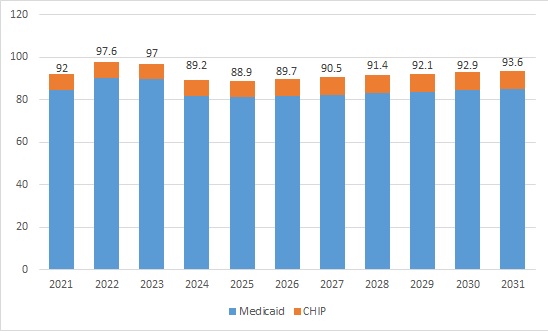
Approximately 92 million people were enrolled in Medicaid and CHIP programs in 2021. Enrollment is projected to have reached a high of 97.6 million in 2022 and is expected to fall between 2023 and 2026 because of Medicaid redeterminations. CMS projects the largest loss in 2024, with 8 million people leaving Medicaid and CHIP that year alone. By 2026, enrollment is projected to hit a low of 89.7 million and start to rise back up in the subsequent years until reaching 93.6 million enrollees in 2031.
Table 1. Historical and Projected Medicaid/CHIP Enrollment (in Millions)

Figure 1. Historical and Projected Medicaid/CHIP Enrollment (in Millions)
Medicare enrollment is projected to continue growing steadily. CMS estimates that Medicare beneficiaries totaled 63.6 million in 2022. By 2031, Medicare enrollment is expected to climb to 76.4 million.
Expenditure Projections
Medicaid expenditures are expected to grow by 5 percent on average in 2022−2031. In 2022, the Medicaid annual growth rate was projected to be −2.1 percent. Following the public health emergency unwinding, average expenditure growth would pick up to 5.6 percent in 2025−2031.
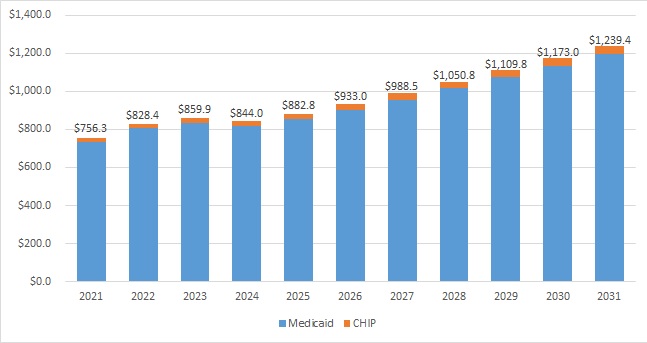
CMS estimated that total Medicaid and CHIP annual spending in 2022 was $828.4 million; by 2031, it is projected to hit $1.2 trillion. For context, private health insurance is projected to reach nearly $2.1 trillion in 2031.
Table 2. Historical and Projected Medicaid/CHIP Expenditures (in Billions)

Figure 2. Historical and Projected Medicaid/CHIP Expenditures (in Billions)
Medicare spending is projected to grow to more than $1.8 trillion in 2031 from $944.2 million in 2022. During this time, average annual expenditure growth is projected to be 7.5 percent. In 2022, spending growth dropped to 4.8 percent compared with 8.4 percent in 2021 because fee-for-service beneficiaries were using fewer emergency department services and as a result of reinstated payment rate cuts associated with the Medicare Sequester Relief Act of 2022.
Medicaid Expenditure Projections by Category
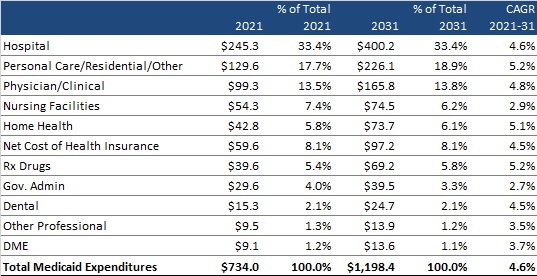
CMS provides a historical and projected breakdown of expenditures by category for Medicaid only (CHIP is bundled with Department of Defense and other public spending). Table 3 summarizes the projected change in annual expenditures for several categories of services and other expenditures. It also shows each category’s percentage contribution to total Medicaid expenditures and the compounded annual growth rate (CAGR) in 2021−2031 for each category of spending. Hospital spending, personal care/residential/other, and physician/clinical expenditures are projected to continue to be the largest contributors to overall Medicaid expenditures, together equaling approximately 65 percent of total expenditures in 2021 and a projected 66 percent in 2031.
Table 3. Historical and Projected Medicaid-Only Expenditures by Category, 2021-2031 (in Billions)
June 21, 2023
CMS Releases National Healthcare Expenditure and Enrollment Projections through 2031
To treat residents with OUD, nursing facilities must improve practices and reduce stigma
This week, our In Focus section highlights a Health Affairs Forefront post, “To Treat Residents With OUD, Nursing Facilities Must Improve Practices and Reduce Stigma,” published June 8, 2023. Health Management Associates (HMA) consultants Dina Besirevic, Kamala Greene Genece, Debbi Witham, David F. Polakoff, and Barry J. Jacobs wrote the article.
The HMA colleagues note that two recent healthcare industry trends are converging to change the admission criteria and clinical practices that some skilled nursing facilities (SNFs) use. Driving one movement is the opioid epidemic in which increased prevalence of fentanyl and its medical complications are spurring the need for posthospital discharge SNF admissions. The other stems from the low occupancy rates in many SNFs since the pandemic. As a result, more SNFs are considering filling beds by admitting individuals with opioid use disorder (OUD) for the first time.
In many respects, this a positive development. The need for skilled nursing care, such as medication-assisted treatment (MAT), for individuals with OUD has never been greater. A March 23, 2023, US Drug Enforcement Administration public safety alert reported that recently analyzed fentanyl samples in 48 of the 50 states had been adulterated with xylazine, or “tranq,” a veterinary sedative added to prolong an opioid high. According to the Substance Abuse and Mental Health Services Administration (SAMHSA), extensive xylazine use commonly causes severe skin wounds requiring weeks of intravenous antibiotics and skilled wound care to prevent amputations. Providing well-managed post-acute care for these patients could lead to improved outcomes.
But admitting and treating individuals with OUD now poses multiple challenges for SNF staffs and administrators. Many of these healthcare workers lack training in OUD pharmacological and support care. Some have stigmatizing attitudes toward individuals with OUD. To address these concerns, SNFs across the country have developed different practice models. Examples include:
- Laguna Honda in San Francisco trains its staff to understand OUD, recognize the signs of resident opioid use, and work closely with nearby OUD providers to provide all OUD treatment.
- At Highbridge Woodycrest Center in the Bronx, NY, the storage and administration of MAT is managed by the SNF staff through a collaborative relationship with a community-based provider, Bronx Care Health System, which prescribes the medications and then delivers them to the facility.
- At other SNFs, SNF physicians and nurse practitioners prescribe buprenorphine with consultation as needed from community-based OUD providers.
HMA’s experts in OUD and SNFs are working collaboratively to assist SNFs interested in exploring the clinical, financial, and operational opportunities and challenges with this emerging line of business. For questions or inquiries, please contact our experts below.
June 14, 2023
To Treat Residents with OUD, Nursing Facilities Must Improve Practices and Reduce Stigma
Takeaways from the early Medicaid unwinding actions
This week, our In Focus checks in on the Medicaid unwinding work and key issues HMA experts are watching as more states resume their normal policies and processes for determining eligibility. A total of 19 states started disenrollments effective for April or May coverage, and 22 additional states plan to start ending coverage this month. States are scheduled to submit the next monthly report by June 8, 2023.
Background
As explained in earlier In Focus articles, (January 12, 2023; November 12, 2022; and April 6, 2022) federal COVID-19 relief laws allowed states to receive higher federal funding for Medicaid as long as the state did not terminate Medicaid coverage for anyone enrolled in Medicaid during the public health emergency (PHE). One result of the continuous coverage policy was sustained growth in Medicaid enrollment; more than 21 million additional individuals were continuously enrolled in Medicaid for up to three years between February 2020 and March 2023. In December 2022, Congress ended the Medicaid continuous coverage policy after March 31, 2023. States were allowed to begin processing redeterminations as early as February 2023 and start disenrolling ineligible individuals as early as April 2023.
Preparations for the Medicaid unwinding have been under way for well over two years. The Centers for Medicare & Medicaid Services (CMS), states, Medicaid health plans, providers, beneficiary advocates, and other interested stakeholders have been working to ensure that the policies, outreach, and assistance are in place to support this massive eligibility renewal and redetermination initiative.
What Do We Know… Or Not Know?
Most of the available forecasts project between 10-15 million enrollees will lose Medicaid coverage. The Health Management Associates (HMA) insurance mix model projects that more than 10 million of the approximately 90 million Medicaid enrollees are at risk for disenrollment. HMA’s model illustrates the variety in state approaches to managing the resumption of eligibility redeterminations as well as key insights related to the differential impact by Medicaid eligibility categories.
- Based on published information, the number of individuals who were disenrolled from Medicaid in April through May is likely to approach 500,000. In these early days of the unwinding period, HMA experts are closely reviewing the reports and engaging with key stakeholders in individual states. Several issues already are garnering more attention, such as the impact on child enrollment, churn and experiences in states using the extended reconsideration period flexibility, among others. Stakeholders will want to monitor how these and other program nuances evolve over the next year.
- We do not yet have robust or consistent data from the states that have resumed their normal processes for determining eligibility. States must submit disenrollment reports to CMS each month, and CMS must publish this information. The states are not, however, required to publish this information on their website. While some states have chosen to publish the data or plan to do so, there is no consistent approach to the specific data states post. For example, while most states publishing a state data dashboard are sharing the number of renewals they are processing each month, only slightly more than half also are sharing the number of renewals resulting in coverage terminations.
CMS is not expected to publish the state data before the end of June. Once this information is available, the state unwinding reports may provide a more comprehensive and consistent picture of enrollment over the next year.
In addition, the total number of “procedural terminations” currently is difficult to determine. Lack of consistent public reporting creates gaps in the data about the number of individuals disenrolled because they did not provide a timely response to the state’s request for more information (or for other procedural reasons). As Medicaid stakeholders know, the procedural disenrollment number is critical because these individuals could still be eligible for the program.
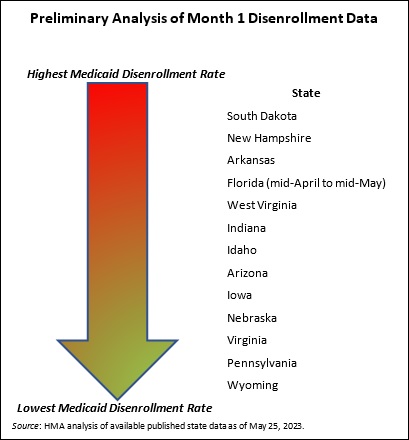
- Early disenrollment numbers should be analyzed carefully and in the context of the state. As noted earlier, the full eligibility renewal and disenrollment reports are unavailable at this time. We do know, however, that the available data is best analyzed in the context of the state’s unwinding plan (e.g., how the state is sequencing its eligibility reviews). The sequencing, pace, staffing, messaging consistency, partner outreach and assistance, and other factors will result in variation in state experiences. States are actively analyzing the data as the information is released and considering course corrections that may be needed, which could affect enrollment.
- Ongoing federal and state collaboration is improving preparations and allowing partners to address concerns as they arise. CMS and states have been transparent about the magnitude of the Medicaid unwinding and the fact that challenges will be inevitable throughout this process. The experiences reported by the first tranche of states to begin their unwinding period reinforce those points. They also provide important lessons for states that are or will shortly resume normal eligibility operations.
What to Watch
HMA’s experts are working with states, Medicaid health plans and their partners, providers, and advocacy organizations to identify and implement solutions to some of the known challenges. We also are looking ahead to forthcoming data, qualitative input, and other important developments that may inform federal and state policies and operations beyond the unwinding period.
- Unwinding trends. Though it is too early to definitively identify trends, HMA experts are monitoring the early state data, and we are prepared to analyze the CMS reports once they are published. We anticipate the CMS published data could be more instructive regarding the impact of the unwinding on enrollment, including states or regions that could benefit from additional outreach and assistance strategies, disproportionate impacts on certain demographic groups, new flexibilities that states may want to consider, and steps that health plans, hospitals and health systems, providers, and other partners could advance.
- State operational plans. As of late May, CMS officials reported they have not asked any state Medicaid agency to develop a corrective action plan related to the unwinding; however, this does not mean that federal officials do not have concerns about the experiences and data being reported out of certain states. States, their business partners, and advocates will all benefit from monitoring shifts in state plans, potential future CMS resources and direction to states such as additional reporting or modifying eligibility processes.
- Coverage Program Transitions. Significant attention has been appropriately placed on the Medicaid disenrollment numbers. HMA experts also are closely watching for new data on the number of individuals who successfully transition and enroll in qualified health plans offered in the Health Insurance Marketplaces. In the short term, the Medicaid unwinding could have a notable impact on total enrollment in Marketplace plans as well as provider payer mix. This could affect longer-term policy, strategy, and operational decisions for officials at the federal and state levels, managed care organizations, providers, and other stakeholders. For example:
- Health insurers should assess the opportunity to participate in the Marketplace program. Other insurers may need to develop new strategies to remain competitive in the Marketplace.
- Providers have similar assessments to conduct related to changes in the number of uninsured people to whom they deliver care, as well as their payer mix and the Marketplace plan networks in which they participate.
- Policymakers may revisit Marketplace regulations and standards in response to enrollment growth, enrollee demographics, and acuity of enrollees in Marketplace plans.
Medicaid agencies, health plans, all types of Medicaid providers, and advocacy organizations should continue to analyze their immediate needs during the Medicaid unwinding. They should also be planning to identify and incorporate lessons from this transition period, as well as preparing for policy and operations changes in the post-unwinding environment.
HMA: What We’re Watching
On June 8, 2023, the Health Care Payment Learning & Action Network (LAN) will hold a virtual meeting focused on accountable primary care. The LAN — an initiative supported by the Centers for Medicare & Medicaid Services (CMS) Innovation Center — is a group of public and private health care leaders that provide thought leadership, strategic direction, and ongoing support to accelerate our care system’s adoption of alternative payment models (APMs). During the session, CMS Administrator Chiquita Brooks-LaSure and the Innovation Center’s Deputy Administrator and Director Liz Fowler will share their vision for accountable primary care.
Over the past several months CMS leaders have discussed their intent to accelerate the transition to value-based care and more accountable primary care. They have identified key principals and hinted at certain components of a potential new primary care model. Additionally, the Innovation Centers’ earlier strategy documents have highlighted the imperative to include payers beyond Medicare, importantly Medicaid and commercial insurers, in models to achieve person-centered accountable and equitable care.
This meeting is notable because the Innovation Center’s models can drive transformational shifts in health care delivery and payment across public and private payers at the system and practice levels. Providers, health systems, insurers, and other interested stakeholders will want to closely monitor the LAN discussion for more information about CMS’ evolving thinking and future opportunities related to a potential model for accountable primary care. HMA experts are available to work with health care organizations and stakeholders to interpret and respond to developments flowing from the LAN session.
Read more about LAN meeting registration and information.
If you have any questions, contact our experts below.
What does passage of the “debt ceiling” bill mean for the healthcare workforce?
On May 31, the House passed H.R. 3746 – the Fiscal Responsibility Act of 2023, otherwise known as the “debt ceiling” bill, which increased the federal debt limit, established new discretionary spending limits, rescinded unused funds, and expanded work requirements for federal programs. It was passed by the Senate on June 1 and will soon be signed into law. What does all this have to do with healthcare workforce? Well, part of the rescindment plan comes from $28 billion in unused pandemic funding, with a substantial portion of those funds that were allocated for healthcare workforce efforts. This includes funds set to be used for mental health and substance use disorder training, grants to improve mental health and burnout in the healthcare workforce, and additional educational and training grants for promoting future workforce. Overall, part of $28 billion specifically includes removal of $1.7 billion from the Centers for Disease Control and Prevention (CDC) and $13.4 billion from the Department of Health and Human Services (DHHS), including $10.4 billion from public health and social services emergency funds.

So, what does this mean for the healthcare workforce? It means healthcare organizations will need to continue to optimize their current and future workforce plans, without additional funding that could provide some relief.
At Health Management Associates (HMA), our healthcare workforce experts have not only partnered with health system leaders to identify real-world solutions, we have directly experienced the same challenges, because our team includes physicians, nurses, advanced practice providers, and former health system operations and financial executives who share the same lived experiences.
HMA offers a number of workforce solutions to healthcare communities across the spectrum. We cannot fill all your staffing gaps tomorrow; however, we can give you an innovative, model-of-care plan designed to lower costs, increase revenue, and position organizations for long-term financial success and operational sustainability.
With HMA’s Delivery System Optimization Team, organizations will benefit from:
- An experienced team of health system leaders, bedside clinicians, and workforce subject matter experts with real-world experience and modern health care delivery solutions
- A thorough quantitative and qualitative assessment including:
- Workforce capacity, needs, and gap analysis.
- Leadership and governance structure evaluation.
- Key regulatory and policy gap analysis.
- Compensation and benefits review.
- Clinical and/or non-clinical workflow evaluation.
- Provider billing practices and quality metric capture.
- Provider and staff utilization analysis.
What organizations receive is:
- A customized, comprehensive phased implementation plan that:
- Improves cash flow and maximizes revenue.
- Reduces turnover, increases retention, and improves health system culture.
- Optimizes the ‘Model of Care’ delivery while still maintaining quality and safety.
- Provides solutions for long-term financial success and operational sustainability.
- Offers on-going executive and leader coaching services to help provide support through the change management process.
Today’s healthcare workforce challenges are unwavering, especially given the recent passage of the “debt ceiling” bill. From significant workforce shortages, to rising costs and competition, to decreasing employee engagement and burnout, today’s health systems face tremendous challenges. But by understanding workforce and health system needs and identifying gaps and inefficiencies, employers can fully utilize the employees they have to their highest potential and deliver care more effectively and efficiently. Here at HMA, our delivery system optimization team can help health care communities struggling with workforce challenges do just that.
Contact our healthcare delivery system experts, who can partner with your organization to design a custom workforce solution for you.