
1356 Results found.


What you need to know about CMS’s proposed changes to Medicaid managed care rules
This week, our In Focus section reviews CMS’s proposed changes to the federal Medicaid managed care access, finance, and quality regulation (CMS-2439-P). A future In Focus will take a closer look at the proposed changes to the federal Medicaid access to care regulation (CMS-2442-P), which also has significant implications for state Medicaid programs.
On April 28, 2023, the Centers for Medicare & Medicaid Services (CMS) unveiled two significant and related proposed rules addressing Medicaid managed care access, finance, and quality requirements. Together these proposed rules signal a new era of accountability and transparency in the Medicaid program. They also strengthen beneficiaries’ role in influencing the policies and administration of state Medicaid programs.
Table 1 identifies a few of the key themes and issues addressed in the Medicaid managed care proposed rule. The deadline for submitting comments to CMS is July 3, 2023.
Table 1. Medicaid Managed Care Proposed Rule: Snapshot of Proposed Changes
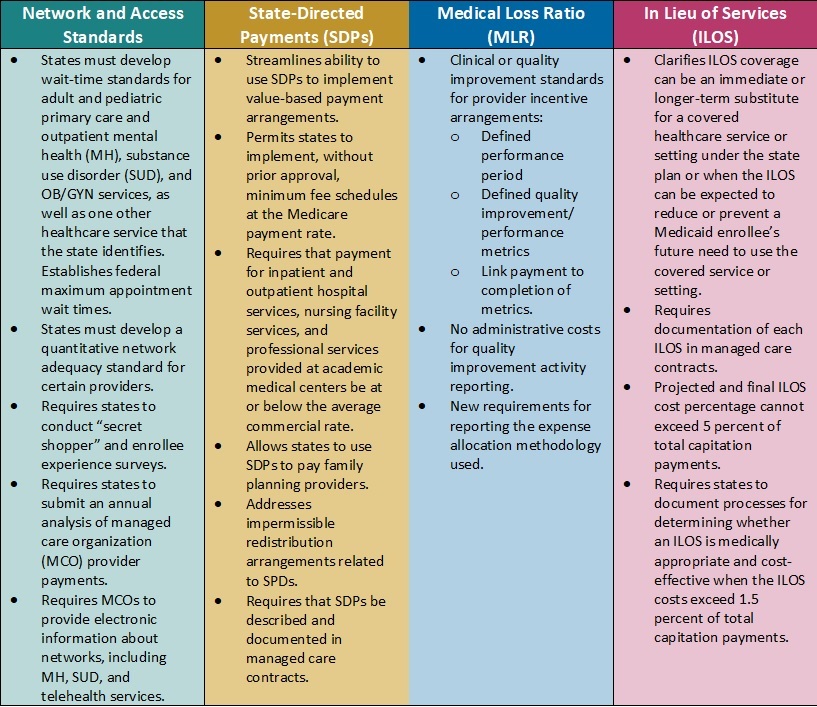
Key Themes and Considerations
Payment Ceilings May Accelerate Value-Based Payment Arrangements. Current federal regulations allow states to direct managed care organizations (MCOs) to pay providers according to specific rates or methods. States have used these directed payment arrangements to set minimum payment rates for certain types of providers or to require participation in value-based payment (VBP) initiatives.
In the proposed rule, CMS calls for establishing an upper limit for these payments. Specifically, the agency plans to limit the projected total payment rates to the average commercial rate (ACR) for inpatient and outpatient hospital services, nursing facility services, and qualified practitioner services at academic medical centers that states include in state-directed payment (SDP) arrangements. The ACR limit, in concert with the proposed SDP documentation and reporting, is among the most significant and complex proposed changes in the rule.
Considerations: The proposed changes represent a strong federal regulatory push to accelerate movement to VBP in Medicaid, which provides states with new levers to drive value in their Medicaid delivery systems. It also means that MCOs, providers, and other stakeholders will need to navigate and help inform the policies and contractual arrangements that will flow from the pending changes. For example, states may need to reflect on the following considerations:
- Whether the proposals will require them to reduce reimbursement
- Whether they will need to develop new value-based arrangements through SDPs and how these policies will be structured
- What outcomes they might need to prioritize
- How transparency in reporting provider-level payments could affect non-federal funding and SDP initiatives
Updated Approach to in Lieu of Services (ILOS) Facilitates Whole-Person Care. In January 2023, CMS issued a State Medicaid Director Letter (SMDL#23-001) advising states of the option to use the ILOS authority in Medicaid managed care programs to reduce healthcare inequities and address unmet health-related social needs (HRSNs), such as housing, food insecurity, and intimate partner violence. The proposed Medicaid managed care rule would expand upon and codify in regulation that guidance.
Considerations: Although the ILOS proposal adds reporting requirements and guardrails to address fiscal accountability, overall, the updated policy signals CMS’s willingness to support innovative state approaches to meet a continuum of beneficiary needs, including HRSNs that affect the social drivers of health. Notably, CMS advises that the substitution of an ILOS for a state plan service or setting should be cost-effective but does not need to be budget-neutral. States also can specify that an ILOS can be an immediate or longer-term substitute for a state plan service or setting.
States could pursue a variety of options under CMS’s revised ILOS framework. State Medicaid agencies and their partners can collaborate on ILOS strategies that will allow them to make further progress toward reducing healthcare inequities, as well as fulfill their quality strategy goals and objectives.
New Standards for Medical Loss Ratio Strengthen Link to Performance Improvement. Existing federal regulations require Medicaid managed care plans to report their medical loss ratio (MLR) to states annually, and, in turn, states must submit a summary of those reports to CMS. Many state MCO contracts require plans to comply with provider incentive and bonus policies; however, MCOs infrequently make incentive payments contingent on the provider meeting quantitative clinical or quality improvement standards.
Consistent with the healthcare sector’s transition toward value-based care, CMS proposes to strengthen the link between an MCOs incentive payment to a provider and the provider meeting defined quality improvement or performance metrics. Additionally, contractual language between MCOs and providers will need to more explicitly identify the dollar amounts tied to successful completion of these metrics. Only incentive payments based on quality improvement will be considered incurred claims when plans calculate their MLR; administrative costs cannot be included in quality improvement activity reporting.
Considerations. The proposed requirements are expected to add more transparency to negotiations between Medicaid MCOs and providers. MCOs will retain flexibility to determine the quality improvement or quantitative performance metrics, which carry more weight and accountability in CMS’s revised regulatory framework.
Network Adequacy Requirements Strengthen Link to Access and Rates. CMS also proposes policies that the agency believes will help strengthen Medicaid enrollees’ access to services. For example, the rule would require states to develop wait-time standards for adult and pediatric primary care and outpatient mental health, substance use disorder (SUD), and OB/GYN services, with CMS establishing federal minimum appointment wait times. States also will need to develop a quantitative network adequacy standard, beyond wait times, for certain providers.
Notably, CMS also plans to require states to submit an MCO-level analysis of MCO-to-provider payments. This analysis may provide more insights about the relationship between rates and access to certain types of providers and services. It may also improve alignment in access policies across delivery systems.
Considerations: States and MCOs should expect to need more sophisticated analysis of provider capacity at state and local market levels. This information will be critical in developing network adequacy standards and determining where additional provider support may be necessary. Expanded and new strategies may be needed to ensure compliance with the federal rules and resulting changes to state policies.
What’s Next
Many of CMS’s proposals track closely with many recent recommendations from federal commissions and oversight entities, including the Medicaid and CHIP Payment and Access Commission (MACPAC) and Government Accountability Office (GAO), which may indicate a greater likelihood that CMS will finalize those policies. If they are finalized largely as proposed, the rule will further the Biden Administration’s directional imprint on the Medicaid program.
Within the proposed rules described above, CMS identifies numerous areas where stakeholder input would be beneficial. States, MCOs, providers, and other interested stakeholders should analyze the proposals and consider submitting comments to CMS on the feasibility, potential impact, and, where applicable, alternatives to the proposed changes. Stakeholders also may use this time to begin planning for 2024 and determining what resources and tools they may need to prepare for implementation of the final regulations, as well as how their approach may vary based on state-specific factors.
For questions about the rule and how HMA’s team of experts can support your organization’s response, please contact our experts below.


May 3, 2023
What You Need to Know about CMS’s Proposed Changes to Medicaid Managed Care Rules

Webinar replay: using 1115 justice waivers to improve carceral healthcare delivery information
This webinar was held on May 18, 2023.
HMA’s five-part 1115 Justice Waivers: Building Bridges of Health for Persons Leaving Carceral Settings webinar series is designed to help plans and other stakeholders improve the long-term health outcomes of individuals leaving carceral settings. This webinar focused on the carceral settings operational healthcare practices, including intake screenings to aid in risk assignment and facilitate community re-entry. The 1115 justice waivers allow Medicaid programs to support in-carceral care, but to optimize resources, systems need information to translate transition in care best practices to carceral places of service.
HMA consultants with lived leadership experience working inside and outside jails and prisons provided plans and state agencies with a unique perspective on opportunities for transformation.
Learning Objectives:
- Establishing Health Care Transitions Across Providers: Methods to improve transitions in care through recognizing carceral facilities as a place of service in the continuum of care.
- Health Risk Assessments to Improve Continuity of Care: Utilizing health screening and risk assessments done at intake and throughout incarceration so Medicaid can improve healthcare transitions from jail into the community.
Other webinars in the “1115 Justice Waivers: Building Bridges of Health for Persons Leaving Carceral Settings” series:
Part 1 – Webinar replay: Medicaid authority and opportunity to build new programs for justice-involved individuals
Register now for Part 3 – June 15, 2pm ET – Transitions of care: identifying and connecting the key partners
July 13 2 p.m. ET – Part 4 – 1115 justice waivers and medication assisted therapy (MAT)
Upcoming Part 5 – 1115 justice waivers and special populations: meeting the needs of justice-impacted youth
Biden administration encourages states to apply for Medicaid Reentry 1115 Demonstration for individuals in carceral settings
This week our In Focus section reviews guidance from the Centers for Medicare & Medicaid Services (CMS), released on April 17, 2023, encouraging states to apply for the new Medicaid Reentry Section 1115 Demonstration Opportunity. The demonstration is aimed at helping improve care for individuals in carceral settings prior to their release.
Background
The United States has approximately 1.9 million individuals incarcerated nationwide. Studies have shown higher rates of mental illness and physical health care needs in incarcerated populations compared to the general population, as well as associations between jail incarceration and increases in premature death rates from infectious diseases, chronic lower respiratory disease, drug use, and suicide.
CMS states that formerly incarcerated individuals with physical and mental health conditions and substance-use disorders (SUDs) typically have difficulty succeeding upon reentry due to obstacles present immediately at release, such as high rates of poverty and high risk of poor health outcomes. These individuals tend to face barriers in obtaining housing, education, employment, and health care access upon release. They often do not seek outpatient medical care and are at significantly increased risk for emergency department (ED) use and hospitalization.
Purpose and Goals
After collecting feedback from stakeholders, including managed care organizations, Medicaid beneficiaries, health care providers, the National Association of Medicaid Directors, and other representatives from local, state, and federal jail and prison systems, CMS designed the Reentry Section 1115 Demonstration Opportunity. The services covered under this demonstration opportunity should aim to improve access to community resources that address the health care and health-related social needs of the carceral population, with the aims of improving health outcomes, reducing emergency department visits, and inpatient hospital admissions for both physical and behavioral health issues once they are released and return to the community.
The purpose of this demonstration opportunity is to provide short-term Medicaid enrollment assistance and pre-release coverage for certain services to facilitate successful care transitions. The full goals, as quoted from CMS, are as follows:
- “Increase coverage, continuity of coverage, and appropriate service uptake through assessment of eligibility and availability of coverage for benefits in carceral settings just prior to release
- Improve access to services prior to release and improve transitions and continuity of care into the community upon release and during reentry
- Improve coordination and communication between correctional systems, Medicaid systems, managed care plans, and community-based providers
- Increase additional investments in health care and related services, aimed at improving the quality of care for beneficiaries in carceral settings and in the community to maximize successful reentry post-release
- Improve connections between carceral settings and community services upon release to address physical health, behavioral health, and health-related social needs
- Reduce all-cause deaths in the near-term post-release
- Reduce number of ED visits and inpatient hospitalizations among recently incarcerated Medicaid beneficiaries through increased receipt of preventive and routine physical and behavioral health care”
CMS encourages states to engage with individuals who were formerly incarcerated when contemplating the design and implementation of their proposal. CMS also encourages states to design a broadly defined demonstration population that includes otherwise eligible, soon-to-be former incarcerated individuals. States have the flexibility to target population, such as individuals with specific conditions, but are encouraged to be mindful of undiagnosed conditions. States should have a plan to ensure incarcerated individuals will be enrolled in Medicaid upon their release, applying for Medicaid no later than 45 days before the day of release.
Reentry Section 1115 Demonstration Opportunity
To receive approval for the demonstration, the state proposal must include in the pre-release benefit backage:
- Case management to assess and address physical and behavioral health needs and health-related social needs;
- Medication-assisted treatment (MAT) services for all types of SUD as clinically appropriate, with accompanying counseling; and
- A 30-day supply of all prescription medications that have been prescribed for the beneficiary at the time of release, provided to the beneficiary immediately upon release from the correctional facility.
In addition to these three services states may include other important physical and behavioral health services to cover on a pre-release basis, such as family planning services and supplies, behavioral health or preventive services, including those provided by peer supporters/community health workers, or treatment for Hepatitis C. CMS is also open to states requesting Section 1115 expenditure authority to provide medical supplies, equipment, and appliances.
The Reentry Section 1115 Demonstration opportunity is not intended to shift current carceral health care costs to the Medicaid program. CMS will not approve state proposals to receive federal Medicaid matching funds for any existing carceral health care services funded with state or local dollars unless the state agrees to reinvest the total amount of new federal matching funds received into activities or initiatives that increase access to or improve the quality of health care services for individuals who are incarcerated.
CMS also expects states to refrain from including federal prisons as a setting in which demonstration-covered prerelease services are provided under the opportunity.
States with approved demonstrations will need to submit an implementation plan, a monitoring protocol, quarterly/annual monitoring reports, a mid-point assessment report, an evaluation design, and interim/summative evaluation reports.
California
California became the first state to receive approval for a Section 1115 waiver amendment earlier this year to provide limited Medicaid services to incarcerated individuals for up to 90 days immediately prior to release. The approval period runs through December 31, 2026, timed with the expiration of the CalAIM Medi-Cal waiver demonstration. California’s reentry demonstration initiative aims to provide health care interventions at earlier opportunities for incarcerated individuals to reduce acute services utilization and adverse health outcomes. The state anticipates it will increase coverage and continuity of coverage for eligible beneficiaries, improve care transitions for beneficiaries as they reenter the community, and reduce morbidity and mortality in the near-term post-release.
Pre-release services include comprehensive care management, physical and behavioral clinical consultation, lab and radiology, MAT, community health worker services, and medications and durable medical equipment. A care manager will be assigned to eligible individuals to establish a relationship, understand their health needs, coordinate vital services, and make a plan for community transition, including connecting the individual to a community-based care manager they can work with upon their release. Additionally, all counties implementing Medi-Cal application processes in jails and youth correctional facilities will “suspend” the Medicaid status while an individual is in jail or prison, so that it can be easily “turned on” when they enter the community.
On April 6, 2023, HMA held a webinar titled, “Medicaid authority and opportunity to build new programs for justice-involved individuals.” The webinar replay is now available. HMA will announce additional webinars on the topic.
April 26, 2023
Biden Administration Encourages States to Apply for Medicaid Reentry 1115 Demonstration for Individuals in Carceral Settings
HMA’s CCBHC program implementation support
Implementation
Since the inception of the Certified Community Behavioral Health Clinics (CCBHC) model, we’ve been working across the country with designated CCBHCs, to help implement the model in ways that maximize the value of the designation.
We’ve worked with a diverse range of behavioral health providers and other stakeholders in planning for and implementing the CCBHC model both within the demonstration program framework, as well as through federally funded CCBHC-expansion grants. Our team of experts supports providers to leverage the CCBHC model to support their overall agency mission and growth goals.
APPROACH
HMA’s CCBHC-related support spans a spectrum from strategic planning through grant securing, grant implementation, organizational change management, to demonstration program participation. HMA offers implementation support that is customized to each organization and its unique circumstances, while leveraging our unmatched breadth of experience with Substance Abuse and Mental Health Services Administration (SAMHSA), CCBHCs, behavioral health treatment and support services, state Medicaid systems, clinical integration, health information technology, quality improvement, healthcare finance, and strategy.
Strategic planning to see how CCBHCs can support each agency to meet its goals
Readiness assessment to best position the agency for CCBHC certification in a competitive landscape
Write SAMHSA proposals to secure CCBHC grant funding
Implementation support in alignment with CCBHC criteria, as well as SAMHSA and state requirements
Ongoing quality improvement to support improvement and advancement of CCBHC programming
Help agencies transition from CCBHC grant funding to a sustainable reimbursement model
In addition, HMA can support a CCBHC implementation with any or all of the following services: financing, workforce recruitment/retention strategies, project management, technical assistance, and health information technology and exchange.
RESULTS
In 2022 alone, we supported behavioral health providers to attain more than $110 million in expansion grant funding they will use in their communities, including over $46 million in CCBHC-planning, development, and implementation grant funding and more than $63 million in CCBHC-improvement and advancement grant funding.
In addition, we have supported more than 20 states to write their CCBHC planning grant applications to initiate a state-run CCBHC model. Most recently, we had 100% success rate for our FY23 planning grant applications, resulting in four states receiving one year planning grants to build a state-run CCBHC model.
CMS’s 2024 hospital inpatient rule proposes payment increases, support for safety net hospitals, and NTAP program changes
This week, our In Focus section reviews the policy changes proposed by the Centers for Medicare & Medicaid Services’ (CMS) on April 10, 2023, for the Fiscal Year (FY) 2024 Medicare Hospital Inpatient Prospective Payment System (IPPS) and Long-Term Acute Care Hospital (LTCH) Proposed Rule (CMS-1785-P). This year’s IPPS Proposed Rule includes several important policy changes that will alter hospital margins and change administrative procedures, beginning as soon as October 1, 2023.
Key provisions of the FY 2024 Hospital IPPS and LTCH Proposed Rule
For FY 2024, CMS proposes to make modifications to several hospital inpatient payment policies. We highlight six proposed policies that are among the most impactful for Medicare beneficiaries, hospitals and health systems, payors, and manufacturers:
- the annual inpatient market basket update,
- hospital wage index adjustments,
- New Technology Add-on Payment (NTAP) program policy changes,
- the agency’s call for input on how to best support Safety Net Hospitals,
- graduate medical education payments at rural emergency hospitals, and
- changes to many cardiovascular-related MS-DRGs.
Stakeholders will have until June 9, 2023, to submit comments to CMS on the contents of this regulation and request for information
1. Market basket update
Proposed Rule: Overall CMS’s Medicare 2024 Hospital Inpatient Proposed Rule will increase payments to acute care hospitals by an estimated $3.3 billion from 2023 to 2024; however, recent trends in economy-wide inflation may alter this estimate by the time the agency releases the Final Rule version of this regulation in August 2023. The primary driver of the estimated $3.3 billion increase in inpatient payments to hospitals is CMS’s proposed 2.8 percent increase in the annual update to inpatient operating payment rates.
HMA/Moran analysis: CMS’s 2.8 percent increase is largely based on an estimate of the rate of increase in the cost of a standard basket of hospital goods, the hospital market basket. For beneficiaries, increasing payment rates will eventually lead to a higher standard Medicare inpatient deductible and increased beneficiary out-of-pocket costs for many other services. For hospitals and health systems, payors, and manufacturers the proposed payment increase (2.8 percent) falls below economy-wide inflation (5-6 percent in recent months) and hospitals are already saying it is insufficient.[1] For this Proposed Rule, data from the third quarter of 2022 was used to calculate the 2.8 percent increase. Importantly, for the FY 2024 Final Rule, CMS will use data through the first quarter of 2023, which we know to include additional growth in economy-wide inflation. As a result, we anticipate the proposed 2.8 percent increase in payment rates may increase slightly by the time rates are finalized later in the year.
2. Hospital Wage Index Adjustments:
Proposed Rule: CMS proposes two wage index policies for FY 2024. First, CMS proposes to continue temporary policies finalized in the FY 2020 IPPS/LTCH PPS final rule to address wage index disparities affecting low-wage index hospitals, which includes many rural hospitals. Second, CMS proposes to include geographically urban hospitals that choose to reclassify into rural wage index areas in the calculation of state-level rural wage index and the calculation of the state-level wage index floor for urban hospitals (referred to as the rural floor policy).
HMA/Moran analysis: The two wage index policies proposed by CMS for FY 2024 will support rural hospitals. The first policy, to continue the low-wage index policy for an additional year beyond the original 4-year plan will allow hospitals with low wage indexes to boost their wage index and their payment rates across all MS-DRGs. Specifically, hospitals with wage indexes below 0.8615 (the 25th percentile across all hospitals) will automatically receive an increase in their wage index by CMS. This policy will bring additional millions of dollars to individual rural hospitals in FY 2024. The second policy, to include the labor data of geographically urban hospitals that choose to reclassify into rural wage index areas within the calculation of the state-level rural wage index and the state-level rural floor will largely benefit rural hospitals. In recent years several large geographically urban hospitals in several markets have chosen to reclassify into rural wage index areas to benefit their Medicare payments. In the past, CMS has not included the labor costs of these hospitals, which tend to have higher than average labor costs in their calculation of the state rural wage index or the rural floor wage index. In making this change, to include the labor costs of the geographically urban hospitals in these calculations, CMS will very likely increase the state-wide rural wage index. This will have the effect of increasing the wage index of many rural hospitals around the country. The overall impact of both proposed wage index policy changes for FY 2024 will be to increase inpatient payment rates to rural hospitals.
3. New technology add-on payments (NTAP):
Proposed Rule: Citing the increased number of applications over the past several years and noting the need for CMS staff to have time to fully review and analyze the applications, CMS proposes two changes to the NTAP application requirements. First, CMS proposes to require all applicants to have a complete and active FDA market authorization request in place at the time of NTAP application submission (if not already FDA approved). In addition, CMS proposes to move the FDA approval deadline from July 1 to May 1, beginning with applications for FY 2025.
HMA/Moran Analysis: CMS’ proposals to change the NTAP application process aim to ameliorate the problem of manufacturers withdrawing applications because they miss the FDA approval deadline. These withdrawals increase CMS’ workload, as the agency reviews some applications multiple times. However, while these proposals provide CMS with more time to review applications, they increase the amount of time some applicants will not receive NTAP payments, depending on the timing of the FDA approval process. The annual NTAP approval cycle and FDA approval deadline create difficulties for manufacturers with products that miss the deadline, which many stakeholders argue creates barriers to access for new technologies. Stakeholders have proposed a variety of potential solutions to these barriers, such as biannual or quarterly NTAP decisions, or extending the conditional approval pathway currently used for certain antibiotic products to all NTAP applications.
4. Safety Net Hospital Request for Information:
Proposed Rule: CMS is seeking public input on the unique challenges faced by safety-net hospitals and the patients they serve, and potential approaches to help safety-net hospitals meet those challenges.
HMA/Moran Analysis: In the 2024 Proposed Rule CMS poses a variety of questions to the public about how safety net hospitals and their patients can be better supported by the Medicare program, both in terms of payment and infrastructure investment. The agency specifically asks stakeholders their opinion on measures that could be used to define safety net hospitals and potentially make differential or additional payments to safety net hospitals. CMS names the safety net index (SNI) developed by the Medicare Payment Advisory Commission (MedPAC) in recent years and the Area Deprivation Index (ADI) developed by the National Institutes for Health (NIH) as the two leading options for defining and potentially reimbursing safety net hospitals. These two methods have several significant differences, including that the SNI is a hospital-level measure based in-part on the volume of cases at a given hospital associated with Medicare beneficiaries that are fully or partially eligible for Medicaid and the ADI is a geographic measure that correlates local socioeconomic factors with medical disparities. HMA has modeled the SNI for hospital stakeholders in the last year and has identified hospitals that would be potential winners and losers if an SNI approach were implemented by CMS.
5. Graduate Medicare Education Training in Rural Emergency Hospitals:
Proposed Rule: CMS proposed to allow Graduate Medical Education (GME) payments for training Rural Emergency Hospitals. Rural Emergency Hospitals are a new provider type established by the Consolidated Appropriations Act, 2021, to address the growing concern over closures of rural hospitals. If finalized, this proposal would allow hospitals converting to REH status and other hospitals newly designated as REHs to receive Medicare GME payments even though they do not have an inpatient facility.
HMA/Moran analysis: If finalized, the proposed policy to allow REHs to offer GME training and to be paid for GME training will enhance access to care in rural areas and will enable hospitals that convert to REHs to expand their capabilities. CMS’s proposal to allow REHs to receive payment based on 100 percent of the reasonable costs for GME training costs allows REHs to operate training programs and to focus new training programs on rural care and outpatient care. This policy, if finalized, will bring additional revenues to hospitals that decide to convert to REHs (thereby relinquishing their inpatient capacity) and will improve access to care for beneficiaries living in rural areas.
6. MS-DRG weights:
Proposed Rule: To set MS-DRG weights for FY 2024 inpatient cases, CMS proposed to use FY 2022 data, which is consistent with pre-pandemic CMS methods. In previous years, CMS had modified its MS-DRG weight calculation to account for high volumes of COVID cases. However, for FY 2024, CMS has returned to its longstanding method of using a single year of data to set MS-DRG weights. In addition, among the various changes CMS has proposed as a part of the 2024 MS-DRG weight setting process CMS has proposed significant changes to many MS-DRGs in the category for diseases and disorders of the circulatory system (Major Diagnostic Category 5).
HMA/Moran analysis: CMS’s return to using a single year of data without COVID modification will be welcomed by many stakeholders, but particularly for those with an interest in short-stay surgical cases. The modifications CMS proposes to make to the MS-DRGs within Major Diagnostic Category 5, which includes numerous cardiovascular MS-DRGs, are likely to be disruptive for many stakeholders initially but over the long term are likely to make CMS coding more consistent with standard clinical practice and per case resource use. For example, CMS is proposing to consolidate five cardiac defibrillator MS-DRGs into three, consolidate three Thrombolysis MS-DRGs into two, and overhaul the family of stenting MS-DRGs. We anticipate that these changes and other proposed by CMS may result in initial coding confusion for hospitals, but that they will slowly adapt throughout 2024.
HMA and The Moran Company work collaboratively to monitor legislative and regulatory developments in the inpatient hospital space and assess the impact of inpatient policy changes on the hospital sector. HMA’s Medicare experts interpret and model inpatient policy proposals and use these analyses to assist clients in developing their strategic plans and comment on proposed regulations. Moran annually replicates the methodologies CMS uses in setting hospital payments and models alternative payment policies to help support its clients’ comments to the rule. Moran also assists clients with modeling for DRG reassignment requests and to support NTAP applications. Typically, these projects run through the summer, to ensure readiness for October deadlines. Finally, many clients find it useful to model payments for different types of cases under different payment scenarios. For example, a client may be interested in how payments for COVID-19 cases may change after the expiration of the Public Health Emergency, and which hospitals will face the biggest payment cuts. Moran is available to help with these and other payment modeling questions—and works on many of these issues in tandem with HMA’s Medicare experts.
For more information or questions about the policies described below, please contact our experts below.
Integrating behavioral health & general medical care is vital to reach the triple aim
The integration of behavioral health and medical care has emerged as a crucial method for improving health and reducing the cost of care. Integrated care offers solutions and advancements in healthcare delivery by improving access to behavioral healthcare, including scarce psychiatric resources, reducing stigma, and enhancing behavior change in everyday life.
As an emerging standard of care, policy makers, payers, and leaders are expecting organizations to develop evidence based approaches to team based care that can demonstrate health outcomes and cost savings. HMA can help your organization navigate this important culture change. Our multidisciplinary team includes clinical, finance and payment, and policy experts with hands-on experience in integrated care service delivery.
Our integration experts can help your team with:
Readiness assessment
Evidence based policy, finance, and model design
Technical assistance, training, team based care
Operational changes including billing, HIE, credentialing
Measurement based care metrics and evaluation
Cultural change and leadership
We are working with an array of clients on integration
Health plan integration
State departments & statewide implementation
Integrated delivery systems
Hospital based providers
PCMH & FQHC primary care providers
Accountable care organizations
Certified community behavioral health clinics and other BH providers
Department of corrections
For more information, contact our featured experts below.
April 19, 2023
CMS’s 2024 Hospital Inpatient Regulation Proposes to Increase Payments to Hospitals, Support Safety Net Hospitals, and Modify the NTAP Program
Implementation Accelerator: leadership training through application
The healthcare industry is constantly evolving and requires a workforce that is responsive and able to lead and adapt to changes. Healthcare professionals are continually asked to incorporate new services, care models, quality measures, and process improvements into daily work.
While clinical innovations and operational improvements are promising, there is growing recognition of the gap between plans to implement them and actual implementation.
HMA has extensive leadership, operational, and clinical expertise working directly with health systems, health plans, providers, foundations, community-based organizations, and associations adopt implementation science informed approaches for successful change.
Drawing on this experience, we developed the HMA Implementation Accelerator, a leadership development framework that utilizes implementation science to address on-the-ground challenges and lead successful implementation efforts.

“The importance of leadership is noted in just about every discussion of implementation. The absence of leadership support is a well-documented barrier, and success is attributed to the presence of leadership support.”
– Active Implementation Research Network
HMA Implementation Accelerator

PEOPLE
Leadership development
Build knowledge, skills, and abilities and apply them to implementation
Change agent engagement and development
Identify formal and informal leaders to inform, support and influence engagement
Implementation approach training
Build knowledge and skills critical to successful implementation
PROCESS
Project management
Develop or enhance structures and approach to guide implementation
Continuous improvement and critical feedback
Integrate structures and practices that facilitate continuous improvement, sustain momentum, and highlight critical adaptation
Communication planning
Plan and deploy intentional, pro-active communication strategies to effectively guide and support implementation
Tool development
Identify, develop, and deploy tools that support effective implementation and create efficiencies for implementation teams
Sustainability planning
Pro-actively plan for sustainability from outset
PURPOSE
Executive sponsorship
Engage and activate sponsorships for critical support and resources
Align implementation with mission
Connect implementation efforts to a larger “why” in alignment with mission
What’s included
Conceptual framework to guide implementation process
Strategies to develop effective sponsorship at the executive or senior leadership level to mitigate barriers and resource effort
Leadership skill development at the level of implementation
Processes to enhance effective ownership and commitment at all levels
Prioritization of change initiatives
Clear accountability of actions in implementation
Continuous quality improvement as part of implementation
Sustainability planning from the start
Research shows that successful leadership development occurs when the learning can be directly applied to active work processes, which aligns with how adults learn most effectively.
Through the Implementation Accelerator, we use a combination of interactive training, peer learning, and coaching to support hands-on learning. The integration of leadership development and implementation science provides a robust opportunity to develop and sustain leadership skills and develop an organizational methodology to guide both current and future implementation efforts.