
Insights

HMA Insights: Your source for healthcare news, ideas and analysis.

HMA Insights – including our new podcast – puts the vast depth of HMA’s expertise at your fingertips, helping you stay informed about the latest healthcare trends and topics. Below, you can easily search based on your topic of interest to find useful information from our podcast, blogs, webinars, case studies, reports and more.

Show All | Podcast | Blogs | Webinars | Weekly Roundup | Videos | Case Studies | Reports | News | Spotlight

Filter by topic:

Receive timely expert insights on topics you care about.

Select Topics

1306 Results found.

Blog

CMS Proposes New Ambulatory Specialty Model, Provides Details About Cell and Gene Therapy Model

Read Blog

Specialty model will focus on upstream management of lower back pain and congestive heart failure in traditional Medicare

This week, the Centers for Medicare & Medicaid Services (CMS) released the Calendar Year (CY) 2026 Medicare Physician Fee Schedule (MPFS) proposed rule, which introduces a new mandatory Ambulatory Specialty Model (ASM), and announced updates on the Cell and Gene Therapy Access Model. These developments reflect CMS’s continued focus on value-based care, chronic condition management, and new payment strategies.

Specialists will be financially accountable for the upstream management of low back pain and congestive heart failure in traditional Medicare. The model is designed to reduce costs and improve healthcare quality through performance-based payment adjustments and enhanced care coordination. The proposal is open for public comment, and CMS may revise model parameters before finalizing the rule later this year.

In this article, Health Management Associates (HMA) experts break down the ASM model’s goals and design features and explains developments in CMS’s Cell and Gene Therapy Access Model. HMA experts are reviewing the CY 2026 MPFS and the CY 2026 Hospital Outpatient Prospective Payment System proposed rules and will highlight key policy provisions in a forthcoming article.

ASM Focus on Chronic Care

CMS estimates that more than two-thirds of traditional Medicare beneficiaries have at least one chronic condition. CMS states that spending on heart failure comes to $10‒$13 billion annually, while annual costs associated with low back pain are $6‒$8 billion. A lack of coordinated care can impede patients’ ability to manage their health and result in low-value care like unnecessary procedures and avoidable hospitalizations that run up costs without improving healthcare outcomes. The ASM will test how incentives such as payment adjustments to providers can encourage preventive care, earlier diagnosis, and better disease management.

Program Goals

The ASM is designed to encourage collaboration and communication between patients’ primary care providers and specialists who treat low back pain and heart failure. According to CMS, improved coordination will lead to the following:

  • Better patient outcomes and reduced disease progression
  • Decreased spending on low-value care experiences, such as unnecessary hospitalizations and procedures
  • Ensure providers are evaluated based on performance measures that are linked to the care they offer their patients
  • Optimize data transparency to allow providers to compare their performance with their peers when being measured on patient-centered outcomes

Performance will be assessed based on the Merit-based Incentive Payment System (MIPS) Value Pathways (MVPs) across four factors:

  1. Improving outcomes, such enhancing patients’ functional status or controlling their blood pressure
  2. Lowering costs, especially through reduced provision of unnecessary services
  3. Increasing patient engagement through clinical care processes
  4. Expanding interoperability and data communication through certified electronic health record technology

Though based on the MIPS MVPs, the ASM will enhance the focus of performance measures, thereby simplifying reporting and allowing for comparisons across different providers and regions.

Table 1. ASM Model Payments, Participants, and Timeline

CategoryDetails
Model TypeTwo-sided risk payment model
Payment Adjustment Range-9% to +9% based on performance relative to peers
Performance Tiers– Positive adjustment for high performance
– Neutral for average performance
– Negative adjustment for low performance
Geographic ScopeRolled out in ~25% of core-based statistical areas (CBSAs) and metropolitan divisions nationwide
Specialties Included– Low back episodes: Anesthesiologists, pain management, interventional pain management, neurosurgeons, orthopedic surgeons, physical medicine or rehabilitation specialists– Heart failure episodes: General cardiologists
First Performance YearJanuary 1, 2027
Duration5 years
Relation to Other Models– ASM is the second mandatory model proposed by CMS, following TEAM (Transforming Episode Accountability Model). While TEAM focuses on hospital-based episodes, ASM shifts accountability to specialists.– Both models align with CMS’s broader strategy to reduce low-value care, a theme also reflected in the recently announced the Wasteful and Inappropriate Service Reduction (WISeR) model.
Policy ContextPart of CMS Innovation Center’s strategy to promote evidence-based prevention, high-value care, and reduce unnecessary utilization

Cell and Gene Therapy Model

On July 15, 2025, CMS announced the participants in the Cell and Gene Therapy (CGT) Access Model. A total of 33 states, plus the District of Columbia and Puerto Rico, will participate in this model, which has the federal government negotiating outcomes-based agreements with CGT manufacturers of sickle cell disease treatments. Participating states represent approximately 84 percent of Medicaid beneficiaries with the condition. Under the model, participating states receive guaranteed discounts and rebates from participating CGT manufacturers if the therapies fail to deliver their promised therapeutic benefits. States also have the option of receiving federal support of up to $9.55 million each to assist with implementation, outreach, and data tracking. States may choose when to begin their participation between January 2025 and January 2026. CMS indicated it may modify the model in the future to cover other diseases with high-cost, high-impact therapies.

Connect with Us

The ASM introduces opportunity and financial risk for specialists, hospitals, and health systems. Providers should consider strategies and tactics that will strengthen their collaboration with primary care teams to manage the chronic conditions addressed in the ASM model, which may require workflow redesign and new communication protocols. Providers also should consider whether they will need to make investments in data infrastructure and reporting to meet their performance quality goals.

HMA’s Medicare team—including actuaries, data analysts, and policy experts—helps organizations model, understand, and navigate the impact of proposed frameworks and policy changes, quantify risk, and more, so organizations can improve both financial performance and patient outcomes.

For details about these model announcements or the new proposed rules, contact the HMA Medicare team tracking these policies.


Blog

HHS Issues Immediate Policy Shift on Federal Benefit Eligibility Under PRWORA

Read Blog

On July 10, 2025, the US Department of Health and Human Services (HHS), Department of Labor, Department of Justice, Department of Education, and US Department of Agriculture (USDA) issued notices that significantly reinterpret the definition of “federal public benefit” used in Title IV of the Personal Responsibility and Work Opportunity Reconciliation Act of 1996 (PRWORA). These changes are effective immediately upon publication in the Federal Register, though agencies have opened 30-day public comment periods to solicit feedback.

In this article, Health Management Associates (HMA) experts explain two of these notices—those from HHS and USDA—based on what we know and outstanding issues that organizations should expect to arise in the coming months.

Programs Affected by HHS’s Revised Interpretation

The notice changes HHS’s 1998 interpretation of PRWORA and will have sweeping implications for service delivery across the country. It does this by reversing the classification of many long-standing programs to be “Federal public benefits;” until now, these programs had been specifically excluded from that definition. People with Unsatisfactory Immigration Status are not permitted to access these benefits. People classified as such include those who are undocumented, but also several categories of people lawfully in the United States, such as holders of H1B and J-1 visas, as well as some lawful permanent residents (green card holders — only for the purposes of eligibility for certain programs).

Programs newly subject to these restrictions include:

  • Head Start
  • Certified Community Behavioral Health Clinics (CCBHCs)
  • Community Mental Health Services Block Grant
  • Community Services Block Grant (CSBG)
  • Health Center Program (Community Health Centers/FQHCs)
  • Health Workforce Programs (including grants, loans, scholarships, and loan repayments)
  • Services administered by the Substance Abuse and Mental Health Services Administration (SAMHSA)
  • Title IV-E programs (Educational and Training Voucher Program, Kinship Guardianship Assistance Program and Prevention Services Program)
  • Title X Family Planning

Organizations that receive federal or pass-through federal funding may now be required to assess immigration status as a condition of service delivery—something many have never done before. This shift raises significant operational, ethical, and mission-aligned challenges for hospitals, community health centers, behavioral health providers, and human services organizations. PRWORA does include language exempting 501(c)(3) charitable organizations from being required to verify immigration status, but as the administration notes in its announcement, they are not barred from doing so. This will be an area to watch.

USDA Interpretation

The USDA’s notice similarly identifies all 16 programs the Food and Nutrition Services (FNS) administers as meeting the definition of “Federal public benefit” used in Title IV of PRWORA. These programs include:

  • Supplemental Nutrition Assistance Program (SNAP)
  • Nutrition Assistance Program for Territories
  • Food Distribution Program on Indian Reservations (FDPIR)
  • Special Supplemental Nutrition Program for Women, Infants, and Children (WIC)
  • National School Lunch Program, School Breakfast Program, and Summer Food Service Program
  • Child and Adult Care Food Program

The notice, however, states that there is a difference between defining a program as a federal public benefit and applying other provisions of PRWORA to those programs. The USDA’s notice clarifies that providers of non-exempt benefits must verify that applicants have a qualified immigration status for purposes of PRWORA but does not address how verification should be implemented or how exceptions should be applied.

What We Know—and Don’t Know

Though the list of affected programs is extensive, many critical implementation details remain uncertain. Both agencies acknowledge that further guidance will be needed to clarify how these changes will be operationalized.

Organizations should expect additional updates and further clarifications from federal agencies in the coming months. Legal challenges to these changes are almost certainly forthcoming.

Looking Ahead

These policy changes are both significant and still evolving. They will affect how and where services are delivered, as well as whether people choose to access the services at all.

During this period of uncertainty, frequent and transparent communication is essential. Deploy information and updates in multiple formats —written, verbal, visual—to reach diverse audiences, including your organization’s staff and other stakeholders in your community. When policy is fluid and changing rapidly, authentic messaging about what is known and what remains unclear will position your organization as an honest broker and trusted partner.

HMA experts are tracking these and related developments. For questions and to discuss the impact of these policies on your organization, contact our featured experts below.

Brief & Report

Project FoodBox: The Case for Food Is Medicine

Download

This literature review explores the concept of Food Is Medicine (FIM)—a healthcare approach that integrates nutrition-based interventions to prevent, manage, and treat chronic diseases. The report emphasizes the role of produce prescriptions, medically tailored meals (MTMs) and groceries in improving health outcomes, especially among low-income populations.

Solutions

Realize transaction-related cost synergies

Read More

HMA Spotlight

Realize transaction-related cost synergies

In the current policy environment, we anticipate increased consolidation in various subsectors due to financial and regulatory headwinds. Organizations can take intentional steps pre- and post-integration to realize cost synergies.

HMA Strategy & Transformation consultants advise organizations in their integration activities, and find it valuable to conduct the following sequence of steps:

Map the operating model pre-close to understand organizational structure, systems, contracts, and key processes across both entities.

Identify risks and quick wins before close—including staffing gaps, system incompatibilities, or duplicative vendors.

Design a Day 1 plan to keep operations stable, align communication, and ensure continuity for staff, patients, and partners.

Stand up integration teams post-close to drive workstreams across finance, IT, HR, and clinical operations with clear timelines and ownership.

Track synergies and milestones to measure progress, course-correct where needed, and deliver the operational and financial goals of the deal.

Intregration with HMA Strategy

A thorough, objective mapping is recommended, to investigate whether to cultivate in-house capabilities or maintain vendor relationships. Considerations include in-house capacity, contracted rates, and the flexibilities and risks associated with outsourcing. We recommend identifying favorable terms in existing vendor contracts that can be leveraged in enterprise-wide contracts.

Although there are internal and external pressures to move aggressively towards transaction deadlines, ensuring that appropriate pre- and post-close activities take place is key.

Ready to transform your organization?

Whether you are focused on payments, healthcare delivery, government policy, behavioral health, life sciences, Medicare, Medicaid, or Managed Care, our HMA experts are ready to partner with you, from initial strategy-setting through implementation.

Related Resources

Learn more about our Strategy & Transformation services

Achieving financial resilience in a time of turbulence

HMA’s Strategy & Transformation Practice collaborates with Stanford University to drive public health innovation

CMS Shakes Up the Innovation Center Model Landscape: What Comes Next?

Building Sustainable Health Systems

How One Organization Unlocked Exceptional Financial Gains Through Revenue Cycle Optimization

Contact our experts:

Headshot of Rebecca Nielsen

Rebecca Nielsen

Managing Director

Rebecca Nielsen is a managing director of HMA’s strategy and transformation practice, where she designs and leads major strategy and … Read more
Headshot of Alex Rich

Alex Rich

Senior Advisor

Alex Rich is an experienced business transformation leader with extensive expertise designing and deploying strategic programs that produce meaningful results. … Read more
Brief & Report

Los Angeles County Child Welfare-Involved Population Medi-Cal Analysis

Download

Comparative Analysis of the Engagement in Care for Children in Medi-Cal Fee-for-Service vs. Managed Care and Learnings from Enhanced Care Management Early Implementation

In November 2023, the Los Angeles (LA) County Board of Supervisors passed a motion to address the implementation of new benefits for the child welfare-involved population launched through California’s Medicaid waiver, California Advancing and Innovating Medi-Cal, known as CalAIM. The CalAIM waiver expanded services to managed care beneficiaries, including enhanced care management (ECM) for coordinated case management, referrals, and community resource navigation and community supports, such as housing assistance, medically tailored meals, housing modifications, respite care for caregivers, and asthma management. These benefits are designed to better address health and social needs for the most vulnerable and at risk Medi-Cal beneficiaries, including children and youth involved in the child welfare system. The Board directed the Office of Child Protection (OCP), in collaboration with key county departments, to engage Health Management Associates, Inc. (HMA), as the technical assistance provider.

Recognizing that approximately two-thirds of child welfare-involved children and youth in LA County are enrolled in fee-for-service (FFS) Medi-Cal and ineligible for new CalAIM supports, HMA conducted a comparative analysis of the experience of children involved in the child welfare system in FFS versus managed care Medi-Cal through an analysis of federal T-MSIS data looking at a snapshot of data from December 2022. The analysis examined the experience of the child welfare-involved population in primary and preventive healthcare services (including well-child visits, dental visits, behavioral health) in Medi-Cal FFS versus managed care plan enrollment (MCPs) to inform decisions about existing practices for care management among the child welfare-involved population. The comparative analysis of the child welfare population in Los Angeles County, San Diego County, and Riverside County revealed children in managed care consistently showed higher rates of engagement in primary and preventative healthcare services.

Blog

H.R. 1 Signed Into Law—What It Means for Medicaid and Public Coverage

Read Blog

Just one week after we reviewed the Senate’s version of the budget reconciliation bill, H.R. 1, President Trump has now signed the legislation into law. The final iteration of H.R. 1 includes sweeping changes to Medicaid, the Affordable Care Act (ACA) Marketplaces, and Medicare—several of which diverge significantly from the version that the House passed May 22, 2025.

This update outlines many of the most consequential healthcare provisions, with a focus on Medicaid financing, eligibility, and operational impacts. It also highlights how stakeholders can act now to prepare for what happens next.

From Proposal to Policy: What Changed

The Senate’s amended version of H.R. 1, approved on July 1 and passed by the House on July 3, 2025, reshaped several key provisions in the earlier version of the House bill. Although the bill retains its core focus on tax policy and entitlement reforms, it further constrains state Medicaid financing and eligibility and scales back Marketplace subsidies for certain populations.

According to preliminary analysis from the Congressional Budget Office, the final bill will reduce federal healthcare spending by approximately $1.15 trillion over the next decade but also will increase the number of uninsured individuals by 11.8 million by 2034 because of changes to both Medicaid and Marketplace programs.

Medicaid Eligibility: A New Era of Policy and Operational Complexity

Mandatory Community Engagement Requirements

By December 31, 2026, states must implement community engagement (work) requirements for certain Medicaid enrollees. These requirements cannot be waived under Section 1115, though states may request “good faith” exemptions through 2028.

States must notify enrollees through multiple channels and develop the infrastructure needed to track compliance. Managed care organizations and other entities that have financial relationships with Medicaid services are prohibited from determining compliance.

Tighter Eligibility and Redetermination Requirements

States must now conduct Medicaid eligibility redeterminations every six months for expansion populations. The bill also delays implementation of previously finalized rules that would have streamlined enrollment and imposes new verification requirements, including address checks. For immigrants, H.R. 1 narrows the definition of “qualified” individuals who are eligible for Medicaid and CHIP, removing coverage for refugees, asylees, and other humanitarian categories.

Cost Sharing for Expansion Adults

Starting in 2028, states must apply cost-sharing requirements to Medicaid expansion adults with incomes greater than 100 percent of the federal poverty level. Though primary care, mental health, and certain other services are exempt, the policy introduces new administrative burdens for states and many providers.

Medicaid Financing: A Structural Shift

Provider Tax Restrictions

H.R. 1 freezes existing provider tax programs and bars any new taxes. Also, Medicaid expansion states must phase down the maximum allowable tax rate from 6 percent to 3.5 percent by 2032. This change will significantly constrain states’ ability to use provider taxes to finance Medicaid and draw down federal matching funds.

Limits on State-Directed Payments

The bill caps state-directed payments at either 100 percent or 110 percent of Medicare rates, depending on the state’s expansion status. Grandfathered payment arrangements will be phased down by 10 percent annually beginning in 2028. These provisions will require states to reassess supplemental payment strategies and may affect provider participation and access to care.

Other Key Provisions

The Rural Health Transformation Program provides $50 billion over five years to support financially distressed rural providers. H.R. 1 requires that each state submit a plan, and the Centers for Medicare & Medicaid Services (CMS) administrator must approve or deny the plan by December 31, 2025, giving CMS and the US Department of Health and Human Services significant authority to shape the approval/denial processes, as well as critical details of the program and funding decisions.

For the Marketplace, the law eliminates ACA subsidy eligibility for certain lawfully present immigrants, ends conditional eligibility for ACA subsidies as well as passive re-enrollment, and eliminates the cap on ACA subsidy repayment at tax time. It also prohibits individuals who are not enrolled in Medicaid because of a failure to satisfy community engagement requirements from receiving any subsidies.

In addition, a new 1915(c) waiver option allows states to offer home and community-based services (HCBS) without requiring that they provide institutional level of care but only if waiting lists for existing services are not extended. Another provision excludes family planning and abortion service providers from receiving Medicaid funding if they received at least $800,000 in Medicaid reimbursements in 2023.

Finally, the law includes a one-year, 2.5 percent increase to the Medicare physician fee schedule conversion factor, which will be in effect for calendar year 2026 and expire thereafter.

What Stakeholders Should Do Now

States can begin planning for eligibility system changes, redetermination volume, and community engagement implementation, all of which require an understanding of the potential interactions of the federal Medicaid, Medicare, and ACA Marketplace policy changes. In addition, state officials should consider reassessing provider tax structures and supplemental payment strategies, where applicable. They need to engage early on rural health transformation funding opportunities and other provider supports.

Health plans can forecast enrollment and risk mix changes. They have opportunities to support states in compliance efforts to avoid federal funding recoupments. In addition, plans must prepare for new administrative requirements related to cost sharing and work requirements, among other policy changes on the horizon. Consumer communications should also be a focus area.

Providers and community-based organizations will need to prepare for greater uncompensated care needs and costs, which can lead to potential revenue loss, as well as new reporting and program integrity expectations. They also will play an integral role in assisting patients in maintaining coverage and navigating new requirements.

Vendors and health information exchanges have several opportunities to support the implementation of new requirements in H.R. 1 alongside the changing regulatory priorities. Examples include reviewing system capabilities to support new eligibility, verification, and reporting requirements and coordinating with states to ensure smooth implementation and program integrity.

Looking Ahead

The passage of H.R. 1 marks a turning point in federal health policy. Although the law’s fiscal goals are clear, its operational impacts will unfold over the coming months and years. States, plans, providers, and community organizations must now pivot from policy analysis to implementation readiness.

HMA will continue to monitor federal guidance, state responses, and stakeholder strategies. For more detailed analysis or support with scenario planning, contact our experts below.

Blog

Medicaid Spending in Federal FY 2024 Totals Nearly $909 Billion

Read Blog

This week, our In Focus section highlights findings from the Centers for Medicare & Medicaid Services (CMS) preliminary CMS-64 Medicaid expenditure report for federal fiscal year (FFY) 2024. According to the preliminary estimates, Medicaid expenditures on medical services across all 50 states and six territories in FFY 2024 totaled $908.8 billion.

This figure provides important context and an initial baseline for tracking Medicaid spending trends following the enactment of H.R. 1, the One Big Beautiful Bill Act. According to the Congressional Budget Office’s preliminary analysis, H.R. 1 will reduce federal Medicaid and Children’s Health Insurance Program (CHIP) spending by approximately $1.02 trillion over the next decade (2025−2034)—a significant share of total Medicaid expenditures.

Total Medicaid Managed Care Spending

The following analysis is based on a Health Management Associates Information Services (HMAIS) analysis of the draft CMS-64 report. This report contains preliminary estimates of Medicaid spending by state for FFY 2024. CMS tracks state expenditures through the automated Medicaid Budget and Expenditure System/State Children’s Health Insurance Budget and Expenditure System (MBES/CBES). The CMS-64 form identifies annual expenditures through these systems.

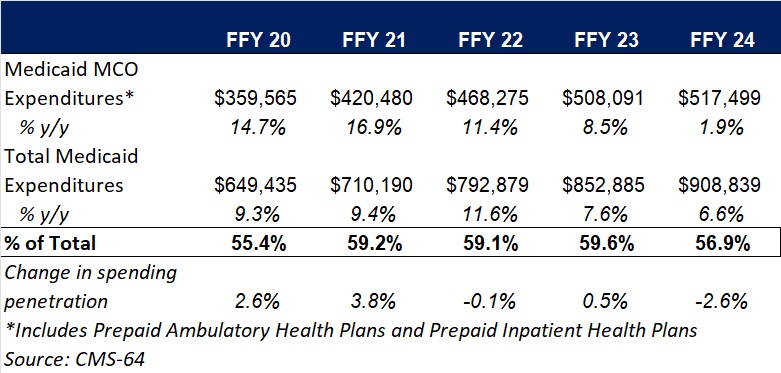
Key findings from HMAIS’ analysis, as also shown in Table 1, include:

  • Total Medicaid managed care spending (federal and state share combined) reached $517.5 billion in FFY 2024, up from $508.1 billion in FFY 2023.
  • This amount represents a 1.9 percent year-over-year increase from FFY 2023 to FFY 2024, a notable slowdown compared to the 8.5 percent growth observed in our analysis of year-over-year spending from FFY 2022 to FFY 2023.
  • Managed care accounted for 56.9 percent of total Medicaid spending in FFY 2024, down 2.6 percentage points from the previous year.
  • In terms of dollars, the increase in Medicaid managed care spending from FFY 2023 to FFY 2024 was $9.4 billion, compared with $39.8 billion from FFY 2022 to FFY 2023.

These figures include spending on comprehensive risk-based managed care organizations (MCOs), prepaid inpatient health plans (PIHPs), and prepaid ambulatory health plans (PAHPs). PIHPs and PAHPs refer to prepaid health plans that provide only certain services, such as dental or behavioral health care. Fee-based programs, such as primary care case management models, are not included in this total.

Table 1. Medicaid MCO Expenditures as a Percentage of Total Medicaid Expenditures, FFY 2020−2024 ($M)

Medicaid Managed Care Spending Insights

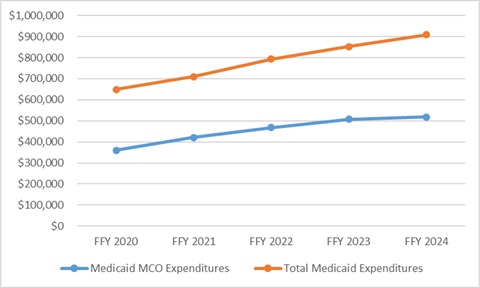
Medicaid managed care expenditures have grown consistently each year with total Medicaid expenditures. In FFY 2024, however, the growth in the share of managed care expenditures was notably lower than in the previous four years. The slower growth in managed care spending aligns with the post-COVID-19 policy unwinding period, during which many states completed eligibility redeterminations that had been paused during the public health emergency, driving historic enrollment increases (see Figure 1).

Figure 1. Total and MCO Medicaid Expenditures, FFY 2020−2024 ($M)

In addition, Health Management Associates (HMA) has access to data in the Transformed Medicaid Statistical Information System (T-MSIS) and has analyzed MCO spending in major categories of healthcare, including inpatient and outpatient hospital care, physician and other professional services, skilled nursing facilities (SNFs) and home and community-based services (HCBS), clinics, pharmaceuticals, and other services. Similarly, based on the CMS-64 data, in FFY 2024, the largest non-managed care spending categories included:

  • HCBS: $108.8 billion
  • Inpatient hospital services: $71.9 billion
  • Nursing facilities: $46.3 billion

HMA’s analysis of the T-MSIS database shows that while managed care remains the dominant delivery system model for Medicaid, spending in certain categories, such as SNFs and professional services, is growing faster. This shift may explain the declining share of managed care in overall Medicaid expenditures, even as absolute spending remains high. Further details can be found on this webpage and this webpage as well.

Federal Versus State Spending

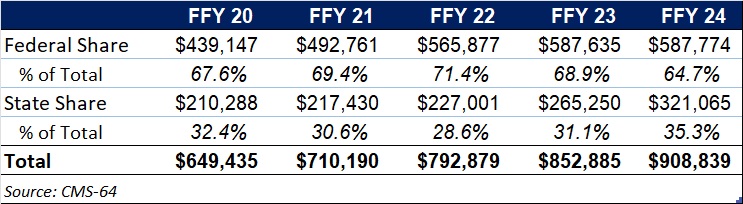
This year’s data reflect the phase-out of the temporary 6.2 percentage-point federal medical assistance percent increase under the Families First Coronavirus Response Act, which ended December 31, 2023. In FFY 2024, 64.7 percent of FFY 2024 spending came from federal sources (see Table 2).

Table 2. Federal versus State Share of Medicaid Expenditures, FFY 2020−2024 ($M)

What to Watch

Looking ahead, state Medicaid agencies will need to reassess financing strategies as total Medicaid federal funding declines because of H.R. 1 and other federal regulatory oversight and policy changes take effect. H.R. 1 includes provisions to gradually reduce allowable state provider tax rates from 6 percent to 3.5 percent by 2032, potentially requiring states to restructure financing or identify cost-saving measures.

CBO projections estimate that the Medicaid provisions in the bill will increase the number of uninsured individuals by an estimated 7.8 million by 2034.

Connect with Us

HMAIS, a subscription-based tool offered by HMA, provides detailed state by state analysis of the CMS-64 data and Medicaid managed care enrollment trends. For more information about the HMAIS subscription and access to the CMS-64 data, contact our experts below.

Solutions

Achieving financial resilience in a time of turbulence

Read More

HMA Spotlight

Achieving financial resilience in a time of turbulence

Healthcare business leaders face significant policy and regulatory headwinds. Ensuring that your organization is financially resilient to weather the storm should be a priority. Achieving financial resilience enables leaders to preserve core functions and staff.  We’ve found that indirect costs are often overlooked and undermanaged and represent an opportunity to build margin (think overhead and administrative costs such as vendor spend).

HMA can help identify cost savings

We find it useful to conduct the following sequence of steps:

Review / categorize all vendor spend to find areas with unnecessary costs, overlapping services, or outdated pricing.

Analyze contracts line -by -line to identify where terms can be improved or where the scope no longer fits current needs.

Stack rank initiatives by risk levels and speed.

Negotiate directly with vendors to lower rates, adjust service levels, or consolidate under better pricing structures.

Monitor results and vendor performance to ensure savings hold over time and services stay aligned with operational needs.

Cost Saving with HMA Strategy

In assessing indirect costs, we visually depict areas of cost reduction by risk of disruption to support client decision-making. There is often a locus of opportunity that can be trimmed with little or no impact to the core business.

As you prepare to batten the hatches, consider assessing indirect costs. Even if the storm isn’t fierce, conducting this work will give you improved real options for optimal decision-making. 

Ready to transform your organization?

Whether you are focused on payments, healthcare delivery, government policy, behavioral health, life sciences, Medicare, Medicaid, or Managed Care, our HMA experts are ready to partner with you, from initial strategy-setting through implementation.

Related Resources

Learn more about our Strategy & Transformation services

HMA’s Strategy & Transformation Practice collaborates with Stanford University to drive public health innovation

CMS Shakes Up the Innovation Center Model Landscape: What Comes Next?

Building Sustainable Health Systems

How One Organization Unlocked Exceptional Financial Gains Through Revenue Cycle Optimization

Contact our experts:

Headshot of Rebecca Nielsen

Rebecca Nielsen

Managing Director

Rebecca Nielsen is a managing director of HMA’s strategy and transformation practice, where she designs and leads major strategy and … Read more
Headshot of Alex Rich

Alex Rich

Senior Advisor

Alex Rich is an experienced business transformation leader with extensive expertise designing and deploying strategic programs that produce meaningful results. … Read more
Webinar

Medicaid, Money & Mission: Unlocking Community Reinvestment Opportunities in Georgia

Watch Now

This webinar was July 22, 2025.

This is a powerful and practical town hall designed to inform Georgia’s community-based organizations (CBOs) with the knowledge to access new funding opportunities through the new community reinvestment requirements in Georgia Medicaid. Learn how HMA can help you to build strategic partnerships with managed care organizations (MCOs) to support your mission—and position your organization for success amid upcoming federal Medicaid work requirements.

Learning Ojectives:

  • What the current federal landscape means for CBOs
  • What community reinvestment means under Georgia Medicaid
  • What Medicaid work requirements could mean for the people you serve
  • How to prepare your organization to respond, engage, and grow

Featured Speaker:

Lynnette Rhodes, Chief Health Policy Officer Georgia Department of Community Health

Ready to talk?