September 11, 2024
Countdown to the HMA Conference: Unlocking Solutions in Medicaid, Medicare, and Marketplace

HMA Insights – including our new podcast – puts the vast depth of HMA’s expertise at your fingertips, helping you stay informed about the latest healthcare trends and topics. Below, you can easily search based on your topic of interest to find useful information from our podcast, blogs, webinars, case studies, reports and more.
Countdown to the HMA Conference: Unlocking Solutions in Medicaid, Medicare, and Marketplace

Watch a replay of our webinar Mastering Star Performance: Strategies from the HMA Stars Accelerator Program.
Star Ratings have been on a steady decline over the last two years resulting in large reductions in quality bonus and rebate payments, potentially impacting opportunities to improve member health outcomes.
We have developed a playbook that captures The HMA Stars Accelerator Solution with proven strategies for Stars improvement based on our diverse and extensive expertise in managed care plan (MCP) operations, MCP strategy, performance improvement, actuarial science, data analytics, risk adjustment, and federal and state policy.
Using our vast experience in the Medicare and Medicaid space, HMA can help you maximize ratings in programs like Medicare Stars and Medicaid quality performance. Together with our actuarial colleagues from Wakely Consulting Group and federal policy expert colleagues from Leavitt Partners, both HMA companies, we can provide the assistance you need to move your organization to a higher Star rating level. With guidance from HMA experts, the Accelerator is scalable for both functional and matrix organizations.
Want a copy of HMA’s
Stars Accelerator Playbook?
Fill out this form and one of our consultants will get back to you.
Meaningful data analysis ensures plans can prioritize the most important areas for strategic focus. Improving performance in Stars requires a multi-pronged, multifactorial approach. The HMA Stars Accelerator Solution is consumer-oriented and customizable to meet the unique needs of your members’ needs. It facilitates understanding of the organization’s current state, identifies opportunities for improvement, provides best practices for design of meaningful solutions to implement, and measures the effectiveness of improvements.


The Centers for Medicare & Medicaid Services (CMS) publishes the Medicare Advantage (Medicare Part C) and Medicare Part D Star ratings each year to measure the quality of health and drug services received by consumers enrolled in Medicare Advantage (MA) and Prescription Drug Plans (PDPs or Part D plans). Star ratings impact a managed care plan’s financial performance, competitiveness, growth, and member retention. They are based on measures of multiple aspects of plan performance including:
Member experience and satisfaction
Administrative performance
Medication safety and/or adherence
Hospital readmissions
Healthcare Effectiveness Data and Information Set (HEDIS) and Health Outcomes Survey (HOS), both of which measure performance improvement.
Contracts are rated on a scale of one to five stars (rounded to nearest half star) based on approximately 45 measures related to preventive care, member experience (health plan customer service, physician point of service care, and perceived health), prescription drug monitoring, health plan operations, etc.
The industry has meaningfully improved traditional quality metrics (e.g. preventative care and medication adherence rates). As performance peaks in those measures, CMS is placing increasing emphasis on the member experience with their health plan and their providers during care.
Plans with 5 stars can market year-round.
The marketing advantage is a distinction for a high rated plan.
Poor performers (under 3 Star rating for 3 years) receive a Poor Performance Icon and may not be able to renew with CMS.
In 2024 there were 29 Part C (Medicare Parts A & B) and 11 Part D (Pharmacy) measures, and they can change every year. CMS recently released plan preview Star performance data for health plans to review. Final scores and Star ratings will be released by CMS in early October 2024 for Star Year 2025 based upon 2023 dates of service.
CMS Star Ratings are a lagged pay-for-performance system. For 2026 Star Ratings, 2024 and early 2025 performance timeframes are critical to success, even though payments for this performance will not be received until 2027.

What plans do in 2024 and 2025 impacts your 2026 Star rating which will affect your plan’s revenues in 2027.
Is your plan building a strategy for next year based upon underperforming measures? Are you looking for ways to lean in on any remaining Consumer Assessment of Healthcare Providers and Systems (CAHPS) and HOS opportunities? Do you know where to start?
See our HMA Solutions page, Star Rating: We Can Help You Navigate to a Higher Level, for more information.

HMA is pleased to welcome new experts to our family of companies in the second quarter of 2024. This group of leaders has decades of experience in health policy, Medicaid, public health, and healthcare strategy. They have led initiatives to enhance access, operational efficiency, and equity and have expertise in areas such as behavioral health, data analysis, and serving underserved populations.
Learn more about our new HMA colleagues
APRIL
MAY
JUNE
This week, our In Focus section reviews state policies designed to increase insurer participation in Medicaid managed care and Marketplace programs. As states seek to address healthcare costs, affordability, and consumer experiences, they are exploring a range of initiatives—from the rise of prescription drug affordability boards to cost containment commissions, cost growth benchmarks, transparency, and examination of mergers and acquisitions.
A notable trend is the use of state policy and purchasing power to encourage or mandate that Medicaid managed care organizations (MCOs) offer Marketplace plans. Dual-market participation can help smooth coverage transitions, ensure continuity of care, and expand consumer choice. The remainder of this article addresses original research and analysis of this trend by our Health Management Associates, Inc. (HMA), featured experts.
Current Landscape
In 2024, enrollment in the Marketplace program has surged to more than 21 million, approximately a 30 percent increase from 2023. This growth was largely attributed to the temporary enhanced subsidies that allowed more people to access affordable coverage. Over the past several regulatory cycles, federal policymakers also have taken steps to further align the Marketplace framework with Medicaid on key issues, such as essential community provider access, eligibility and enrollment processes, and plan design standards. In response, states are innovating to meet federal requirements while pursuing their own healthcare goals related to coverage, affordability, access, and healthcare outcomes.
Value Proposition
A compelling value proposition for Medicaid MCOs to participate in the Marketplace (and vice versa) includes the ability to market to and retain people moving from one program to another as life circumstances change. Dual-market participation also supports diversification and growth strategies. In fact, enrollment in the Marketplace has nearly doubled since 2020. For Medicaid MCOs in particular, expanding product offerings to include Marketplace plans presents a unique opportunity to leverage existing provider networks and reimbursement arrangements to deliver more competitive rates.
Consumers benefit when the same organization participates in both markets. Families with parents and children who obtain coverage under different programs have an opportunity to work with a single organization and choose providers from the same or overlapping networks. Income fluctuations may result in disenrollment from one program (e.g., Medicaid) and eligibility for a new program (e.g., Marketplace subsidies). Continuity of care policies can smooth these transitions in areas such as prior authorization, care management, and provider network.
State Strategies to Increase Dual-Market Participation
The Affordable Care Act expanded access to affordable health insurance coverage for as many as 45 million individuals by giving states the option to expand Medicaid and provide federal subsidies to people who purchase Marketplace plans. States are now using various strategies to encourage or require insurer participation in both programs to ease transitions for individuals and families “churning” from one program to another, increase competition and choice of Marketplace plans, and reduce the risk of coverage gaps. For example:
The Centers for Medicaid & Medicare Services (CMS) collaborated with states to promote continuity of coverage following the end of the Medicaid continuous enrollment requirement established in the Families First Coronavirus Response Act of 2020, also known as the Medicaid public health emergency (PHE) unwinding. This support includes the clarification of permissible outreach activities by Medicaid MCOs that also offer a Marketplace plan, information sharing, and other assistance. Many states have incorporated the CMS guidanceiii into Medicaid MCO contracts. North Carolina, Utah, and West Virginia include additional contract terms supporting their Medicaid MCOs’ ability to co-market Medicaid and Marketplace plans, including when an individual is losing Medicaid eligibility.
What to Watch For
Coverage transition challenges throughout the Medicaid PHE unwinding have highlighted the real-life impact of coverage gaps and the importance of policies and practices that promote uninterrupted access to healthcare coverage. Historic Marketplace enrollment levels and recent CMS guidance clarifying the allowability of outreach to people who are losing Medicaid coverage about Marketplace plan available make the prospect of dual-market participation increasingly attractive for Medicaid MCOs. A greater focus on improving continuity of care and Marketplace plan choice may lead to more states encouraging or requiring Medicaid MCOs to participate in the Marketplace.
Connect with Us
The upcoming HMA event, Unlocking Solutions in Medicaid, Medicare, and Marketplace, will offer more opportunities to engage with leaders from various sectors who are advancing innovations in Medicaid managed care and Marketplace programs and the points at which these programs intersect. State Medicaid and insurance commissioners, health plan executives, and community leaders, among others, will share insights into their market success and initiatives designed to address healthcare costs and insurance affordability.
Experts from HMA and our family of companies have extensive experience in the policy, structure, and administration of healthcare markets and health plan contracting. For more information, contact our featured experts below.
How States Are Shaping Medicaid Managed Care and Marketplace Participation

HMA’s trusted experts have a wealth of harm reduction experience, from training volunteers for community outreach to managing state procurement processes for harm reduction tools, to policy analyses at all levels of government.
Our consultants have worked with stakeholders of all walks of life including people with lived and living experience of drug use, sex work, and homelessness. In fact, we believe in talking to them first to understand local needs and feasible solutions.
The term “harm reduction” is often used to describe:
provision of risk reduction tools, like condoms, naloxone, and sterile syringes;
approach of meeting people where they are and supporting them at their own pace, without judgement, to pursue self-determined goals; and,
philosophy that promotes equitable access to resources for people who use drugs and struggle to meet basic needs due to the impact of social structures.
The Substance Abuse and Mental Health Services Administration (SAMHSA) defines harm reduction as a practical and transformative approach that incorporates community-driven public health strategies — including prevention, risk reduction, and health promotion — to empower people who use drugs and their families with the choice to live healthier, self-directed, and purpose-filled lives.
The President’s National Drug Control Strategy is the first-ever to champion harm reduction to meet people where they are and engage them in care and services.
People are dying from drug overdose at an alarming rate in the U.S. For the fourth year in a row, we have lost over 100,000 people (enough to fill the University of Michigan stadium). Many of these deaths are preventable. Harm reduction interventions proven to stop overdose deaths include making the overdose reversal drug naloxone available to all at risk of overdose, reducing barriers to medications that treat opioid use disorder, and providing supervised drug consumption services for rapid overdose response. Moreover, successful harm reduction programs rely on reducing the stigma of drug use and people who have an addiction.
Harm reduction is more than handing out naloxone or syringes; it’s a nonjudgemental approach that affirms participant autonomy and engages people in care over the long term.
Here are just a few services HMA can offer to help clients establish, expand, or improve services for people who use drugs, respond to overdose and infectious disease syndemics (combinations of two or more diseases or health conditions that interact within a population, often due to social and structural factors and inequities), and prevent the next drug crisis.
HMA provides training and technical assistance to a range of clients – from community-based organizations conducting outreach, to medical providers wishing to better serve their patients, to large hospital systems wishing to incorporate drug user health into their systems. HMA can:
A quality improvement (QI) strategy is vital for healthcare organizations to maximize patient outcomes and satisfaction, achieve efficiency, and ensure compliance with regulations. HMA can:
Many funding opportunities require (or can benefit from) a detailed assessment of the community’s need for the services being funded. Our experts can help gather both quantitative data and qualitative stakeholder input to ensure that the client’s proposed plan targets the populations, communities, and gaps in service for which resources will be most impactful. HMA can:
The legal landscape related to drug use varies across communities and does not always facilitate a public health approach. HMA can:
Multi-sector collaboration is essential to develop sustainable, impactful solutions to reduce physical and structural harms related to drug use. HMA can:
HMA consultants work with clients to review program efficacy and cost efficiency based on process, outcomes, costs and more, considering quantitative and qualitative data sources and using data-driven tools to assess and measure impact. HMA can:
Project Spotlight
Contact our experts:










This week, our In Focus section recognizes International Overdose Awareness Day (IOAD), August 31, by highlighting how states can use opioid abatement funds to mitigate the persistent overdose crisis in communities across the country.
In honor of IOAD, the August 2024 edition of HMA’s Podcast, Vital Viewpoints, features Erin Russell, a Principal at Health Management Associates (HMA), who discusses the importance of emphasizing harm reduction as a compassionate approach to drug policy. Meanwhile, this article addresses current gaps, opportunities, and strategies for applying opioid abatement funds to make further progress in addressing overdoses and the crisis.
Context for Opioid Abatement
Overdoses have claimed more than one million lives since the late 1990s, with more than 100,000 deaths occurring annually. Exacerbating the overdose epidemic and the racial and ethnic disparities in fatal overdoses are persistent inequities in access to evidence-based treatment, which extend to biases based on physical and/or mental ability, sexual orientation and gender identity, geographic location, and socioeconomic and housing status.
In 2021, nationwide settlements were awarded to resolve all opioid litigation that states and local subdivisions brought against pharmaceutical distributors and manufacturers, with subsequent agreements reached in 2022 against pharmacy chains and additional manufacturers. These historic opioid settlement agreements, which total more than $56 billion, will provide funds to state and local governments to address the crisis in their communities.
Policy changes and investments to address this epidemic remain critical. These approaches require careful consideration of the data and evidence-based strategies that are responsive to the crisis. In 2024, the US Department of Health and Human Services issued a rule that updates the regulations regarding the governance of opioid treatment programs; for example, removing barriers to the treatment of substance use disorder (SUD) and expanding access to care. The State Opioid Response and Tribal Opioid Response grant programs are another significant tool to improve prevention, expand treatment, and deliver free, lifesaving medications. Medicaid, including Medicaid managed care plans, also can be instrumental in supporting harm reduction strategies and enhancing access to addiction treatment and recovery support.
Opioid abatement funds offer states the opportunity to apply innovative solutions in response to the overdose epidemic. Despite their potential, however, HMA experts have identified significant opportunities across many states to effectively use available opioid abatement funds.
Opioid Abatement Funds and planning for Community Needs
Strategic planning processes allow state and community leaders to understand the needs of residents, examine current services offered and their existing strengths, and explore barriers to accessing care to make informed decisions about how the settlement funding can be used successfully. A strategic plan can assist in tracking progress and establishing a clear vision for an organization’s future and can yield a living document that guides the most advantageous use of the funds. HMA experts supported a strategic planning process for Carrabus County, NC, that identified strategies for designing, implementing, and evaluating tailored solutions for disbursing opioid abatement funds. The following are examples of approaches that are included in strategic plans for opioid abatement.
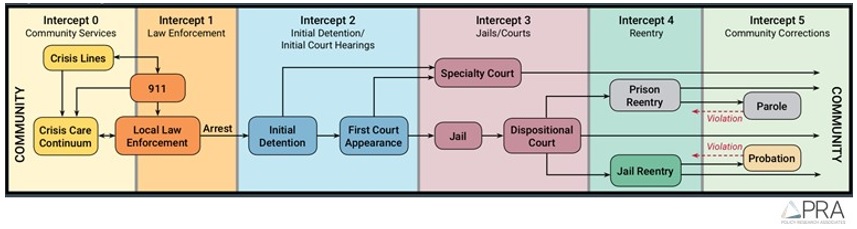
Sequential intercept model (SIM). SIM, one of the models used to support communities in building a stronger system of care, helps identify intervention opportunities with the highest potential for success based on a community’s strengths and needs. SIM maps out the stages of intervention to pinpoint gaps and opportunities, ensuring funding is used to address the most critical areas for improving community care systems, including those integrated within Medicaid managed care delivery systems (see Figure 1).
Figure 1: Sequential Intercept Model
Low-barrier/low-threshold recovery supports and treatment. The expansion of low-barrier/low-threshold recovery supports and treatment, including access to medications for opioid use disorder, is essential to reducing overdose deaths. States, local jurisdictions, and individual providers can redesign their treatment delivery systems to incorporate person-centered, low-barrier treatment access, including flexible scheduling and walk-in visits, same-day admission and medication initiation, and revision of clinic policies and procedures to eradicate practices that produce high barriers to treatment.
Though expanding low-barrier care in traditional treatment settings is an essential element of the response, implementation of nontraditional delivery modalities is another important target for using opioid abatement funds. Examples include:
Finally, the availability of opioid abatement funds can introduce opportunities for local governments to partner with community members, including people with both past and current lived experience, to design, implement, and disseminate culturally responsive and tailored SUD treatment and recovery support services, including services to address health-related social needs to mitigate barriers to treatment entry and engagement.
Continuous quality improvement (CQI) plans. Locales that receive opioid abatement funds have the opportunity to develop strategies to create transformational systemic change. Each entity should have an intentional CQI plan in place. Ensuring the presence of strong CQI processes can streamline and improve services, connect data to practice, and ensure interventions are progressively more effective.
Connect with Us
The upcoming HMA event, Unlocking Solutions in Medicaid, Medicare, and Marketplace, will offer more opportunities to engage with leaders across multiple sectors and industries advancing innovations in the design of mental health and SUD systems, value-based purchasing, and care strategies. Notably, state Medicaid and behavioral health directors, insurance commissioners, health plan executives, and community leaders, among others, will share insights into major initiatives under way in their states to manage ongoing crises in mental health and SUDs.
HMA has a strong, diverse bench to help communities maximize opioid abatement funds and build a stronger system of care. We provide technical assistance in large-scale initiative implementation, convening stakeholder groups, designing CQI strategies, developing planning documents, and facilitating strategic discussions. For more information about HMA’s work, contact our featured behavioral health experts below.
Harnessing Opioid Abatement Funds to Prevent Overdoses and Enhance Community Care
On International Overdose Awareness Day (IOAD), August 31st, communities worldwide come together to honor, without stigma, the people who have lost their lives to overdose. It’s a day for families to recognize their loved ones and for all of us to acknowledge the grief of family and friends who have experienced this loss. It’s also an opportunity to think critically about the programs and policies our communities need to finally put an end to the overdose crisis. In honor of this year’s IOAD theme, “Together we can,” HMA recognizes the power of community when we all stand together with a united goal of ending overdose.
Overdose can affect anyone. In the last twelve months alone, there were more than 100,000 reported overdose deaths across the U.S., and 42 percent of Americans now report they know someone who has died of drug overdose. More than ever, we need strong, multifaceted coalitions to shift the narrative around overdose and ensure we are using resources effectively to reduce harm, increase chances of overdose survival, and promote quality of life for people who use drugs, people in recovery, and the communities where they live.
HMA brings together people with lived and living experience, local community members, and public health professionals to plan, evaluate, and implement meaningful programs across the continuum of care to address overdose as the health crisis that it is. Our trusted subject matter experts have their own lived experience that influences HMA’s approach, and we strive to center the voices of people who are most impacted at every opportunity.
HMA is committed to helping clients prioritize effective solutions to the overdose crisis, which includes promoting services that are evidence-based and designed with robust input from community stakeholders. HMA supports naloxone distribution by engaging in street-based outreach, developing mapping tools for organizations to see the impact of their efforts in real time, and training healthcare providers on harm reduction. In 2024, HMA also hosted the Compassionate Overdose Response Summit to address questions about naloxone dosing and the long-term effects of precipitated withdrawal. HMA continues to be a leader in helping clients revolutionize treatment, particularly for priority populations such as children’s behavioral health and the justice involved. Earlier this year HMA led a webinar series called the Substance Use Disorder (SUD) Ecosystem of Care Webinar Series: Pivoting to Save Lives describing a whole person, integrated, solutions-based approach to the ongoing overdose epidemic. The series encourages leaders to reconsider standard attempts to solve this crisis and be willing to pivot away from approaches that have not yielded the level of impact that this crisis demands.
On IOAD, and every day, HMA stands united with the communities that are left behind to experience the long-lasting impacts of grief, and we celebrate the thousands of people who have experienced overdose and survived. Every overdose survival is another opportunity to uplift the strategies that work to save lives. We honor everyone impacted by overdose by using a community-led approach that encourages collective action to prevent, and ultimately end, all overdoses.
For more information on HMA overdose prevention services, visit our Harm Reduction solutions page or contact our featured experts below.

Erin Russell is a principal at Health Management Associates and joins our podcast to discuss the importance emphasizing harm reduction as a compassionate approach to drug policy. She shares her journey from volunteering at a syringe service program to becoming deeply invested in harm reduction, highlighting how these programs offer critical support and connections to treatment and reduce overdose deaths. Erin also explores the impact of drug policy on drug-related harms, advocating for the need to overcome stigmas that impede treatment.
This podcast is being released the same week as International Overdose Awareness Day (IOAD), which is observed on Saturday, August 30th. In honor of this important day, check out HMA’s special blog post highlighting the importance of harm reduction efforts in connection with IOAD at this link.
#TogetherWeCan #IOAD2024 #EndOverdose
HMA found that the substance use disorder treatment system, which sits outside of specialty mental health and mild-to-moderate mental health services, results in an inconsistent and siloed system. The delivery of programs and services across the state vary because of differences in geography (rural, suburban, and urban densities) as well as county participation in the Drug Medi-Cal Organized Delivery System (DMC-ODS). This landscape analysis provides a deeper exploration into the challenges and opportunities specific to addressing substance use disorder.
The analysis was produced with support from the California Health Care Foundation.